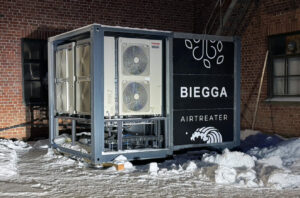
Military and security facilities require condition management systems that guarantee performance under operational stress, extreme temperatures, and rapid deployment constraints. Standard commercial HVAC equipment is not designed for these demands. As a NATO-registered supplier (NCAGE code A04WG), AirTreater engineers containerised heating, cooling, filtration, and process cooling systems that deliver guaranteed nominal capacity at all outdoor temperatures, making them directly applicable to defense and security infrastructure. The sections below address the most critical questions procurement and logistics officers ask when specifying climate control for military environments.
What makes condition management in military facilities uniquely challenging?
Condition management in military facilities is uniquely challenging because operational continuity is non-negotiable, deployment locations are often remote or austere, and climate systems must perform reliably across extreme temperature ranges without access to permanent infrastructure or on-site technical support. A heating or cooling failure in a command centre, communications hub, or field medical facility carries consequences that go beyond discomfort.
Military sites impose demands that commercial facilities do not. Equipment must operate in locations where civil infrastructure is absent or deliberately avoided. It must withstand outdoor temperatures that fall well below what conventional heat pumps are rated to handle. And it must be deployable without the weeks-long lead times that fixed installation systems require.
Conventional heat pumps are typically rated at nominal conditions, meaning their stated capacity applies at moderate outdoor temperatures. At -15 °C, many systems derate significantly, delivering a fraction of their specified output. For a military facility operating through a northern winter, that gap between rated and actual performance is an operational liability. Condition management systems specified for defense applications must guarantee nominal capacity at all outdoor temperatures, not only under optimal conditions.
What types of climate control systems are used in military facilities?
Military facilities use a range of climate control systems depending on mission type, facility permanence, and operational environment. These include fixed hydronic heating systems for permanent bases, direct expansion air-to-air heat pumps for smaller structures, and containerised industrial heat pump systems for deployable or semi-permanent installations where speed of setup and relocatability are operational priorities.
For permanent bases with established infrastructure, fixed plant room installations remain standard. These systems offer high efficiency and long service life but require significant civil works and cannot be redeployed when a facility’s operational role changes.
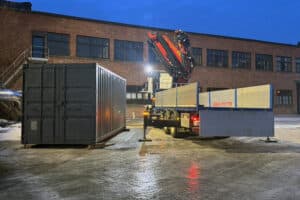
For forward operating bases, temporary command facilities, and deployable infrastructure, containerised solutions are increasingly the specification of choice. A containerised industrial heat pump arrives pre-configured, connects to a site’s utility points in a single working day, and is fully operational within 4 hours of arrival. When the mission ends or the facility relocates, the system relocates with it, with no permanent infrastructure left behind.
Liquid-cycle systems, which distribute thermal energy through water or glycol circuits rather than ducted air, are particularly well-suited to large military structures. They deliver more even temperature distribution across large floor areas, integrate with underfloor heating and radiator networks, and operate more efficiently than air distribution systems at high heating loads.
How does a containerised heat pump solution work in field deployments?
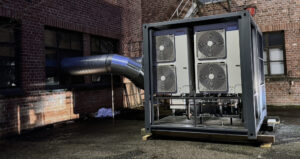
A containerised heat pump solution for field deployments is a self-contained climate system pre-installed within a standard shipping container, pre-configured at the factory, and shipped ready to connect. On site, the container is positioned, utility connections are made, and the system is commissioned without specialist civil works or extended installation periods.
AirTreater Čáhci illustrates how this works in practice. The system is an air-to-water heat pump that extracts thermal energy from outdoor air and transfers it into a liquid circuit, which then distributes heat to the facility through radiators, underfloor heating, or air handling units. The container arrives with the heat pump, controls, and ancillary equipment already installed and tested.
Connection on site involves linking the liquid distribution circuit to the facility’s heat emitters, connecting power, and configuring the automated remote management platform. In most field deployments, this takes one working day. Where no heat distribution network is required, the system is fully operational within 4 hours of arrival on site.
AirTreater Čáhci maintains 120 kW of nominal heating capacity at -15 °C using compressors alone, with a maximum output of 420 kW at temperatures down to -15 °C. The heat pump operates down to -28 °C. When outdoor temperatures fall below -28 °C, the integrated backup system activates to guarantee at least 300 kW of heating capacity even without external electric power in hazardous situations. This is not a rated condition with an asterisk — it is a guaranteed operational parameter, which is the specification standard that defense procurement requires.
What performance standards should military-grade HVAC equipment meet?
Military-grade HVAC equipment should meet performance standards that guarantee nominal heating or cooling capacity across the full operational temperature range of the deployment environment, maintain function without dependence on permanent infrastructure, support remote monitoring and control, and comply with NATO supplier quality requirements where defense procurement frameworks apply.
The most critical performance standard is temperature-range reliability. Equipment specified for northern or high-altitude military environments must deliver its stated capacity at outdoor temperatures that may reach -25 °C or lower. Systems that derate at -10 °C or -15 °C cannot be relied upon precisely when heating demand is highest.
Redundancy is a related requirement. Military installations cannot accept single points of failure in critical systems. Climate control equipment should incorporate integrated backup capability that activates automatically when primary components reach their operating limits, maintaining setpoint without manual intervention.
From a procurement compliance perspective, NATO-registered supplier status is a prerequisite for many defense procurement processes. AirTreater holds NATO supplier registration with NCAGE code A04WG, confirming that the company meets the quality and reliability documentation standards required for engagement within NATO procurement frameworks. This registration is a verifiable credential, not a general quality claim, and it matters specifically in defense and security infrastructure procurement.
How can remote monitoring improve security facility operations?
Remote monitoring improves security facility operations by giving operators real-time visibility into climate system performance from any location, enabling immediate detection of parameter deviations, and allowing settings adjustments without requiring a technician to be physically present on site. For facilities that are unmanned or located in restricted-access areas, this capability is operationally essential.
AirTreater systems are managed via an automated remote management platform, which provides a real-time operational dashboard accessible through a standard web browser. Operators can view outlet water temperatures, system status, energy consumption data, and alarm states from any location with internet access. Named end users can also have access to the automation system. Settings adjustments, including temperature setpoints and operating schedules, are made directly through the browser interface without requiring on-site access.
For security facilities, the operational benefits extend beyond convenience. A system fault detected remotely at 02:00 can be diagnosed and, in many cases, resolved without dispatching a technician. When a technician is required, the remote data provides the diagnostic information needed to arrive with the correct parts and a clear understanding of the fault. AirTreater’s service centre provides 24/7/365 help-desk support, which means remote monitoring data is backed by continuous technical availability.
For facilities in remote or high-security locations where physical access is controlled or logistically complex, the combination of automated remote management and 24/7 support eliminates the scenario where a climate system fault goes undetected until the next scheduled site visit.
When should a security facility choose portable over fixed HVAC systems?
A security facility should choose a containerised HVAC system over a fixed installation when the facility is temporary or semi-permanent, when deployment speed is a critical constraint, when the facility may need to relocate, or when permanent civil works are operationally or logistically impractical. The decision is driven by the facility’s operational lifecycle, not by a preference for one technology over another.
Fixed installations deliver advantages in facilities with a defined, long-term operational role and established infrastructure. They integrate deeply with building systems, require less visible external equipment, and can be optimised for a specific building’s thermal characteristics over time.
Containerised solutions are the correct specification when one or more of the following conditions apply:
- The facility has an operational lifespan of months to a few years rather than decades
- The facility must be operational within days of site establishment, not weeks
- The site lacks permanent utility infrastructure or a prepared plant room
- The climate system must be redeployable to a different location when the mission concludes
- Procurement requires NATO-compliant supplier documentation and rapid delivery timelines
For process cooling requirements within security facilities, such as server rooms, communications equipment, or power generation systems, AirTreater Prosea provides a containerised process cooling solution designed per project and site. Its free-cooling function operates energy-efficiently in cold conditions without engaging compressors, reducing energy consumption and eliminating the primary mechanical failure point of conventional chiller systems across the many low-temperature operating hours typical of northern European climates.
The asset recovery argument also applies directly to defense procurement. A containerised system is a relocatable capital asset. When a facility closes or a unit redeploys, the climate system moves with the operation rather than being written off as a fixed asset.
To discuss technical specifications or procurement documentation for defense and security applications, contact the AirTreater technical team directly for a review of your site requirements and operational parameters.