Lifecycle management is essential for industrial heating and cooling systems because it determines whether a system delivers its specified performance throughout its operational life, controls total cost of ownership, and prevents unplanned failures that halt production. For industrial operators, an unmanaged system does not simply underperform — it fails at the worst possible moment. The sections below address the most important questions procurement engineers and facility managers ask when evaluating long-term HVAC strategy.
What does lifecycle management involve for industrial HVAC systems?
Lifecycle management for industrial HVAC systems is the structured oversight of a system from initial specification and commissioning through routine maintenance, performance monitoring, and eventual replacement or upgrade. It encompasses planned service intervals, performance benchmarking against nominal capacity, component condition tracking, and decisions about repair versus replacement at each stage of the system’s operational life.
In practice, lifecycle management begins before a system is installed. Selecting equipment that is correctly sized for actual operating conditions — including worst-case outdoor temperatures — determines how much margin the system retains as it ages. A system specified at its performance limit on day one has no reserve capacity to compensate for gradual degradation. Equipment that is guaranteed to deliver at least its nominal heating or cooling capacity at all outdoor temperatures, including extreme sub-zero conditions, enters service with a meaningful performance buffer.
Ongoing lifecycle management involves several parallel activities: scheduled preventive maintenance, real-time performance monitoring, documentation of service history, and periodic reassessment of whether the system still meets the site’s operational requirements. For industrial and process applications, this is not optional administrative overhead — it is the mechanism that keeps critical systems running continuously and predictably.
How does poor lifecycle management affect system performance and costs?
Poor lifecycle management causes industrial heating and cooling systems to degrade faster than their design life allows, increases energy consumption as efficiency declines, and raises the probability of unplanned failures that carry consequences far beyond the cost of the repair itself. In process-critical environments, a single unplanned cooling interruption can result in lost production, equipment damage, and process restart costs that dwarf years of deferred maintenance spending.
The cost impact of neglected lifecycle management accumulates in three distinct ways. First, energy consumption rises as refrigerant charge depletes, heat exchangers foul, and compressor efficiency declines — all conditions that are detectable and correctable during routine service but invisible until they become failures if monitoring is absent. Second, reactive maintenance — responding to breakdowns rather than preventing them — consistently costs more than planned service, both in parts and in emergency labour rates. Third, premature system replacement forces capital expenditure earlier than the system’s design life would otherwise require.
For industrial operators running continuous processes, the calculation is straightforward: the total cost of a structured lifecycle management programme is reliably lower than the combined cost of energy waste, reactive repairs, and early replacement that result from its absence.
What is the typical lifespan of an industrial heat pump system?
An industrial heat pump system that is correctly specified, properly commissioned, and maintained according to manufacturer schedules will typically operate reliably for 15 to 25 years. The actual lifespan depends on operating hours, the severity of the thermal and environmental conditions the system faces, the quality of the original installation, and the consistency of maintenance over the system’s life.
Several factors compress or extend this range in practice. Systems that operate continuously — as is common in process cooling and biogas applications — accumulate operating hours faster than intermittently used equipment, placing greater demands on compressors, refrigerant circuits, and heat exchangers. Systems deployed in harsh outdoor environments, including extreme cold or coastal corrosive atmospheres, face accelerated wear on external components. By contrast, systems with integrated redundancy — such as backup capacity that reduces compressor run hours during moderate conditions — distribute mechanical stress more evenly and extend component life.
Refrigerant availability is an increasingly relevant factor in lifespan planning. Systems using refrigerants subject to phaseout schedules under EU F-gas regulations may reach an effective end of serviceable life before their mechanical components wear out, because refrigerant supply constraints make maintenance uneconomical. Specifying equipment that uses compliant, future-safe refrigerants is a lifecycle management decision that belongs at the procurement stage, not during a mid-life service review.
How does remote monitoring improve lifecycle outcomes?
Remote monitoring improves industrial HVAC lifecycle outcomes by providing continuous, real-time visibility into system performance — enabling operators and service teams to detect deviations from nominal operating parameters before those deviations become failures. Early detection converts potential breakdowns into scheduled maintenance events, which are less costly, less disruptive, and far easier to plan around than emergency repairs.
The operational value of remote monitoring is particularly significant for systems at unmanned or remote sites, where a physical inspection might occur weekly or less frequently. A system operating outside its normal parameters for days before anyone notices it represents both an energy waste and an accelerating failure mode. Continuous monitoring eliminates that gap.
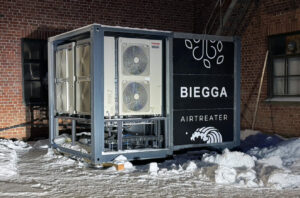
AirTreater systems are managed via an automated remote management platform, which provides real-time operational data and full settings control through a standard web browser — accessible from any location, at any time. Named end users can also have access to the automation system. Operators can review outlet temperatures, compressor status, and energy consumption data without travelling to site, and can adjust operating setpoints remotely when conditions change. This capability directly supports predictive maintenance: when the platform shows a compressor drawing higher current than baseline for its operating conditions, that is a diagnostic signal that warrants investigation before the component fails.
Remote monitoring also generates the longitudinal performance data that makes lifecycle planning credible. A system with three years of continuous operational records provides a factual basis for forecasting maintenance needs, assessing remaining useful life, and justifying capital replacement decisions to procurement committees — rather than relying on estimates or manufacturer generalizations.
When should an industrial heating or cooling system be replaced versus repaired?
An industrial heating or cooling system should be replaced rather than repaired when the cost of the repair approaches or exceeds 40 to 50 percent of the replacement cost, when the system can no longer reliably deliver its required nominal capacity, when the refrigerant it uses is being phased out and supply is constrained, or when the system’s energy consumption has increased to the point where replacement delivers a measurable return on investment within an acceptable payback period.
Indicators that favour repair
Repair is the appropriate decision when the system is within the first half of its expected operational life, the failure is isolated to a single serviceable component, spare parts are readily available, and the system’s overall performance record demonstrates that it has been operating within its specified parameters. A compressor replacement on a seven-year-old system with strong maintenance records and a clean service history is a straightforward repair decision.
Indicators that favour replacement
Replacement becomes the rational choice when failures are recurring rather than isolated, when the system’s measured performance has declined materially from its nominal specification, or when the operational requirements of the site have changed and the existing system is no longer correctly sized. Systems that cannot maintain their required heating or cooling output at the outdoor temperatures the site actually experiences — regardless of what they were originally specified to deliver — are not candidates for repair. They are candidates for replacement with equipment that is guaranteed to meet at least the site’s actual nominal heating or cooling capacity at all outdoor temperatures, including the most extreme conditions the site experiences.
Total cost of ownership analysis should drive this decision, not the immediate repair invoice. A repair that delays replacement by two years at the cost of continued elevated energy consumption and ongoing reactive maintenance may be more expensive over that period than a planned replacement would have been.
What role does manufacturer support play in long-term system reliability?
Manufacturer support is a direct determinant of long-term system reliability because it controls access to the three things an ageing system needs most: genuine spare parts, accurate technical documentation, and qualified service expertise. A system whose manufacturer provides structured, accessible support throughout its operational life will consistently outlast and outperform equivalent equipment where that support is absent or difficult to access.
For industrial operators, the most critical dimension of manufacturer support is availability. Process cooling and industrial heating applications run continuously — failures do not wait for business hours. A 24/7/365 help-desk service is not a convenience feature for these operators; it is a prerequisite for system reliability in environments where a heating or cooling interruption carries immediate operational consequences. AirTreater’s service centre provides this level of support as a standard element of its service offering.
Manufacturer support also encompasses remote diagnostics capability — the ability for a service team to access system data, review operational logs, and diagnose fault conditions without requiring a site visit. This capability compresses the time between fault detection and resolution, particularly at remote or unmanned sites where physical access takes time to arrange. Combined with a structured preventive maintenance programme and access to the system’s full service history, manufacturer-backed support is the foundation on which a credible lifecycle management strategy is built.
When evaluating industrial heating and cooling equipment, procurement teams should treat post-sale support capability with the same rigour applied to technical specifications. AirTreater covers heating, cooling, filtration, and process cooling, and all systems are guaranteed to deliver at least their nominal heating or cooling capacity at all outdoor temperatures. A system supported by a manufacturer with documented 24/7 service capability is a fundamentally different procurement proposition than one that offers equivalent capacity but limited post-installation support. The specification determines day-one performance. The support structure determines whether that performance is still being delivered in year ten.