Regulatory pressure is tightening. Energy costs are rising. And the businesses that treat the green transition as a compliance exercise rather than an operational opportunity are already falling behind their competitors.
In 2026, sustainable business is not a future ambition. It is a present-tense requirement with measurable financial and operational consequences.
The Business Pressures Driving Green Transition in 2026
The European Union’s energy efficiency directives, carbon pricing mechanisms, and supply chain disclosure requirements have moved from policy discussions into procurement contracts. Buyers are asking for emissions data. Investors are applying ESG criteria. Regulators are enforcing reporting obligations that did not exist three years ago.
For industrial operators, the pressure arrives from three directions simultaneously:
- Regulatory compliance costs that increase with every tonne of avoidable carbon output
- Energy price volatility that punishes inefficient, high-consumption operations
- Competitive disadvantage when sustainability credentials become a procurement requirement
The green transition for businesses in 2026 is not a values statement. It is a cost structure problem with engineering solutions.
Where Energy-Intensive Operations Lose the Most Ground
Heating and cooling account for a substantial share of energy consumption across industrial facilities, construction sites, and process operations. Conventional systems compound this problem in two ways.
First, they consume more energy than necessary because they were designed without free-cooling capability or heat recovery integration. Second, they are rated under optimal conditions, which means their actual performance in cold-climate operations falls short of the nameplate specification. The gap between rated and delivered capacity is where energy waste concentrates.
For operations running continuous processes, that gap is not theoretical. It translates directly into higher energy bills, increased carbon output, and reduced process reliability during exactly the conditions when reliable performance matters most.
How Industrial Heat Pump Technology Closes the Gap
Modern industrial heat pump solutions address both sides of the energy efficiency problem. They deliver more usable heating or cooling output per unit of electrical energy consumed, and they do so consistently across the full range of operating temperatures.
The critical distinction is between systems rated at standard test conditions and systems guaranteed to deliver nominal capacity at all outdoor temperatures. A heat pump rated at 90 kW that derates to 50 kW at -15 °C is not a 90 kW system in a Finnish winter. It is a 50 kW system with a misleading nameplate.
Genuine energy efficiency requires performance guarantees that hold at the temperatures where the system actually operates, not at the temperatures where it looks best on a data sheet.
Free-cooling capability extends the efficiency advantage further. When outdoor temperatures drop sufficiently, compressor-off operation delivers full cooling capacity at a fraction of the energy input of conventional chiller systems. For process cooling applications running through northern winters, this represents a measurable reduction in energy consumption over extended periods.
What Sets AirTreater Apart from Conventional Solutions
AirTreater covers heating, cooling, filtration, and process cooling. All AirTreater systems are guaranteed to deliver at least nominal heating or cooling capacity at all outdoor temperatures. This is not a rated condition. It is a guarantee.
AirTreater Čáhci, the air-to-water heat pump designed for liquid-cycle energy distribution in large industrial and commercial spaces, maintains 120 kW of nominal heating capacity even at very low temperatures using compressors alone. Maximum output reaches 420 kW, and the heat pump operates down to -28 °C. Below -28 °C, the integrated backup system guarantees at least 300 kW of heating capacity even without external electric power in hazardous situations.
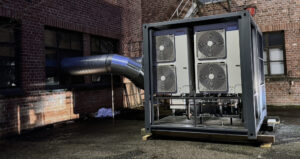
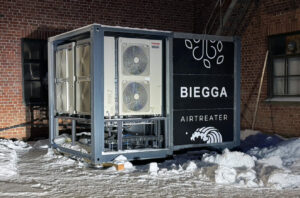
AirTreater Prosea, the containerised process cooling solution with an integrated free-cooling function, operates energy-efficiently without engaging compressors during cold-weather conditions. When temperatures rise, the compressor circuit maintains setpoint without interruption. Prosea systems are designed per project and site, ensuring the solution is matched precisely to each installation’s requirements.
The operational advantages for energy-intensive businesses pursuing carbon neutrality are concrete:
- Guaranteed nominal capacity at all outdoor temperatures eliminates the performance gap that drives overcapacity purchasing and excess energy consumption
- The free-cooling function reduces compressor operating hours during extended cold-weather periods, lowering both energy consumption and mechanical wear
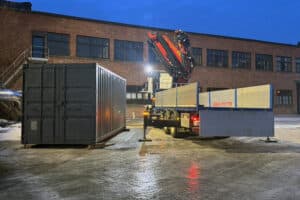
- Containerised deployment connects on site in a single working day, with full operation achieved within 4 hours of arrival
- The automated remote management platform provides real-time operational data and full settings control through a standard web browser, accessible from any location at any time; named end users can also have access to the automation system
- 24/7/365 help-desk support through the AirTreater service centre eliminates the support availability gap that makes conventional suppliers unsuitable for continuous-process operations
The containerised form factor also eliminates the civil works commitment of fixed installations. When operational requirements change, the system relocates. The capital asset moves with the project.
Start Your Green Transition with a Scalable HVAC Solution
The green transition for businesses in 2026 requires more than a sustainability policy. It requires infrastructure that delivers guaranteed energy efficiency under real operating conditions, not laboratory conditions.
AirTreater’s containerised heating, cooling, filtration, and process cooling solutions are designed for industrial operators who cannot afford the performance gap of conventional systems. Every system ships pre-configured, connects in a single working day, and delivers guaranteed nominal capacity from the first hour of operation — at all outdoor temperatures.
The path to sustainable operations does not require a permanent infrastructure commitment or a lengthy procurement process. It requires a system that performs as specified, in the conditions where it will actually operate.
Contact the AirTreater technical team to discuss your site’s heating or cooling requirements and receive a specification proposal matched to your operational conditions.