Scheduled servicing and condition-based maintenance differ in their trigger: scheduled servicing runs on a fixed calendar or runtime interval regardless of equipment state, while condition-based maintenance intervenes only when sensor data or operational readings indicate that a component is approaching a failure threshold. For most industrial heating and cooling systems, condition-based maintenance reduces unplanned downtime more effectively, but the right strategy depends on the criticality, instrumentation, and operating profile of the equipment in question. The sections below address the most common questions facility managers and plant engineers ask when choosing between the two approaches.
Which maintenance approach actually reduces downtime more?
Condition-based maintenance reduces unplanned downtime more than scheduled servicing in the majority of industrial HVAC and heat pump applications. By monitoring real operating parameters (compressor discharge pressure, refrigerant temperature, electrical draw, vibration), the approach identifies developing faults before they cause a failure, rather than waiting for a calendar date to trigger an inspection. Scheduled servicing, by contrast, may arrive too late after a fault develops or unnecessarily early when equipment is operating well within tolerances.
The performance gap between the two strategies is not marginal. U.S. Department of Energy research estimates that predictive and condition-based maintenance programs save 8 to 12 percent over preventive calendar-based approaches and up to 30 to 40 percent compared with purely reactive strategies. For industrial systems running continuous processes, those savings translate directly into fewer production interruptions and lower emergency repair costs.
That said, condition-based maintenance only outperforms scheduled servicing when the monitoring infrastructure is in place and the data is acted upon. A system with real-time remote visibility, such as AirTreater equipment managed through Ouman’s remote management platform, can surface anomalies the moment they appear, giving maintenance teams time to plan an intervention rather than respond to a breakdown. Without continuous monitoring, the condition-based advantage disappears.
How does condition-based maintenance detect problems early?
Condition-based maintenance detects problems early by continuously measuring operational parameters and comparing them against defined performance baselines. When a reading drifts outside its expected range (a compressor drawing more current than its load justifies, a heat exchanger showing reduced thermal transfer, a refrigerant circuit losing pressure between cycles), the system flags the deviation as a potential fault before it escalates into a failure. The earlier the deviation is caught, the simpler and cheaper the corrective action.
Key parameters monitored in HVAC and heat pump systems
In industrial heating and cooling equipment, the parameters most predictive of impending failure include compressor discharge and suction pressures, refrigerant superheat and subcooling values, motor current draw relative to load, vibration signatures on rotating components, and heat exchanger approach temperatures. A rising approach temperature on a condenser, for example, typically signals fouling or refrigerant undercharge weeks before the system loses meaningful capacity.
The role of remote monitoring platforms
Modern IoT-connected systems make continuous condition monitoring practical at scale. Platforms such as Ouman’s remote management system collect and display operational data in real time through a standard web browser, allowing engineers to monitor equipment at multiple sites without physical presence. Alarm thresholds can be configured so that a deviation in any monitored parameter generates an immediate notification, enabling a planned maintenance response rather than an emergency callout. For unmanned or remote installations, this remote visibility is not a convenience feature; it is the mechanism that makes condition-based maintenance operationally viable.
What are the main disadvantages of scheduled servicing?
The main disadvantages of scheduled servicing are over-maintenance of healthy equipment, under-maintenance of equipment that degrades faster than the service interval anticipates, and the inability to detect faults that develop between scheduled visits. A fixed calendar interval is a statistical average; it does not account for the actual operating conditions, load cycles, or environmental stresses that any specific piece of equipment has experienced since the last service.
Over-maintenance carries a cost that is frequently underestimated. Replacing filters, belts, or refrigerant that still have serviceable life remaining wastes materials and incurs unnecessary labour. More significantly, every scheduled intervention is itself a source of risk: components disturbed during servicing can be incorrectly reinstalled, torque specifications can be missed, and contaminants can be introduced into refrigerant circuits. A maintenance event that was not technically necessary creates failure modes that would not otherwise have existed.
The more serious risk runs in the opposite direction. Equipment operating under high thermal load, in dusty or corrosive environments, or at the edge of its design envelope can develop faults within days or weeks of a scheduled service. A calendar-based program has no mechanism to detect this. The fault grows undetected until either the next scheduled visit or, more often, an unplanned failure, precisely the outcome the maintenance program was designed to prevent.
When should a facility use scheduled servicing instead?
Scheduled servicing is the appropriate primary strategy when equipment lacks the instrumentation for continuous condition monitoring, when regulatory or warranty requirements mandate periodic inspections at defined intervals, or when the cost of monitoring infrastructure exceeds the value of the downtime it would prevent. It also remains essential for tasks that are inherently time-based rather than condition-based: refrigerant leak checks under F-Gas regulations, filter replacements in environments with known particulate loads, and lubrication cycles specified by component manufacturers.
Certain failure modes do not produce detectable early warning signals in the parameters that remote monitoring typically tracks. Electrical insulation degradation, for example, may not manifest in current or pressure readings until the insulation fails completely. Scheduled dielectric testing catches this class of fault more reliably than continuous operational monitoring. For these components, a calendar-based inspection interval is not a compromise; it is the correct engineering choice.
Facilities with limited technical staff or without the internal capability to interpret condition monitoring data also benefit from the predictability of scheduled servicing. A maintenance program that generates alerts but lacks the resources to act on them promptly offers little practical advantage over a well-designed calendar schedule. In those environments, scheduled servicing with a competent service provider, ideally one offering 24/7 support, delivers more reliable outcomes than a condition-based approach that is not adequately resourced.
Can scheduled servicing and condition-based maintenance be combined?
Yes. Scheduled servicing and condition-based maintenance are most effective when used together as a hybrid strategy. The scheduled component covers mandatory regulatory inspections, time-based wear items, and tasks that require physical access regardless of operational condition. The condition-based component monitors the system continuously between visits, catching faults that develop between intervals and allowing the scope of each scheduled service to be adjusted based on actual equipment state rather than a fixed checklist.
In practice, this means that a heat pump system might have a mandatory annual refrigerant circuit inspection, required under EU F-Gas regulations for systems above defined charge thresholds, while simultaneously running continuous monitoring of compressor performance, heat exchanger efficiency, and electrical parameters. If the monitoring data shows that a compressor is drawing elevated current between annual visits, the maintenance team can schedule a targeted intervention before the annual date rather than waiting for a potential failure.
This hybrid approach also allows maintenance intervals to be extended safely for components that continuous monitoring confirms are performing within specification. Rather than replacing a filter on a fixed 90-day cycle, a facility can inspect differential pressure across the filter in real time and replace it only when resistance reaches the threshold that affects system efficiency. The result is fewer unnecessary interventions, lower consumable costs, and a maintenance program that reflects the actual condition of the equipment rather than an average assumption about it.
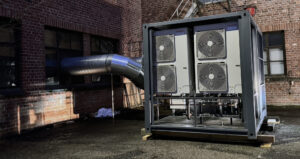
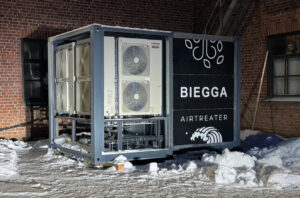
For facilities managing AirTreater containerised systems across multiple sites, Ouman’s remote management platform provides the continuous operational visibility that makes a hybrid strategy practical. Real-time data from each unit feeds into a centralised dashboard, giving maintenance teams the information they need to prioritise interventions, plan scheduled visits efficiently, and avoid both over-maintenance and undetected degradation. If you want to discuss how a combined maintenance strategy applies to your specific site and equipment configuration, contact the AirTreater team to speak with a technical specialist.