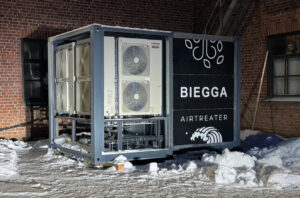
Remote fault response prevents equipment shutdowns by detecting abnormal operating conditions before they escalate into failures. When a heat pump or industrial HVAC system transmits real-time performance data to a monitoring platform, trained engineers can identify a developing fault, diagnose its cause, and intervene remotely, often before the site operator is even aware of an issue. The sections below answer the most common questions industrial facility managers ask about remote fault response and how to evaluate it.
How does remote fault response actually prevent equipment shutdowns?
Remote fault response prevents shutdowns by closing the gap between when a fault first appears and when it causes a failure. Most equipment failures do not happen without warning: they are preceded by measurable changes in operating parameters: rising discharge pressure, declining compressor efficiency, abnormal outlet temperatures, or increasing energy draw. A remote fault response system captures these signals continuously and triggers an alert when values deviate from defined thresholds, giving engineers time to act before the fault becomes a trip.
The distinction between monitoring and response is critical here. Monitoring alone records data. Remote fault response means a qualified engineer reviews the alert, assesses severity, and takes corrective action: adjusting setpoints, resetting a fault condition, or dispatching a technician with the correct parts already identified. This sequence compresses the response window from hours or days to minutes.
For industrial heat pump systems operating in continuous-process environments, the stakes are direct. A heating or cooling interruption does not just affect comfort; it can halt production, damage temperature-sensitive processes, or trigger a costly restart sequence. Remote fault response eliminates the scenario where a fault develops overnight on an unmanned site and is only discovered when the morning shift arrives to a cold plant.
What types of faults can remote monitoring detect early?
Remote monitoring for industrial HVAC and heat pump systems can detect a wide range of fault conditions early, including compressor performance degradation, refrigerant pressure anomalies, heat exchanger fouling, fan motor irregularities, electrical supply deviations, and control system communication errors. Any parameter that is measured and has a defined normal operating range can be monitored for early deviation.
In practice, the most operationally significant early-detection categories are:
- Thermal performance drift: Outlet water temperature or air delivery temperature diverging from setpoint, indicating reduced heat transfer efficiency or refrigerant circuit issues
- Compressor operating envelope violations: Suction or discharge pressures moving outside normal bands, which can signal refrigerant loss, expansion valve faults, or blocked heat exchangers
- Electrical anomalies: Phase imbalance, voltage drops, or abnormal current draw that precede motor failures
- Control system faults: Communication losses between sensors, controllers, and actuators that can cause incorrect system behaviour even when mechanical components are intact
- Auxiliary system activation patterns: Unusually frequent or prolonged activation of integrated backup systems, which can indicate that the primary circuit is underperforming
The value of detecting these conditions early is that most of them are correctable without a site visit if caught at the parameter-deviation stage. Left unaddressed, each one follows a predictable path toward a protection trip or component failure.
How fast can a remote fault response team intervene?
A remote fault response team can intervene within minutes of an alert being generated, provided the monitoring platform delivers real-time data and the team operates on a 24/7/365 basis. The intervention timeline has three stages: alert generation, engineer assessment, and corrective action. In a well-structured remote fault response system, the first two stages complete in under 15 minutes at any hour.
The speed of corrective action depends on the fault type. Faults that can be resolved through remote parameter adjustment (setpoint corrections, control resets, mode changes) are resolved without any physical presence on site. Faults that require a technician are escalated immediately, but the remote assessment means the technician arrives with a diagnosis already confirmed and the correct components identified, eliminating the diagnostic delay that typically extends repair times.
For sites operating unmanned or in remote locations, this response speed is not a convenience; it is the difference between a managed fault and an unplanned shutdown. AirTreater’s service centre provides 24/7/365 help-desk support backed by Ouman’s remote management platform, which gives engineers a real-time operational view of every connected system and the ability to adjust settings directly from a browser. This means the response clock starts the moment a parameter deviates, not the moment someone happens to check a dashboard.
What’s the difference between remote monitoring and a building automation system?
Remote monitoring and a building automation system (BAS) serve different functions. A building automation system controls and schedules HVAC, lighting, and building services within a fixed facility; it is primarily a control layer, not a diagnostic one. Remote monitoring, by contrast, is focused on equipment health: it collects operational data, compares it against performance baselines, and generates alerts when anomalies appear. The two can coexist, but they are not interchangeable.
What a building automation system does
A BAS manages setpoints, schedules, and zone control across a building’s systems. It executes instructions: turn on at 06:00, maintain 20 °C, switch to night mode at 22:00. Most BAS platforms include basic fault alarms, but these are typically binary: the system is either running or it has tripped. They do not track the gradual parameter drift that precedes a trip, and they rarely include the analytical layer needed to distinguish a nuisance alarm from a developing mechanical fault.
What remote monitoring adds
Remote monitoring operates at the equipment level, tracking continuous performance data against dynamic baselines. It identifies trends, not just states. A BAS will tell you the heat pump has tripped; remote monitoring tells you that compressor discharge pressure has been rising over the past six hours and the trip was predictable. That distinction is the foundation of condition monitoring: moving from reactive fault response to proactive fault prevention.
AirTreater systems integrate with existing automation infrastructure via standard protocols, so remote monitoring through the Ouman platform can operate alongside a site’s BAS rather than replacing it. The BAS handles scheduling and control; Ouman handles performance visibility and fault diagnostics.
When should remote fault response be paired with on-site maintenance?
Remote fault response should be paired with scheduled on-site maintenance when the system is operating in a high-criticality application, when the operating environment is physically demanding, or when the system has been in service long enough to accumulate wear on mechanical components. Remote diagnostics identify what is wrong and often resolve it, but they cannot replace physical inspection, refrigerant checks, filter servicing, or mechanical component replacement.
The most effective maintenance model for industrial heat pump and HVAC systems combines both layers:
- Continuous remote condition monitoring to catch parameter deviations in real time and resolve remotely-addressable faults without delay
- Scheduled preventive maintenance visits timed to the system’s operating hours and environmental conditions, not to a fixed calendar interval that ignores actual wear
- Condition-triggered on-site intervention when remote diagnostics identify a fault that requires physical access, dispatched with a confirmed diagnosis to minimise time on site
For industrial sites in demanding environments (high particulate loads, extreme temperatures, continuous operation), remote monitoring data should actively inform the maintenance schedule. If filter differential pressure is trending upward faster than expected, the maintenance interval shortens. If compressor performance metrics remain stable, a scheduled visit can be deferred without risk. This data-driven approach to maintenance scheduling reduces both unnecessary service costs and unplanned downtime.
What should an industrial site look for in a remote fault response system?
An industrial site evaluating a remote fault response system should prioritise four capabilities: real-time data transmission with no meaningful latency, configurable alert thresholds that reflect the equipment’s actual operating envelope, 24/7/365 access to qualified engineers who can act on alerts, and full audit trail logging for compliance and post-fault analysis. A system that delivers data but lacks the human response layer is condition monitoring, not fault response.
Beyond these core requirements, the following criteria separate capable systems from basic ones:
- Browser-based access without proprietary hardware: Engineers and site managers should be able to view system status and adjust settings from any standard browser, without requiring a dedicated workstation or site visit
- Integration with existing automation infrastructure: The remote management platform should communicate with the site’s existing control systems via standard protocols, not operate as an isolated island
- Scalability across multiple units or sites: Industrial operators managing several systems or locations need a unified view, not separate logins for each asset
- Vendor-agnostic diagnostic capability: The engineering team reviewing alerts must understand the specific equipment deeply enough to distinguish a genuine fault from a sensor error or a normal operating transient
- Documented response SLAs: The service provider should commit to specific response times, not just availability, and those commitments should be contractual
AirTreater systems are managed via Ouman’s remote management platform, which provides real-time operational data, browser-based settings control, and full integration capability with existing site automation. The 24/7/365 help-desk service ensures that alerts receive a qualified engineering response at any hour. For industrial facility managers who need to evaluate this capability against their own requirements, the most direct step is to discuss the specifics of your site with AirTreater’s technical team. Contact AirTreater to review your remote fault response requirements and the monitoring and support structure that fits your application.