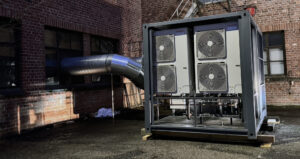
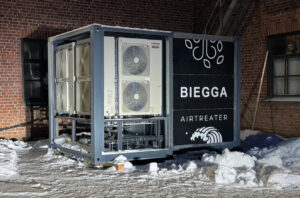
AirTreater Biegga is a containerised air-to-air heat pump that produces heat by transferring thermal energy from outdoor air rather than generating it through electrical resistance. A traditional portable heater converts electricity directly into heat at a 1:1 ratio. Biegga delivers an average of 2 or more units of heat energy for every unit of electrical energy consumed. The sections below address the specific differences in mechanism, efficiency, capacity, cold-weather performance, and application fit.
How does Biegga actually produce heat compared to a resistive heater?
AirTreater Biegga produces heat by extracting thermal energy from outdoor air and transferring it indoors using a refrigerant circuit and compressor. A traditional portable resistive heater converts electrical current directly into heat through a heating element. The fundamental difference is that Biegga moves heat rather than creates it, which changes everything about its efficiency profile and operating cost.
In a resistive heater, every watt of electrical input becomes exactly one watt of heat output. The conversion is direct, and the physics are simple. In Biegga, the compressor uses electrical energy to drive a refrigerant cycle that absorbs heat from outside air and releases it indoors. Even when outdoor temperatures are low, the air still contains usable thermal energy. The compressor work required to extract and transfer that energy is a fraction of the heat energy ultimately delivered into the space.
Biegga has a nominal heat pump output of 84 kW, supported by an 81 kW electric resistance backup element for conditions where supplementary heating is required. The heat pump circuit handles the primary load; the backup element activates only when the thermal demand exceeds what the compressor circuit delivers alone. This architecture keeps energy consumption low during normal operation while maintaining output reliability across temperature ranges.
What are the energy efficiency differences between Biegga and a traditional portable heater?
A traditional portable resistive heater operates at a coefficient of performance (COP) of 1.0 by definition: one kilowatt-hour of electricity produces one kilowatt-hour of heat. AirTreater Biegga operates as a heat pump, delivering a COP between 1.5 to 2.5 under most conditions, meaning it produces multiple units of heat energy for every unit of electrical energy consumed. The efficiency gap is not marginal; it is structural.
For large spaces with sustained heating demand, this difference has direct operational cost consequences. A resistive heater running continuously at high output draws electrical power in direct proportion to its heat output. Biegga’s heat pump circuit produces the same or greater heat output while drawing considerably less power from the electrical supply. At scale and over extended operating periods, the energy cost difference between the two approaches is substantial.
The 81 kW electric backup element in Biegga does operate at a COP of 1.0, matching a resistive heater in efficiency terms. However, this element is a supplementary system, not the primary heat source. It engages to maintain total output when the heat pump circuit alone is insufficient. The heat pump circuit carries the base load, and the backup element handles the remainder. The blended efficiency of the combined system across a heating season remains well above what a purely resistive heater can achieve.
Can a traditional portable heater also cool a space?
A traditional portable resistive heater cannot cool a space. It has one function: converting electricity into heat. AirTreater Biegga, by contrast, operates as a reversible heat pump and delivers a maximum cooling capacity of 81 kW. For applications that require both heating in winter and cooling in summer, Biegga eliminates the need for two separate systems.
This dual-mode capability is a direct consequence of how heat pump refrigerant circuits work. The same compressor and refrigerant loop that extracts heat from outdoor air in heating mode can be reversed to extract heat from indoor air and reject it outside in cooling mode. A resistive heater has no refrigerant circuit and no reversible thermodynamic cycle, so cooling is simply not within its operating envelope.
For large industrial spaces, event venues, construction sites, or temporary facilities that need climate control across seasons, this distinction determines whether one system or two must be procured, transported, and managed. Biegga’s 81 kW cooling capacity is available from the same containerised unit that provides up to 165 kW of maximum heating output, making it a single-asset solution for year-round olosuhdehallinta requirements.
What heating capacity can Biegga reach versus a standard portable heater?
AirTreater Biegga delivers a maximum heating capacity of 165 kW, combining 84 kW from the heat pump circuit with 81 kW from the integrated electric backup element. A standard portable resistive heater in an industrial or construction context typically operates in the range of 3 kW to 30 kW. For large spaces, multiple resistive units would need to be deployed in parallel to approach comparable output, compounding both capital cost and energy consumption.
The 84 kW heat pump output alone exceeds what most portable resistive heating products deliver even at their maximum rated capacity. When the full 165 kW combined output is engaged, Biegga is operating at a scale that is simply not accessible through conventional portable resistive heating without significant electrical infrastructure and a large number of individual units.
For applications such as large production halls, aircraft hangars, temporary industrial enclosures, or event structures, the capacity differential is operationally decisive. A single Biegga deployment replaces what would otherwise require an array of smaller resistive heaters with corresponding electrical distribution, monitoring complexity, and failure exposure across multiple units.
How does Biegga perform in cold outdoor temperatures?
All AirTreater systems, including Biegga, are guaranteed to deliver at least nominal capacity at all outdoor temperatures. This is not a rated condition or a laboratory specification; it is a performance guarantee. When outdoor temperatures fall to levels where the heat pump circuit alone cannot sustain full output, the integrated 81 kW electric backup element engages to maintain total heating capacity. The system does not derate; it adapts.
This is a critical distinction from conventional heat pumps available on the market, which are typically rated at nominal conditions and experience significant capacity reduction as outdoor temperatures drop. A heat pump rated at 84 kW at +7 °C may deliver substantially less at very low temperatures unless it incorporates a backup system designed to compensate for that loss. Biegga’s architecture addresses this directly: the backup element exists precisely to close the gap between compressor-only output and the required nominal capacity in extreme cold.
For operations in northern climates where winter temperatures regularly fall to very low levels, this guarantee has direct operational significance. A heating system that underperforms during the coldest periods is a liability, not an asset. Biegga’s maximum heating output of 165 kW and at least 81 kW at all outdoor temperatures is available precisely when it is most needed. Conventional systems in comparable conditions may lose as much as 40% of their rated capacity, while Biegga’s architecture prevents this degradation.
When should a traditional portable heater be chosen over Biegga?
A traditional portable resistive heater is appropriate when the heating requirement is small in scale, short in duration, and the upfront cost of a containerised heat pump system is disproportionate to the task. For a single room, a small temporary enclosure, or a brief spot-heating application measured in kilowatts rather than tens of kilowatts, a resistive heater is a practical and sufficient choice.
Biegga is a containerised industrial system designed for large spaces with sustained heating or cooling demand. Its value proposition is strongest when all of the following conditions apply:
- The space is large and requires 84 kW or more of heating capacity
- The heating or cooling requirement extends over weeks or months, making energy efficiency a cost factor
- Both heating and cooling are required across different seasons
- Reliable performance in cold outdoor temperatures is non-negotiable
- A single deployable system is preferable to managing multiple smaller units
Where those conditions do not apply, a resistive heater remains a simpler and more cost-proportionate option. The decision is not about which technology is superior in absolute terms; it is about matching the system to the operational requirement. For small, short-term, low-demand applications, the engineering sophistication of a heat pump system is unnecessary. For large-scale, sustained, or dual-mode requirements, a resistive heater cannot meet the specification that Biegga delivers as a guarantee.
For procurement teams evaluating temporary or permanent large-scale heating and cooling requirements, contact the AirTreater technical team to discuss site-specific capacity requirements and deployment timelines.