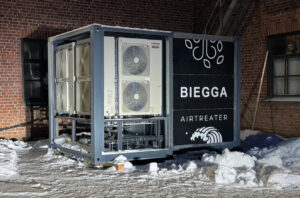
AirTreater Biegga commissions within one working day of arrival on site. The containerised format eliminates the civil works and infrastructure lead times that fixed installations require, meaning the system connects, starts, and delivers full nominal heating and cooling capacity within a single working day in most configurations. The sections below address the specific conditions, preparations, and operational capabilities that determine that timeline.
What makes the Biegga unit faster to deploy than fixed systems?
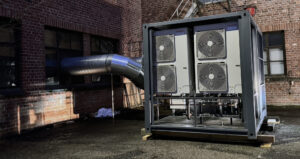
AirTreater Biegga deploys faster than fixed systems because it arrives on site as a complete, pre-configured containerised solution requiring no permanent civil works, no plant room construction, and no site-specific fabrication. The entire heating and cooling system is contained within a single unit that connects to an existing power supply and, where required, a heat distribution point. Connection completes in one working day.
Fixed heat pump installations require a fundamentally different procurement and construction sequence. A permanent system demands plant room design, civil foundation work, equipment delivery across multiple shipments, on-site assembly, commissioning by specialist contractors, and regulatory sign-off before any heating or cooling is produced. That process typically spans weeks or months, depending on site complexity and contractor availability.
AirTreater Biegga eliminates every one of those dependencies. The unit ships as a complete system. No on-site assembly is required. No permanent infrastructure is committed to. When the project ends or operational requirements change, the unit relocates rather than being written off as a sunk cost.
What site preparations are needed before a Biegga arrives?
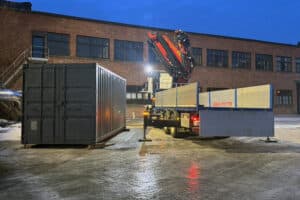
Before AirTreater Biegga arrives on site, three preparations are required: a level, load-bearing surface capable of supporting the container, an adequate electrical supply connection point, and confirmed access for the delivery vehicle and any lifting equipment needed to position the unit. No groundworks, plant room, or permanent structural modifications are necessary.
The electrical supply specification should be confirmed with AirTreater’s technical team during the pre-delivery phase, as the required capacity depends on whether the unit will operate on heat pump capacity alone or with the integrated 81 kW electric heating element active. Sites with constrained electrical supply should clarify this before delivery to avoid any delay during commissioning.
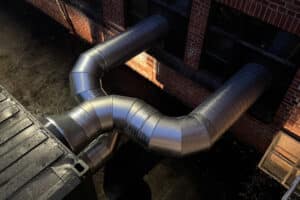
For applications where the Biegga will supply conditioned air to an enclosed space, the site team should confirm that air intake and discharge paths are unobstructed and that the target space dimensions are compatible with the unit’s air distribution capacity. AirTreater Biegga is designed for large, open spaces, and the pre-delivery technical review will confirm suitability for the specific site geometry.
How long does it actually take to commission a Biegga on site?
AirTreater Biegga commissions in one working day for electrical connection and system startup. Where no heat distribution network is required, the unit is fully operational within 4 hours of arriving on site. This timeline is not an estimate under optimal conditions — it is the standard commissioning sequence for the containerised format.
The commissioning process covers electrical connection, system parameter configuration, startup verification, and confirmation that the unit is delivering against its setpoints. AirTreater’s team handles the technical commissioning, and the automated remote management platform is activated during this phase so that the operator has immediate access to real-time system data from the point the unit goes live. Named end users can also be granted access to the automation system.
Sites that require integration with an existing building management or automation system may add time to the commissioning sequence, depending on the complexity of the interface. AirTreater systems are designed to integrate with existing automation infrastructure, and the integration scope should be defined before delivery to keep the on-site commissioning window as tight as possible.
What heating and cooling capacity is available immediately after commissioning?
Immediately after commissioning, AirTreater Biegga delivers 84 kW of heat pump heating capacity. With the integrated 81 kW electric heating element active, maximum heating output reaches 165 kW, and at least 81 kW is guaranteed at all outdoor temperatures. Maximum cooling capacity is 81 kW. These are nominal capacities guaranteed at all outdoor temperatures — not rated-at-optimal-conditions figures that derate in cold weather.
This guarantee is the critical operational distinction. Conventional air-to-air systems are typically rated at standard test conditions and deliver meaningfully less capacity when outdoor temperatures drop — like 40% degradation at -15 °C. AirTreater Biegga delivers at least its nominal capacity regardless of outdoor temperature. For sites commissioning in winter conditions, that means full output from the first hour of operation, not a reduced capacity that requires supplementary heating to compensate.
The 81 kW electric heating element functions as an integrated backup system, activating when additional output is required rather than as a primary heat source. This architecture ensures that the unit operates at maximum heat pump efficiency under normal conditions while maintaining the full 165 kW maximum output ceiling when peak demand requires it.
How does remote monitoring work once the Biegga is commissioned?
Once AirTreater Biegga is commissioned, the unit is managed via an automated remote management platform, which provides real-time operational data and full settings control through a standard web browser. No specialist software is required. The operator can monitor system status, adjust setpoints, and review performance data from any location at any time. Named end users can also be granted access to the automation system.
The automation platform gives the operator a live view of the unit’s operating parameters — outlet temperatures, energy consumption, system status, and alarm conditions. Settings adjustments take effect immediately, meaning a site manager can respond to a change in operational requirements or outdoor conditions without travelling to the unit. For remote or unmanned sites, this capability is not a convenience — it is an operational requirement.
AirTreater’s 24/7/365 help-desk service operates through the same infrastructure. If an alarm condition is flagged or an operator needs technical support outside standard business hours, the service centre has direct access to the same system data, enabling faster diagnosis and response than a site visit alone would allow.
When should a site choose Biegga over a permanent heat pump installation?
A site should choose AirTreater Biegga over a permanent installation when the heating or cooling requirement is time-limited, when the site lacks the infrastructure for a fixed system, when commissioning speed is a critical constraint, or when the ability to redeploy the asset at project completion has operational or financial value. For large, open spaces where air-to-air distribution is appropriate, Biegga is the technically correct choice regardless of project duration.
Construction sites represent the clearest application. A permanent heat pump installation requires civil works that the site will never use again. AirTreater Biegga connects in one working day, operates for the duration of the project, and relocates when the project completes. The asset is not written off — it moves to the next site.
For applications where heat distribution infrastructure already exists and liquid-cycle energy distribution is preferred, AirTreater Čáhci is the appropriate containerised alternative, delivering up to 420 kW through a water-based circuit. The choice between air-to-air and air-to-water distribution is determined by the site’s existing infrastructure and the nature of the spaces being conditioned — not by the deployment speed, which is comparable across both platforms.
Sites with permanent, continuous heating or cooling requirements and existing plant room infrastructure may find that a fixed installation delivers better long-term efficiency. AirTreater’s technical team can assess whether the containerised or fixed approach is the correct specification for a given site — contact the team with your site parameters and commissioning timeline to receive a direct recommendation.