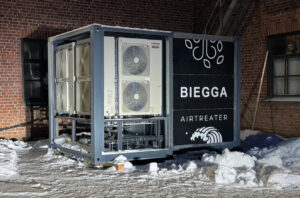
AirTreater Biegga suits both temporary and long-term installations, but the decision depends on the type of space, the heat distribution infrastructure available, and the outdoor temperature range the site experiences. For large, open-volume spaces without existing liquid-cycle pipework, Biegga delivers reliable air-to-air climate control with 84 kW of heat pump capacity and a maximum heating output of 165 kW. The sections below address the most common technical and operational questions about Biegga in 2026.
What makes Biegga different from a standard portable heat pump?
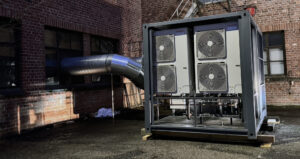
AirTreater Biegga is a containerised air-to-air heat pump, not a portable consumer unit. It delivers 84 kW of nominal heat pump capacity supported by an 81 kW electric heating element, reaching a maximum heating output of 165 kW, and at least 81 kW at all outdoor temperatures. Standard portable heat pumps are rated under optimal conditions and derate sharply in cold weather — like 40% at -15 °C for conventional systems. Biegga guarantees 81 kW backup heating at all outdoor temperatures.
That performance guarantee is the defining distinction. Conventional equipment is rated at a test-condition temperature that rarely reflects actual site conditions in northern climates. Biegga is engineered to maintain its specified output regardless of what the outdoor thermometer reads. The integrated electric heating element is not a fallback for poor performance — it is a designed component that activates to extend the system’s total output envelope when site demand requires it.
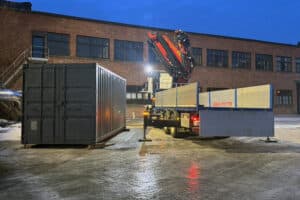
The containerised form factor also separates Biegga from smaller mobile alternatives. The system ships in a standard container, connects on site in a single working day, and is fully operational within 4 hours of arriving on site when no heat distribution network is required. No permanent plant room, no civil works, no long commissioning window.
What types of spaces is Biegga designed for?
Biegga is designed for large, open-volume spaces where direct air heating and cooling is practical and where no liquid-cycle heat distribution network exists. Typical applications include production halls, warehouses, logistics facilities, temporary construction enclosures, military field installations, and large event or industrial tents. The air-to-air configuration makes it the right choice when installing hydronic pipework is impractical or unnecessary.
The system’s maximum cooling output of 81 kW also makes it viable for spaces that require active cooling during summer months or where process heat loads need to be removed from the occupied volume. A single Biegga unit covers a substantial floor area in a well-insulated industrial building, and multiple units can be deployed in parallel for larger sites.
Where the space already has a heat distribution network with radiators, underfloor circuits, or fan coil units, AirTreater Čáhci is the more appropriate choice. Biegga works directly with the air volume — it does not produce hot or chilled water for distribution through pipework.
How does Biegga perform in low outdoor temperatures?
Biegga maintains at least its nominal 84 kW heat pump capacity at all outdoor temperatures. When outdoor conditions reduce the coefficient of performance of the compressor circuit, the integrated 81 kW electric heating element activates to sustain total system output. The combined maximum heating capacity of 165 kW is available even in demanding sub-zero conditions, and at least 81 kW is guaranteed at all outdoor temperatures.
This is not a conditional claim. All AirTreater systems are guaranteed to deliver at least nominal capacity at every outdoor temperature — this is the engineering baseline the company was built on. For sites in Finland and other northern European climates where winter temperatures regularly fall to -15 °C and below, that guarantee eliminates the performance cliff that affects standard market heat pumps — like 40% degradation at -15 °C for conventional systems.
The electric heating element draws additional power when it engages, so energy consumption increases at the temperature extremes where compressor-only operation cannot sustain the required output. For sites with limited electrical supply, this is a factor to evaluate during the specification stage. AirTreater’s technical team can model expected energy draw against site-specific temperature data before deployment.
Is Biegga better suited for temporary or permanent installations?
Biegga is suited to both, but its containerised format makes it particularly well matched to temporary and relocatable deployments. The system connects in one working day and reaches full operation within 4 hours of arriving on site when no heat distribution network is required. When the project ends or the site requirement changes, the container relocates without leaving behind any fixed infrastructure. For permanent installations in large open spaces, Biegga is equally capable — the container simply remains in position.
For temporary applications, the key operational advantage is speed. Construction site enclosures, temporary production facilities, emergency replacement heating during planned maintenance shutdowns, and seasonal climate control for structures without permanent HVAC all represent scenarios where Biegga’s deployment timeline is a direct operational benefit. There is no lead time for civil works, no plant room to build, and no decommissioning cost when the requirement ends.
For permanent installations, the decision should weigh whether air-to-air distribution suits the long-term use of the space. If the building will eventually gain a hydronic distribution system, specifying Biegga now and transitioning to AirTreater Čáhci later is a practical path. If the space will always be a large open volume heated and cooled directly, Biegga is a permanent solution that happens to be relocatable if the business case changes.
What remote monitoring and support options come with Biegga?
Biegga integrates with an automated remote management platform, which gives operators real-time visibility into system performance and full settings control through a standard web browser. Named end users can also have access to the automation system. There is no requirement to be on site to monitor temperatures, adjust setpoints, or review operational data. Access is available from any location at any time.
The automation platform is not a simplified status display. It provides the operational data that facility managers and plant engineers need to verify that the system is running within its nominal parameters, identify anomalies before they develop into failures, and document performance over time. For unmanned or remote sites, this visibility is the difference between reactive problem-solving and proactive management.
AirTreater’s service centre provides 24/7/365 help-desk support for all deployed systems. For operations that run continuously — whether a production facility, a temporary critical infrastructure installation, or a seasonal site with no on-site technical staff — that support availability is a baseline operational requirement, not an optional extra. Biegga can also integrate with existing building automation systems where the site already has an established control infrastructure.
When should you choose Čáhci or Prosea instead of Biegga?
Choose AirTreater Čáhci when the site has or requires a liquid-cycle heat distribution network. Čáhci is an air-to-water heat pump that produces heated or chilled water for distribution through radiators, underfloor circuits, or fan coil units. It maintains 120 kW of nominal heating capacity even at very low temperatures using compressors alone, with a maximum output of 420 kW. The heat pump operates down to -28 °C, and below -28 °C the backup system guarantees at least 300 kW even without external electric power in hazardous situations. For large sites with existing hydronic infrastructure, Čáhci delivers more even temperature distribution and higher efficiency than air-to-air alternatives.
Choose AirTreater Prosea when the application is process-specific rather than space conditioning. Prosea is designed for process industry requirements — precise temperature control for industrial processes, biogas plant cooling, data centre thermal management, or any application where the cooling or heating load is tied to a process rather than a building. Prosea systems are engineered for each individual application, which means the specification, capacity, and configuration are matched exactly to the process requirement rather than selected from a standard product range.
Biegga is the right choice when the space is large and open, air-to-air distribution is practical, no liquid-cycle infrastructure is available or planned, and the requirement may be temporary or the system may need to relocate. If any of those conditions do not apply, Čáhci or Prosea will typically deliver better performance and efficiency for the specific application.
To determine which AirTreater system matches your site’s technical requirements, contact the AirTreater technical team with your space dimensions, temperature requirements, and available electrical supply data for a site-specific specification review.