AirTreater Čáhci delivers guaranteed nominal heating and cooling capacity at all outdoor temperatures, making it a reliable choice for hospitals and large office buildings where climate interruptions are operationally unacceptable. Its liquid-cycle energy distribution, integrated backup system, and containerised form factor address the specific demands of facilities that cannot tolerate performance gaps in extreme cold. The sections below address the most important operational questions facility managers and procurement engineers ask before specifying Čáhci.
How does Čáhci deliver reliable heating in extreme cold?
AirTreater Čáhci maintains 120 kW of nominal heating capacity at -15 °C using compressors alone, with no reliance on auxiliary heat strips to reach that figure. Maximum heating output reaches 420 kW at -15 °C, and the heat pump operates down to -28 °C. Below -28 °C, the integrated backup system guarantees at least 300 kW of heating capacity even without external electric power in hazardous situations. This is a guarantee, not a rated condition based on optimal laboratory temperatures.
Conventional heat pumps are typically specified at nominal conditions and derate significantly as outdoor temperatures fall. At -15 °C, many standard systems deliver a fraction of their stated capacity. Čáhci is designed so that the performance figure on the specification sheet is the performance figure the operator receives in the field, regardless of what the weather is doing. The integrated backup system activates when conditions demand it, maintaining the setpoint without operator intervention. For facilities in northern climates where winter temperatures routinely reach -15 °C and below, this distinction between a rated capacity and a guaranteed capacity is the difference between a heating system and a heating guarantee.
What energy efficiency advantages does Čáhci offer over conventional systems?
Čáhci is an air-to-water heat pump, which means it transfers heat through a liquid-cycle distribution network rather than moving conditioned air directly. Heat pump technology delivers more thermal energy per unit of electrical input than direct resistance heating, and liquid-cycle distribution is significantly more efficient at transporting heat across large floor areas than ducted air systems. The result is lower energy consumption per kilowatt of delivered heat across the building’s entire heating load.
The efficiency advantage compounds over time. Liquid-cycle systems maintain more even temperature distribution across large spaces, which reduces the energy wasted on overcooling or overheating zones to compensate for uneven air distribution. For office buildings and hospitals with substantial heating loads running continuously through winter months, the cumulative difference in energy consumption between a liquid-cycle heat pump and a conventional system is operationally significant. Čáhci can also be configured with a ground-source heat pump where a borehole field is available on site, which further improves the coefficient of performance in cold-weather operation.
Why is Čáhci particularly suited to hospitals?
Hospitals require uninterrupted heating and cooling at all times. A heating failure in a clinical environment creates immediate patient safety risks and regulatory compliance failures. Čáhci’s guaranteed nominal capacity at all outdoor temperatures, combined with its integrated backup system providing at least 300 kW of heating capacity, means the system does not present a single point of failure during extreme weather events.
Hospitals also operate large, complex hydronic distribution networks that connect radiators, underfloor heating circuits, air handling units, and process heating loads. Čáhci’s liquid-cycle architecture integrates directly with these existing networks without requiring the facility to rebuild its heat distribution infrastructure. The system connects to the building’s hydronic loop and operates within the temperature parameters the existing network requires.
Beyond thermal performance, hospitals need operational visibility. Čáhci systems are managed via an automated remote management platform, which provides real-time operational data and full settings control through a standard web browser. Named end users can also have access to the automation system. Combined with AirTreater’s 24/7/365 help-desk service, facility engineers have continuous oversight of system performance and immediate access to technical support if an anomaly arises. For a hospital’s engineering team managing dozens of critical building systems simultaneously, that level of remote visibility is not a convenience — it is a requirement.
How does Čáhci benefit large office buildings?
Large office buildings present a dual demand: heating in winter and cooling in summer, often simultaneously across different zones. Čáhci addresses both modes within a single liquid-cycle system, eliminating the need for separate heating and cooling infrastructure. The system’s capacity range, up to 420 kW of heating output, is appropriate for large commercial floor areas where smaller heat pump units would require multiple installations and complex zoning arrangements.
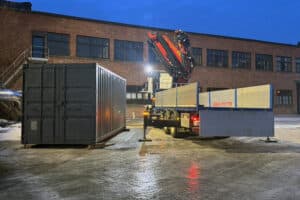
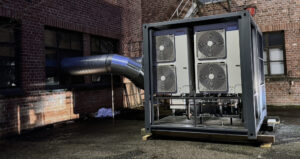
Office buildings also face a practical challenge that hospitals share: the cost and disruption of replacing or supplementing a failing heating system mid-season. Čáhci’s containerised format means the system can be deployed and connected quickly, with startup achievable within 4 hours of arriving on site where no heat distribution network is required, and commissioning including electrical connection completed within one working day. For office buildings undergoing renovation, phased development, or temporary heating provision during a plant room upgrade, this deployment speed reduces the period of operational exposure. When the project is complete or the building’s permanent system is restored, the containerised unit can be redeployed to another site rather than written off.
How does Čáhci’s remote management system work?
Čáhci systems are managed via an automated remote management platform, which gives operators a real-time view of system performance and the ability to adjust settings directly from a standard web browser. No specialist software installation is required. The platform is accessible from any location at any time, which is particularly relevant for facility managers responsible for multiple buildings or for buildings that operate with reduced on-site engineering staff outside core hours. Named end users can also have access to the automation system.
The automation platform displays live operational data including temperatures, output levels, and system status. Operators can modify setpoints, review performance trends, and respond to alerts without travelling to the plant room. For hospitals and office buildings where the engineering team is managing a broad portfolio of building services, centralised remote visibility over the heating and cooling system reduces the time cost of routine monitoring and accelerates response to performance deviations.
Čáhci systems are also designed to integrate with existing building automation systems, which means the remote management capability can be folded into a facility’s existing operational dashboard rather than requiring a standalone monitoring interface. AirTreater’s service centre provides 24/7/365 help-desk support alongside the automation platform, ensuring that technical assistance is available whenever the system requires it.
When should a facility choose Čáhci over other heat pump solutions?
Čáhci is the appropriate choice when a facility requires liquid-cycle heat distribution, high heating capacity in sub-zero conditions, and a guaranteed performance floor that does not derate with falling outdoor temperatures. It is specifically suited to large buildings with existing hydronic distribution networks, facilities where heating continuity is non-negotiable, and sites where a containerised solution offers deployment or mobility advantages over a permanent fixed installation.
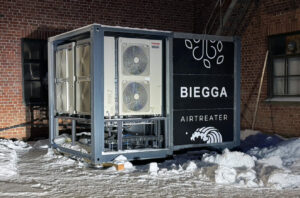
For facilities where air-to-air distribution is acceptable and the heating load is within the range of AirTreater Biegga’s 84 kW heat pump capacity and 165 kW maximum output, Biegga may be the more appropriate specification. Where the application involves process heating or cooling with highly specific temperature and flow requirements, AirTreater’s Prosea range is designed and specified individually for each site. Čáhci occupies the space between these options: large-scale, liquid-cycle, high-capacity, and deployable without permanent infrastructure commitment.
The decision should also account for site-specific factors. If a borehole field is available, Čáhci can be configured with a ground-source heat pump to improve cold-weather efficiency further. If on-site electrical capacity is sufficient, an electric boiler can serve as the integrated backup system in place of the standard configuration. These options mean Čáhci adapts to the constraints of the specific site rather than requiring the site to adapt to the system. Contact AirTreater’s technical team to discuss your site’s heating and cooling requirements and receive a specification matched to your operational parameters.