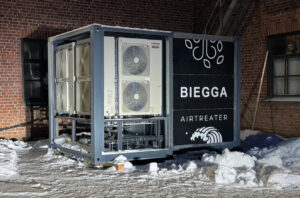
Air quality solutions for defense operations must address a fundamentally different set of demands than standard commercial HVAC systems. Defense environments combine contamination risks, extreme operating temperatures, mission-critical reliability requirements, and the need for rapid, flexible deployment — conditions that disqualify most conventional climate control equipment before procurement even begins. The sections below address the specific questions defense facility managers and military procurement officers ask when evaluating air quality infrastructure.
What air quality challenges are unique to defense environments?
Defense environments present air quality challenges that commercial facilities rarely face at the same scale or severity. These include exposure to chemical contaminants, particulate matter from weapons discharge and vehicle exhaust, biological hazards in field medical settings, and the need to maintain controlled atmospheres in enclosed structures ranging from hardened bunkers to temporary forward operating bases. Unlike commercial facilities, a failure in air quality control in a defense setting carries direct operational and personnel safety consequences.
The range of facility types compounds the challenge. A fixed military base housing sensitive electronics requires precise humidity and particulate control to protect equipment. A field deployment tent in sub-zero conditions requires heating that does not produce combustion byproducts. A maintenance hangar servicing armored vehicles generates concentrated fume loads that standard ventilation systems cannot adequately address. Each scenario demands a different filtration and conditioning specification — but all share the requirement that the system performs without interruption.
Mobility adds a further layer of complexity. Defense air quality infrastructure must often move with the operation. Systems that require permanent civil works, fixed ductwork, or specialist installation teams are operationally incompatible with forward-deployed environments. The combination of contamination diversity, extreme conditions, and deployment flexibility defines what separates defense-grade air quality solutions from standard industrial HVAC.
What filtration standards apply to defense facility air systems?
Defense facility air systems are typically required to meet HEPA filtration standards at a minimum, with NBC (Nuclear, Biological, Chemical) filtration capability required for frontline or high-risk installations. HEPA filters remove at least 99.97% of airborne particles at 0.3 microns — the most penetrating particle size — which covers biological aerosols, fine particulates from combustion, and most industrial contaminants. NBC filtration adds activated carbon layers to address chemical vapors and radiological particulates.
For fixed defense installations, national and NATO standards govern filtration specifications. NATO STANAG documents establish interoperability requirements for collective protection systems, which include the air handling equipment serving shelters and operations centers. Procurement teams working within NATO frameworks expect suppliers to demonstrate familiarity with these standards and the ability to integrate compliant filtration into their systems.
For industrial air purification in military contexts — maintenance facilities, logistics depots, and technical workshops — EN 1822 and ISO 29463 standards define HEPA and ULPA filter classification. Procurement officers should verify that any air quality solution specifies the filter class, not just the filter type, and that replacement filter availability is confirmed for the expected operational lifespan of the installation.
How do temperature extremes affect air quality control in defense operations?
Extreme temperatures directly compromise air quality control in defense operations by degrading system performance, altering air density and humidity behavior, and creating condensation and freezing conditions that damage filtration media and heat exchanger surfaces. In sub-zero environments, conventional heat pumps typically derate significantly — meaning their actual heating output even at very low temperatures falls well below their nominal specification. When the climate control system underperforms, so does the filtration and ventilation function it supports.
Cold weather also affects humidity management. At very low temperatures, outdoor air carries minimal moisture, but when that air is heated rapidly inside a structure, relative humidity drops sharply — creating conditions that increase static electricity risk around sensitive electronics and cause discomfort for personnel. Conversely, in hot and humid operational environments, inadequate cooling capacity allows moisture to accumulate, promoting mold growth and degrading air quality in enclosed spaces.
The operational implication is direct: an air quality system that cannot guarantee its nominal capacity across the full temperature range of the deployment environment is not a reliable solution for defense use. Systems must be specified and guaranteed to maintain full heating, cooling, and filtration performance at the actual outdoor temperatures of the operating theater — not just at laboratory test conditions. AirTreater Biegga, for example, guarantees a minimum of 81 kW output at all outdoor temperatures, with a maximum heating capacity of 165 kW combining 84 kW of heat pump output with 81 kW of electric resistance backup — ensuring that air conditioning and filtration functions are never thermally compromised.
What’s the difference between fixed and mobile air quality systems for defense use?
Fixed air quality systems are permanently installed into a facility’s structure, integrated with its ductwork, electrical supply, and building management infrastructure. Mobile air quality systems are self-contained, deployable units that connect to a site without permanent civil works and can be relocated when the operational need changes. For defense use, the distinction determines whether a system can serve forward-deployed, temporary, or rapidly evolving operational environments — or only established, permanent bases.
Fixed Systems: Strengths and Limitations
Fixed installations offer deep integration with building automation, optimised ductwork layouts, and the ability to serve multiple zones from centralised plant. They are appropriate for permanent defense infrastructure — headquarters buildings, training facilities, and established bases where the facility footprint will not change. The trade-off is lead time: permanent HVAC installation requires civil works, building permits, and commissioning periods that can extend to months. Fixed systems cannot be recovered and redeployed when a facility is decommissioned or a unit relocates.
Mobile Containerised Systems: Deployment Advantages
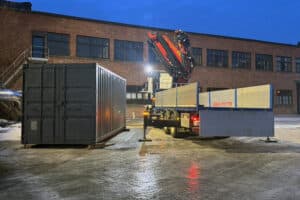
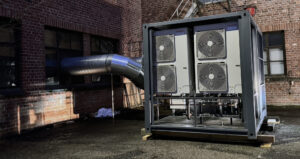
Containerised air quality solutions eliminate the civil works dependency entirely. A properly specified containerised system arrives on site pre-configured, connects to the local electrical supply and any required distribution network in a single working day, and reaches full operational status within 4 hours of arriving on site when no heat distribution network is required. When the operation moves, the container moves with it — the asset is fully recoverable. For defense logistics officers managing temporary installations, forward operating bases, or rapid-response deployments, the containerised format is not a compromise on capability. It is the operationally correct choice.
When should defense operations use air-to-air versus air-to-water heat pump systems?
Defense operations should use air-to-air heat pump systems when the target space is large, open, and does not have an existing hydronic distribution network. Air-to-water systems are the correct choice when the facility already has or requires a liquid-cycle heat distribution network — such as underfloor heating, radiators, or process cooling loops — or when multiple zones need to be served from a single heat source. The decision turns on the facility’s heat distribution infrastructure, not on the climate control requirement alone.
Air-to-air systems like AirTreater Biegga deliver conditioned air directly into the space, making them well-suited to large open structures: hangars, temporary shelters, logistics warehouses, and assembly areas. A single Biegga unit covers spaces of 500 to 1,500 m² — calculated on a site-specific basis — without requiring any liquid distribution pipework. This significantly reduces installation complexity and deployment time, which is operationally valuable in defense contexts where speed of setup is a constraint.
Air-to-water systems are the appropriate choice for facilities where heat needs to be transported over distance, distributed to multiple rooms, or integrated with existing hydronic infrastructure. They also suit applications where a consistent outlet water temperature is required for process purposes. For defense facilities being established from scratch with no existing distribution network, the air-to-air route typically delivers faster deployment and lower infrastructure cost. For facilities upgrading or extending existing heating plant, air-to-water integration preserves the existing distribution investment.
How can defense facilities monitor and control air quality remotely?
Defense facilities can monitor and control air quality systems remotely through integrated building automation platforms that provide real-time operational data, alert management, and settings adjustment via a standard web browser or GSM connection. Remote management eliminates the requirement for on-site technical personnel to perform routine monitoring and adjustments — a significant operational advantage for unmanned installations, forward-deployed sites, or facilities where technical staff resources are limited.
AirTreater systems integrate with an automated remote management platform, which gives operators a real-time view of system performance — outlet temperatures, operating mode, energy consumption, and fault status — accessible from any browser, at any location, at any time. Settings can be adjusted remotely without dispatching a technician to site. Named end users can also have access to the automation system. For defense installations operating across multiple locations or in remote environments, this capability directly reduces the operational burden of maintaining air quality standards.
Fault response is equally important. AirTreater’s 24/7/365 service centre monitors connected systems continuously. When an alert is generated, the service centre responds immediately — analyzing the fault remotely and, where possible, resolving it without a site visit. For defense operations where air quality interruption carries personnel safety or mission-critical implications, this level of support availability is a procurement requirement, not an optional extra.
For defense procurement teams evaluating air quality solutions, AirTreater holds NATO supplier registration with NCAGE code A04WG — confirming compliance with the quality and reliability standards required for deployment in mission-critical environments. To discuss specific site requirements or request technical documentation for procurement review, contact the AirTreater technical team directly.