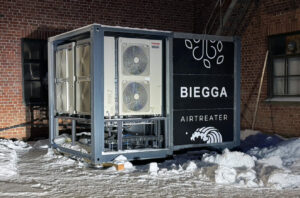
AirTreater Biegga delivers 84 kW of heat pump heating capacity and up to 165 kW of combined maximum heating output, making it capable of covering a 1,000 m² space under most industrial and commercial conditions. Coverage depends on the thermal load of the specific building, not floor area alone, but for well-insulated large spaces, a single Biegga unit is a viable heating and cooling solution.
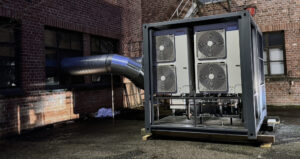
Biegga is an air-to-air heat pump containerised for rapid deployment, designed specifically for large open-plan environments where direct air distribution is practical. The sections below address the most common technical questions about Biegga’s capacity, application fit, and operational performance.
What heating and cooling capacity does Biegga actually deliver?
AirTreater Biegga delivers 84 kW of heat pump heating capacity, with an integrated 81 kW electric heating element providing supplementary output when required. Combined maximum heating capacity reaches 165 kW. On the cooling side, Biegga delivers a maximum cooling capacity of 81 kW. These are guaranteed nominal figures, not rated-at-optimal-conditions estimates.
The distinction between the heat pump output and the combined maximum matters in practice. The 84 kW heat pump circuit operates as the primary heating mode, drawing on ambient air as the heat source. When outdoor temperatures require additional support, the 81 kW electric heating element activates as an integrated backup system, bringing total output to 165 kW, and at least 81 kW at all outdoor temperatures. This architecture ensures that heating capacity does not collapse in cold weather, which is the failure mode of conventional air-to-air systems that are specified at peak conditions and derate substantially in sub-zero operation.
For cooling, the 81 kW capacity is delivered directly through the air-to-air circuit. There is no water-side distribution involved, which keeps the system self-contained and eliminates the need for a separate hydronic network.
How many square metres can Biegga realistically cover?
For a well-insulated industrial or commercial space with a heating load in the range of 80 to 150 W/m², a single AirTreater Biegga unit covers approximately 1,000 to 2,000 m². A 1,000 m² space with a heating load of 100 W/m² requires 100 kW, which falls within Biegga’s combined capacity of 165 kW, with meaningful headroom.
Floor area alone does not determine coverage. The relevant variable is the building’s actual thermal load, which depends on insulation quality, ceiling height, air infiltration rate, and the thermal demands of any equipment or processes operating inside. A 1,000 m² warehouse with a high ceiling and poor insulation may carry a heating load of 150 kW or more, which would require Biegga to operate at or near its combined maximum. A 1,000 m² production hall with modern insulation and a standard ceiling height may require only 80 to 100 kW, leaving the heat pump circuit alone sufficient for most operating conditions.
For cooling, the 81 kW output covers a 1,000 m² space where the cooling load does not exceed that figure. In spaces with high internal heat gain from industrial equipment or direct solar exposure through large openings, the cooling load may exceed this threshold and require a second unit or a different system architecture.
What types of spaces is Biegga designed for?
AirTreater Biegga is designed for large, open-plan spaces where direct air-to-air heat distribution is practical. Typical applications include industrial production halls, warehouses, logistics facilities, large temporary structures, and construction site enclosures. The air-to-air format works best in spaces without internal partitioning that would obstruct airflow and create uneven temperature distribution.
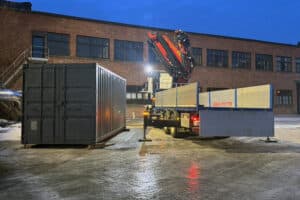
The containerised format makes Biegga particularly well suited to sites where permanent infrastructure is not in place or where the heating and cooling requirement is temporary or project-based. Construction projects, temporary industrial operations, and sites awaiting permanent installation are all strong application fits. The container connects on site within 4 hours of arriving on site when no heat distribution network is required, with full commissioning including electrical connection completed within one working day, which makes it a practical response to time-sensitive heating or cooling requirements.
Biegga is less suited to spaces with complex room layouts, multiple separate zones requiring individual temperature control, or applications where heat distribution through a hydronic network is already in place. For those scenarios, a liquid-cycle system delivers more precise and efficient distribution.
How does Biegga perform at low outdoor temperatures?
AirTreater Biegga guarantees nominal heating capacity at all outdoor temperatures. When the heat pump circuit’s output alone is insufficient at low ambient temperatures, the integrated 81 kW electric heating element activates to maintain total output up to 165 kW, and at least 81 kW at all outdoor temperatures. This guarantee applies regardless of outdoor conditions, which is the operational baseline for all AirTreater systems.
Conventional air-to-air heat pumps are typically rated at a standard test condition, often +7 °C outdoor temperature, and their actual output drops significantly as ambient temperature falls. At -15 °C, many standard market systems deliver a fraction of their rated capacity, like 40%. Biegga’s integrated backup system eliminates this performance cliff. The electric heating element is not an afterthought; it is a specified system component dimensioned to cover the gap between heat pump output and the total required capacity at extreme outdoor temperatures.
For sites in northern climates where outdoor temperatures regularly fall below -20 °C, this architecture ensures that the 1,000 m² space maintains its setpoint temperature without manual intervention or emergency supplementary heating. The system manages the transition between heat pump operation and combined output automatically.
When should you choose Biegga over a water-based system like Čáhci?
Choose AirTreater Biegga when the target space is large and open-plan, no hydronic distribution network exists or is planned, and rapid deployment is a priority. Choose AirTreater Čáhci when the site already has a heat distribution network, when multiple zones require individual temperature control, or when very high heating capacity with liquid-cycle efficiency is the primary requirement.
The core architectural difference is the distribution method. Biegga distributes heat and cooling directly through air, which makes it immediately deployable in any space with sufficient volume and open floor plan. Čáhci distributes energy through a water circuit, which requires pipework, radiators, or fan coil units to be in place before the system can operate. In a space with existing hydronic infrastructure, Čáhci delivers more even temperature distribution and typically higher efficiency at scale. In a space without that infrastructure, Biegga is operational within 4 hours of arriving on site when no heat distribution network is required, with commissioning including electrical connection completed within one working day, without any civil works.
Capacity is also a differentiating factor. Čáhci’s nominal output reaches 120 kW from compressors alone at -15 °C, with a maximum output of 420 kW, making it the appropriate choice for very large facilities or high-load industrial processes. Biegga’s 165 kW combined maximum suits large spaces with moderate thermal loads. For a 1,000 m² space with a standard heating load, either system is technically capable, but the deployment context and distribution infrastructure available on site will typically determine the right choice.
Can Biegga be managed remotely and integrated with existing systems?
Yes. AirTreater Biegga supports remote management via an automated remote management platform, which provides real-time operational data and full settings control through a standard web browser, accessible from any location at any time. Named end users can also have access to the automation system. Biegga can also be integrated into existing automation systems, making it compatible with site-level building management infrastructure.
The automation platform gives operators a live view of system status, current output, and temperature setpoints without requiring on-site presence. Settings adjustments, including setpoint changes and operational mode switching, are made directly through the browser interface. For sites where Biegga is deployed in a temporary or remote capacity, this eliminates the need for dedicated on-site personnel to manage day-to-day operation.
AirTreater’s service centre provides 24/7/365 help desk support for all deployed systems. For facility managers and project engineers responsible for continuous operations, this means that any operational issue can be escalated at any hour, not only during standard business hours. Integration with existing automation systems allows Biegga’s operation to be coordinated with other site processes, which is relevant for industrial facilities where heating and cooling demand varies with production schedules.
To assess whether Biegga’s capacity and configuration match your specific site requirements, contact AirTreater’s technical team with your floor area, ceiling height, insulation specification, and target temperature range.