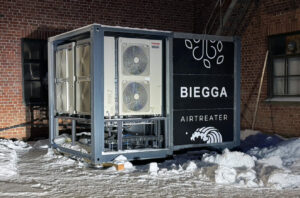
AirTreater Čáhci can replace a permanent heating and cooling system in many industrial and large-scale commercial applications. Its containerised air-to-water heat pump architecture delivers guaranteed nominal capacity at all outdoor temperatures, operates on a liquid-cycle distribution network identical to a fixed plant, and connects to site infrastructure in a single working day. The sections below address the specific performance, site, and operational questions that determine whether Čáhci is the right long-term answer for a given project.
How does Čáhci deliver heating and cooling performance year-round?
AirTreater Čáhci maintains a nominal heating capacity of 120 kW at -15 °C using compressors alone, with a maximum output of 420 kW available at the same temperature threshold. The heat pump operates down to -28 °C, and when outdoor conditions push beyond the compressor range, an integrated backup system guarantees at least 300 kW of heating capacity even without external electric power in hazardous situations. This performance is not a rated condition — it is a guarantee that holds across all outdoor temperatures, including the extremes of a Finnish winter.
The system operates as an air-to-water heat pump, transferring energy through a liquid-cycle distribution network. That architecture means heat or cooling is delivered consistently to every point on the distribution loop, regardless of the building’s layout or the number of terminal units connected. There is no performance cliff at low temperatures, no derating curve to account for in the design phase.
For sites that require additional resilience, AirTreater Čáhci can be configured with a ground-source heat pump if a borehole field is available on site. Where grid capacity permits, an electric boiler serves as an alternative integrated backup system. Both configurations ensure that nominal output is maintained even during extended cold spells when air-source efficiency would ordinarily be under pressure.
What makes a heating system count as ‘permanent’?
A permanent heating system is one that delivers continuous, guaranteed climate control for the operational life of a facility — not for a defined project window or a temporary phase. The key criteria are reliable output at all operating conditions, compatibility with the site’s heat distribution infrastructure, remote monitoring capability, and access to ongoing technical support. A system that meets all four criteria qualifies as permanent regardless of whether it is fixed in concrete or delivered in a container.
The conventional assumption is that permanence requires civil installation — plant rooms, fixed pipework penetrations, and embedded mechanical infrastructure. In practice, what operators and facility managers actually require is continuity of performance and operational certainty. A containerised system that connects to an existing hydronic distribution network and delivers guaranteed output year-round satisfies those requirements as fully as any built-in installation.
Support infrastructure matters as much as the hardware. A system that operates without 24/7 technical support is not suitable for permanent deployment in critical or continuous-process environments. AirTreater’s service centre provides 24/7/365 help desk coverage, and all Čáhci systems are managed via an automated remote management platform, which gives operators real-time visibility and full settings control through a standard web browser from any location. Named end users can also have access to the automation system.
How does Čáhci compare to a fixed installed heating system?
AirTreater Čáhci delivers equivalent heating and cooling performance to a fixed installed system on every technical measure that matters to a facility manager: guaranteed nominal capacity at all outdoor temperatures, liquid-cycle heat distribution, remote management, and 24/7 support. The primary operational difference is that Čáhci connects in a single working day and can be redeployed when site needs change — a fixed installation cannot.
Conventional fixed heat pump installations are rated at nominal conditions, which typically means performance at +7 °C outdoor temperature. Actual output at -15 °C is often substantially lower than the nameplate figure. AirTreater Čáhci’s performance guarantee applies at all outdoor temperatures — the nominal figure is the floor, not the ceiling under ideal conditions. That distinction is operationally significant in northern climates where the coldest periods coincide with peak heating demand.
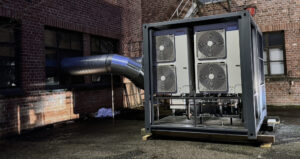
From a capital and logistics perspective, a fixed installation requires plant room space, civil works, and a lead time that typically runs to weeks or months. Čáhci arrives on site in a standard container, connects to the existing distribution network in one working day, and is fully operational — startup within 4 hours of arriving on site when no heat distribution network is required, with commissioning including electrical connection taking one working day. When the project concludes or operational requirements shift, the system relocates without leaving behind embedded infrastructure costs.
What types of sites can Čáhci serve as a permanent solution?
AirTreater Čáhci is suited to permanent deployment at large industrial facilities, production halls, warehouses, logistics centres, energy sector operations, and construction sites with extended operational windows where a fixed plant room installation is impractical, unavailable, or disproportionate to the project scope. Any site with an existing or planned liquid-cycle heat distribution network can integrate Čáhci directly.
Sites that particularly benefit from Čáhci as a long-term heating and cooling solution include:
- Industrial facilities requiring reliable process temperature control across seasonal extremes
- Large commercial and logistics buildings where plant room space is constrained or unavailable
- Temporary or semi-permanent industrial sites where infrastructure investment must remain recoverable
- Energy sector operations, including biogas and power generation facilities, where process continuity is non-negotiable
- Remote or off-grid sites where permanent civil infrastructure is not viable but operational reliability is required
- Multi-site operators who need a heating and cooling asset that can be redeployed across the portfolio
For defense and critical infrastructure applications, AirTreater holds NATO supplier registration with NCAGE code A04WG, confirming compliance with the quality and reliability standards required for mission-critical deployments. This makes Čáhci a viable permanent solution for military facilities, forward operating bases, and security-sensitive installations where supplier qualification is a procurement prerequisite.
When should Čáhci not replace a permanent system?
AirTreater Čáhci is not the right long-term solution when a site’s heating load consistently exceeds 420 kW, when the required distribution medium is steam rather than hot water, or when site-specific regulatory or planning requirements mandate a permanently installed and inspected plant room. In these cases, a fixed installation or a bespoke Prosea-type engineered solution is the appropriate path.
Sites with very high peak loads that require simultaneous heating and cooling across multiple independent zones may also find that a single Čáhci unit does not cover the full scope without supplementary equipment. This is a capacity and zoning question rather than a technology limitation — the answer in those cases is typically a multi-unit configuration or a hybrid approach combining Čáhci with existing plant.
Where a site already has a fully functional, recently installed fixed heating system with remaining service life, replacing it with a containerised solution before end of life is unlikely to be economically justified unless the site’s operational footprint is changing. Čáhci delivers its strongest value proposition when it is filling a gap — a new site, a failed or end-of-life plant, a temporary phase that has become permanent, or a project where speed of deployment is the decisive factor.
What does it take to deploy Čáhci as a long-term heating solution?
Deploying AirTreater Čáhci as a permanent heating and cooling solution requires a suitable connection point to an existing or new liquid-cycle heat distribution network, adequate electrical supply for the compressor circuit and integrated backup system, and a stable, level surface for the container. With those conditions in place, the container connects in a single working day, with startup achievable within 4 hours of arriving on site when no heat distribution network is required.
For sites without an existing heat distribution network, the distribution infrastructure must be planned and installed in advance of the unit’s arrival. This is the primary variable that affects the deployment timeline — the Čáhci unit itself is not the scheduling constraint. Once the network is ready, connection is straightforward and does not require specialist civil works beyond standard hydronic connection.
Long-term operation is managed via an automated remote management platform, which provides real-time system data and full settings control through a standard web browser. Named end users can also have access to the automation system. This means a facility manager or remote operator can monitor outlet water temperatures, adjust setpoints, and review system status without being on site. For sites that require integration with existing building management or automation systems, AirTreater Čáhci supports integration with standard industrial automation protocols.
To assess whether Čáhci is the right permanent heating and cooling solution for a specific site, contact the AirTreater technical team with your site’s heating load profile, distribution network details, and outdoor temperature range — they will confirm the appropriate configuration and deployment timeline.