Energy costs do not lie. If your facility runs conventional heating or cooling equipment, a measurable share of your operational budget disappears every month as wasted energy, underperforming plant, and reactive maintenance calls. The green transition is often framed as a cost to absorb. The more accurate question is whether you can afford to delay it.
For industrial operators, the answer is increasingly clear: modern climate control technology does not just reduce emissions. It reduces operating expenditure, eliminates unplanned downtime, and converts energy spend into productive output. The financial case is built on engineering, not ideology.
Where Energy Waste Silently Drains Operational Budgets
Most facilities do not experience energy waste as a single visible problem. It accumulates quietly, across every hour of operation, in systems that were never designed for the conditions they actually face.
Conventional heating and cooling equipment is typically rated at optimal conditions. When outdoor temperatures drop to -15 °C, performance drops with them. The system still draws full electrical power. It no longer delivers full output. That gap between energy consumed and useful heat or cooling produced is pure operational loss.
The compounding effect is significant:
- Underperforming equipment runs longer to reach setpoint, increasing energy consumption per unit of useful output
- Reactive maintenance replaces predictable costs with unpredictable ones, typically at the worst possible time
- Fossil fuel heating carries both direct energy costs and increasing regulatory exposure as EU buildings policy accelerates the phase-out of fossil fuel incentives
- Fixed installations lock capital into infrastructure that cannot move when operational needs change
These are not theoretical risks. They are the daily operating reality for facilities running equipment that was not built for industrial-grade demands or northern climate conditions.
How Modern Climate Technology Converts Efficiency into Savings
A heat pump does not generate heat by burning fuel. It moves heat from one place to another, using electrical energy to drive that transfer. For every unit of electricity consumed, a well-specified heat pump delivers multiple units of useful thermal energy. That ratio, the coefficient of performance, is what makes heat pump technology fundamentally more efficient than resistance heating or combustion-based systems.
The critical variable is cold-weather performance. Standard heat pumps derate as temperatures fall. Industrial-grade systems, designed specifically for northern operating conditions, maintain nominal capacity regardless of outdoor temperature. That distinction determines whether the efficiency gains you calculate at procurement actually materialise in operation.
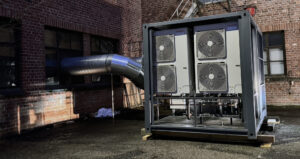
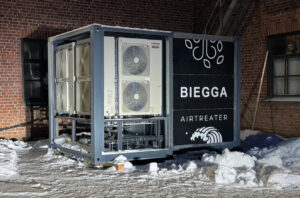
AirTreater Čáhci, for example, maintains 120 kW of nominal heating capacity at -15 °C using compressors alone, with an integrated backup system guaranteeing 300 kW of heating output at that same threshold. This is not a rated condition. It is a guaranteed operational minimum.
The financial translation is direct:
- Higher coefficient of performance means fewer kilowatt-hours purchased per unit of useful heat delivered
- Guaranteed nominal capacity means no gap between specified and actual output during peak demand periods
- Reduced compressor dependency during cold periods, when free-cooling functions operate without mechanical refrigeration, eliminates both energy draw and mechanical wear simultaneously
- Predictive remote monitoring converts maintenance from a reactive cost centre into a planned, controllable expenditure
Sustainable HVAC is not a compromise between performance and efficiency. Correctly specified, it delivers both.
The Financial Case for Switching Sooner Rather Than Later
The regulatory environment has already shifted. The EU’s revised F-Gas Regulation 2024/573 accelerates the phase-down of high-GWP refrigerants, with service restrictions on air conditioning and heat pump equipment extending from 2026. Facilities operating older systems face rising maintenance costs as compliant refrigerants become more constrained and expensive.
Delay compounds that exposure. Each year of continued operation on legacy equipment is a year of above-market energy costs, a year of increasing regulatory risk, and a year of deferred capital that will eventually be forced rather than planned.
The counterargument to early switching, that capital investment is a cost, is correct but incomplete. The relevant comparison is total cost of operation over the asset lifecycle, not upfront purchase price. Industrial-grade heat pump systems with guaranteed cold-weather performance, remote management capability, and containerised mobility eliminate several cost categories that fixed, conventional systems carry as permanent line items.
For facilities where the heating or cooling load is continuous and interruption is operationally unacceptable, the long-term savings case is strongest precisely because the baseline cost of failure is highest.
What Sets Industrial-Grade Systems Apart from Standard Solutions
The HVAC market contains a wide range of heat pump products. Most are designed for residential or light commercial applications, rated at standard conditions, and specified with the assumption that outdoor temperatures will remain within a moderate range. For industrial operators in northern climates, that assumption fails regularly.
Industrial-grade climate control systems are differentiated by what they guarantee under actual operating conditions, not what they achieve under optimal ones.
AirTreater systems are built around that distinction. Key operational differentiators include:
- Guaranteed nominal capacity at all outdoor temperatures, including extreme sub-zero conditions, with integrated backup systems that activate automatically when required
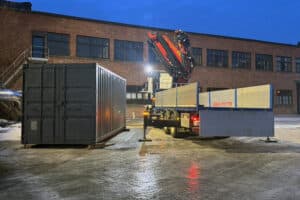
- Containerised deployment that connects on site in a single working day and reaches full operation within two, without permanent civil works or fixed infrastructure commitment
- Ouman remote management platform, providing real-time operational data and full settings control through a standard web browser, from any location, at any time
- 24/7/365 help-desk support through AirTreater’s service centre, ensuring that operational issues are addressed regardless of when they occur
- Integration with existing automation systems, allowing AirTreater equipment to operate within established facility management infrastructure rather than alongside it
For applications where process continuity is non-negotiable, the AirTreater Prosea line extends this capability into custom-engineered process cooling and heating, designed specifically for industrial process requirements where standard configurations do not apply.
The Finnish heat pump market, where SULPU data records nearly two million installed units providing close to 30% of all building heating nationally, demonstrates that heat pump technology at scale is proven in genuine northern conditions. Industrial-grade systems take that proven technology and apply it at the performance levels and reliability standards that industrial operations require.
Start Cutting Costs with Climate Control Built for Industry
The green transition does not require a values argument. It requires an engineering argument, and that argument is straightforward: modern industrial climate control technology delivers more useful energy per unit of electricity consumed, operates reliably at the temperatures your facility actually experiences, and eliminates the maintenance and regulatory cost exposure that legacy systems carry.
The question is not whether switching makes financial sense. For most industrial operators running conventional heating or cooling equipment, it does. The question is how quickly those savings begin to offset the investment, and that depends on how well the specified system matches the actual operating environment.
AirTreater systems are designed for that match. Guaranteed nominal capacity. Containerised deployment. Remote management. Continuous support. If your facility has a heating or cooling requirement that conventional equipment is not meeting reliably or efficiently, the right starting point is a direct technical conversation.
Contact the AirTreater team to discuss your site’s specific requirements, operating conditions, and the system configuration that delivers guaranteed performance from day one.