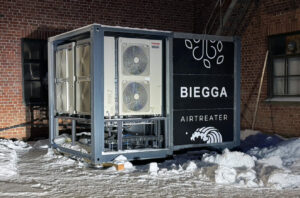
Defense and critical infrastructure sites require climate control solutions that guarantee performance at all outdoor temperatures, deploy without permanent civil works, and operate continuously without interruption. Conventional HVAC equipment is not designed to these standards. The questions below address the specific technical and operational requirements that matter most when specifying climate control for demanding environments.
What makes climate control critical for defense and infrastructure sites?
Climate control is critical for defense and infrastructure sites because temperature failure is not an inconvenience — it is an operational event with measurable consequences. Electronic command systems overheat. Fuel storage becomes unstable. Personnel in extreme cold lose operational effectiveness. Process equipment at power generation and communications facilities fails outside narrow thermal bands. In these environments, HVAC is not a comfort system; it is a mission-critical utility.
The distinction between standard commercial climate control and systems designed for critical applications comes down to the guarantee. Conventional equipment is rated at nominal conditions — typically around +7 °C outdoors for heating and +35 °C for cooling — and derates significantly outside those conditions. At a defense installation in northern Europe operating at -20 °C, a system rated at 100 kW may deliver 40 to 60 kW in practice. That gap is operationally unacceptable.
Critical infrastructure sites also demand continuous operation. A biogas plant, a telecommunications hub, or a military forward operating base cannot tolerate a scheduled maintenance window that coincides with a cold snap. The system must deliver at least nominal heating or cooling capacity at every outdoor temperature, every hour of the year — not as a design aspiration, but as a contractual guarantee.
What are the biggest climate control challenges in military and field environments?
The biggest climate control challenges in military and field environments are extreme temperature ranges, rapid deployment requirements, the absence of permanent infrastructure, and the need for remote operation without on-site technical staff. Each of these constraints eliminates most conventional HVAC options from consideration before specifications are even reviewed.
Extreme Temperature Performance
Military operations in northern latitudes routinely expose equipment to outdoor temperatures below -20 °C. Most commercial heat pumps reach a performance cliff between -15 °C and -20 °C, where compressor efficiency drops sharply and heating output becomes unreliable. Systems intended for field deployment must maintain guaranteed nominal capacity across the full operational temperature range — including the worst-case conditions that are, by definition, the conditions under which the system is most needed.
Deployment Without Fixed Infrastructure
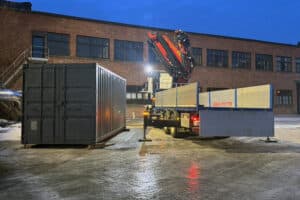
Field environments rarely have permanent plant rooms, established heat distribution networks, or long-term grid connections. Climate control equipment must arrive pre-configured, connect to available utilities in a single working day, and reach full operational status within 4 hours of arrival on site. When the mission or project moves, the system must relocate with it — without requiring specialist civil works or leaving behind permanent infrastructure.
Unmanned Operation and Remote Visibility
Many forward sites operate with minimal on-site technical personnel. Climate control systems must function autonomously, with remote monitoring and settings control available to operators at a central location. Any failure mode that requires a technician to be physically present creates an unacceptable operational dependency in field conditions.
How does an air-to-water heat pump perform in extreme cold?
An air-to-water heat pump extracts thermal energy from outdoor air and transfers it to a liquid circuit — typically water or glycol — for distribution through a heating network. In extreme cold, performance depends entirely on whether the system is designed and guaranteed for sub-zero operation, or merely rated at standard conditions. The two are not equivalent.
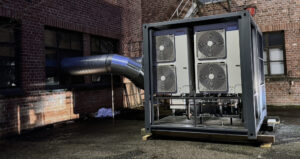
AirTreater Čáhci, for example, maintains 120 kW of nominal heating capacity at -15 °C using compressors alone — no auxiliary heat strips, no performance reduction. Maximum output reaches 420 kW at the same outdoor temperature. The heat pump operates down to -28 °C, and when conditions drop below -28 °C, an integrated backup system activates to guarantee at least 300 kW of heating capacity even without external electric power in hazardous situations. This is a guarantee, not a rated condition: the system delivers at least nominal capacity at every outdoor temperature within its operational envelope.
Conventional air-to-water heat pumps are typically rated at +7 °C outdoor temperature. At -15 °C, many deliver 50 to 70 percent of their rated output, and some units shut down entirely below -20 °C. For defense and critical infrastructure applications, this performance cliff is not a specification footnote — it is the reason the system fails when it is most needed. The engineering requirement is not a heat pump that works in cold weather; it is a heat pump that guarantees nominal output in cold weather.
What is free cooling and when does it apply to process cooling?
Free cooling is the rejection of heat from a process or building to the outdoor environment without engaging mechanical refrigeration compressors. When outdoor air temperature is sufficiently low relative to the required coolant temperature, the ambient temperature differential alone provides the driving force for heat transfer. This eliminates compressor energy consumption and removes the primary mechanical failure point of conventional chiller systems.
Free cooling applies to process cooling when outdoor temperatures fall below the threshold at which the ambient air can absorb heat from the process circuit without mechanical assistance. AirTreater Prosea is designed per project and site, and delivers its full cooling capacity energy-efficiently without engaging compressors when outdoor conditions are sufficiently cold. Under those conditions, Prosea operates purely on the temperature differential between the process coolant and the outdoor air, drawing a fraction of the energy a conventional chiller requires.
When outdoor temperatures rise above the free-cooling threshold, the compressor circuit engages to maintain the required coolant temperature. The transition between free-cooling and compressor-assisted operation is automatic and continuous — the system maintains setpoint regardless of which mode is active. For process cooling applications in northern climates, this means that for a substantial portion of the operating year, full cooling capacity is available at minimal energy cost and with no compressor wear accumulation.
Process cooling applications where free cooling delivers the greatest operational benefit include data centres, biogas digesters, power electronics cooling, and any continuous industrial process where coolant temperature must be maintained within a defined band regardless of season. In these applications, extended free-cooling operation reduces both energy expenditure and the mechanical maintenance burden that compressor-dependent systems accumulate over time.
How does remote monitoring work for industrial climate control systems?
Remote monitoring for industrial climate control systems works by connecting the system’s control unit to a cloud-based management platform, which provides operators with real-time operational data and full settings control through a standard web browser — from any location, at any time. No specialist software or on-site presence is required to monitor performance or adjust setpoints.
AirTreater systems are managed via an automated remote management platform. The dashboard gives operators a real-time view of system status, including outlet water temperatures, compressor operating state, energy consumption, and any active fault conditions. Settings — including temperature setpoints, operating schedules, and alarm thresholds — can be adjusted directly through the browser interface without dispatching a technician to site. Named end users can also have access to the automation system.
For defense and critical infrastructure applications, remote management capability is not a convenience feature — it is an operational requirement. Sites that operate with minimal on-site personnel, or that are located in remote or access-restricted areas, depend on remote visibility to detect developing faults before they become failures. The automation platform supports this by providing configurable alarm notifications, so operators are alerted to out-of-specification conditions in real time rather than discovering a failure after the fact.
AirTreater’s 24/7/365 help-desk service operates through the same service infrastructure, meaning that when an alarm triggers outside business hours, technical support is available immediately. For continuous-process applications where a cooling or heating interruption carries direct operational cost, this support availability is a specification requirement, not an optional service tier.
What should you look for in a portable climate control solution for critical sites?
A portable climate control solution for critical sites must meet five non-negotiable criteria: guaranteed nominal capacity at all outdoor temperatures, containerised deployment with a connection time of one working day or less, self-contained operation without permanent infrastructure dependencies, remote management capability, and verifiable compliance with the procurement standards of the sector it serves.
Guaranteed performance is the primary filter. A system that delivers its rated capacity only at optimal conditions is not a portable climate control solution for critical sites — it is a liability. Verify that the manufacturer states a performance guarantee at all outdoor temperatures, not a rated capacity at standard conditions. The distinction is the difference between a specification and a promise.
Deployment speed and logistics determine whether a containerised solution is genuinely deployable in practice. The container must connect to available utilities in a single working day. Without heat distribution network requirements, the system should be fully operational within 4 hours of arrival. Anything longer than this introduces project risk in time-sensitive applications.
For defense and security sector procurement, supplier registration status is a prerequisite. AirTreater holds NATO supplier registration with NCAGE code A04WG, confirming compliance with the quality and reliability standards required for deployment in defense and critical infrastructure environments. Procurement teams evaluating climate control for military or government-contracted sites should verify this credential before advancing any supplier to technical evaluation.
- Guaranteed nominal capacity at all outdoor temperatures — not rated at standard conditions
- Container connection in one working day — full operation within 4 hours of site arrival
- Self-contained, relocatable format — no permanent civil works or infrastructure commitment
- Remote management via a verified automated remote management platform — real-time visibility and settings control from any location
- 24/7/365 technical support availability — not business-hours-only service
- Verified procurement compliance — NATO NCAGE registration or equivalent sector-specific certification where required
Contact AirTreater’s technical team to request specification documentation for procurement review, including NATO supplier registration details and full product data sheets for AirTreater Čáhci and AirTreater Prosea.