Most climate systems are rated under ideal conditions. When temperatures drop below -15 °C, performance drops with them — and that gap between specified capacity and actual output becomes an operational problem your site cannot afford.
AirTreater builds industrial climate systems that deliver guaranteed nominal heating and cooling capacity at every outdoor temperature. Not rated under optimal conditions. Guaranteed under all conditions.
Full Capacity at Every Temperature, Guaranteed
Conventional heat pumps derate in cold weather. The further the temperature falls, the wider the gap between what the specification sheet says and what the system actually delivers on site.
AirTreater systems are engineered differently. Every unit guarantees at least nominal capacity regardless of outdoor temperature — because in northern climates, there is no acceptable alternative.
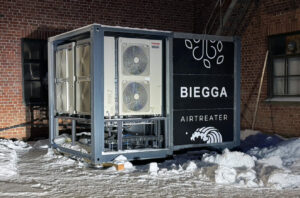
- AirTreater Biegga guarantees a minimum of 81 kW at all outdoor temperatures, with a maximum heating capacity of 165 kW combining 84 kW heat pump output and 81 kW electric backup heating
- AirTreater Čáhci maintains 120 kW nominal heating capacity at -15 °C using compressors alone, with a maximum capacity of 420 kW; the heat pump operates down to -28 °C, and below -28 °C the integrated backup system guarantees at least 300 kW even without external electric power in hazardous situations
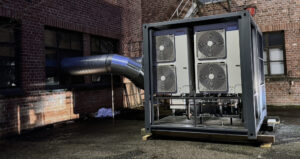
- Both systems arrive as containerised solutions, ready to connect in a single working day
This is not a performance claim. It is a guarantee backed by engineering, not marketing language.
When Standard Climate Solutions Fall Short
Standard HVAC equipment is specified for controlled environments. Industrial sites, construction projects, and remote operations are not controlled environments.
If your site operates through Finnish winters, runs continuous processes that cannot tolerate interruption, or requires climate control in a location where permanent infrastructure is unavailable, standard market solutions create real operational risk.
- Capacity derating at sub-zero temperatures leaves heating and cooling deficits precisely when demand is highest
- Fixed installation requirements create long lead times, civil works dependencies, and permanent infrastructure commitments that do not suit temporary or relocatable operations
- Lack of remote visibility means problems on unmanned or remote sites go undetected until they become failures
- Supplier support that ends at 5 pm is incompatible with 24/7 industrial operations
AirTreater’s containerised heat pump systems were designed to eliminate each of these failure points — not to work around them.
A Complete System for Heating, Cooling, and Air Quality
AirTreater delivers full industrial climate control from a single containerised platform. There is no need to source separate systems for heating, cooling, and air quality management.
AirTreater Biegga is an air-to-air heat pump designed for large open spaces and industrial halls. One unit covers up to approximately 1,000 m², delivering both heating and cooling in a single system. It eliminates fossil fuel dependency entirely and reduces energy consumption compared to conventional resistance heating.
AirTreater Čáhci is an air-to-water heat pump for sites requiring liquid-cycle energy distribution. It integrates with existing hydronic systems and can be configured with a ground source heat pump where a borehole field is available.
AirTreater Prosea addresses process cooling and heating requirements in industrial applications where standard configurations are insufficient. Prosea systems are designed to the specific parameters of each site.
- Heating, cooling, humidity control, and air filtration from one platform
- No fossil fuels — near-zero emissions operation across all product lines
- The container connects on site in one working day; fully operational within 4 hours of arriving on site where no heat distribution network is required
- Relocatable as project requirements change — no permanent infrastructure commitment
Remote Control and 24/7 Support Built In
Every AirTreater system integrates with an automated remote management platform. Operational data is available in real time through a standard web browser — from any location, at any time. Named end users can also have access to the automation system.
Setting adjustments, fault analysis, and parameter changes can be made remotely without requiring a site visit. For unmanned sites or remote operations, this capability is not a convenience — it is an operational requirement.
- Real-time system visibility via the automated remote management platform, accessible from any browser
- Full settings control remotely over a GSM connection or fieldbus integration
- 24/7/365 help-desk support through AirTreater’s service centre — alarms route directly to the team, who act to resolve issues without waiting for a call
- Integration with existing building automation systems where required
When a fault occurs at 2 am on a Sunday, the service centre is already monitoring. Response is immediate, not next-business-day.
Get Your Site Climate-Ready — Contact AirTreater
Every site has specific requirements. AirTreater’s team works through the technical parameters of your application — space dimensions, temperature requirements, deployment timeline, and existing infrastructure — to identify the right containerised solution.
There are no standard packages imposed on non-standard problems. Prosea systems are configured entirely to site specifications. Biegga and Čáhci deployments are sized and scoped based on actual operating conditions, not catalogue assumptions.
- Guaranteed nominal capacity at all outdoor temperatures — specified in writing, not implied in marketing
- Container connection in one working day; fully operational within 4 hours of arriving on site where no heat distribution network is required
- 24/7/365 remote monitoring and support included
- Designed and tested for northern European operating conditions
Contact AirTreater’s technical team to discuss your site requirements and request a specification review. Bring your operating parameters — temperature range, space dimensions, deployment timeline — and the conversation will be direct and specific.