Green transition planning looks straightforward on paper. In practice, most industrial operators discover that the gap between committed targets and measurable results is where transition programs quietly fail.
The problem is rarely ambition. It is performance certainty. When the systems underpinning your transition cannot guarantee output under real operating conditions, every efficiency projection becomes an estimate, and every estimate carries risk.
Where most green transition plans fall short
Conventional heating and cooling equipment is rated under optimal laboratory conditions. When outdoor temperatures drop significantly or below, nominal capacity figures become aspirational, not operational.
For industrial sites running continuous processes, that gap has direct consequences:
- Heating shortfalls that force supplementary fossil fuel backup into the energy mix
- Cooling interruptions that halt production or compromise process integrity
- Energy consumption figures that exceed transition plan projections, undermining decarbonization targets
- Audit periods that expose the distance between committed performance and delivered performance
Green transition planning built on unverified performance assumptions does not fail at the strategy stage. It fails at the first cold winter, when the equipment that was supposed to deliver sustainable heating and cooling delivers something less.
How guaranteed output changes the transition equation
Every AirTreater system delivers at least its nominal heating or cooling capacity at all outdoor temperatures. This is not a rated condition. It is a guarantee.
That distinction matters for transition planning because it changes what you can commit to. When nominal capacity is guaranteed, energy efficiency projections are grounded in verifiable output, not optimistic assumptions.
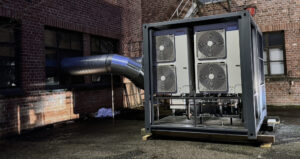
AirTreater Čáhci, the air-to-water heat pump designed for liquid-cycle energy distribution in large industrial and commercial spaces, maintains 120 kW of nominal heating capacity at -15 °C using compressors alone. Maximum output reaches 420 kW at temperatures down to -15 °C. The heat pump operates down to -28 °C, and below -28 °C an integrated backup system guarantees at least 300 kW of heating capacity even without external electric power in hazardous situations.
These are not best-case figures. They are the numbers your transition plan can be built on.
Industrial-grade solutions for heating, cooling, filtration, and process applications
Sustainable heating, cooling, filtration, and process cooling at industrial scale requires more than energy-efficient equipment. It requires systems engineered for the specific demands of continuous, critical, and process-dependent operations.
AirTreater Prosea is a containerised process cooling solution with a free-cooling function that delivers cooling energy-efficiently without engaging compressors when outdoor temperatures are sufficiently low. For facilities running continuous processes, this eliminates the primary mechanical failure point of conventional chiller systems while significantly reducing energy consumption during extended cold-weather operation. Prosea systems are designed per project and site, ensuring each installation is specified to match the exact load profile and conditions of the facility it serves.
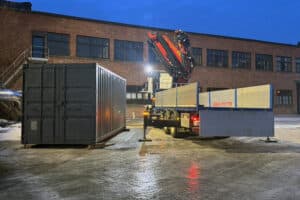
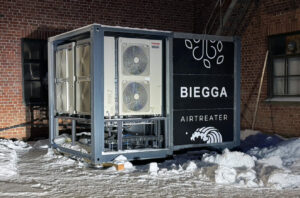
Both systems are delivered in standard containers, pre-configured and ready to connect. The container connects on site in a single working day. Without heat distribution requirements, the system is fully operational within 4 hours of arrival.
For industrial climate control applications, that deployment timeline means:
- No permanent civil works or plant room infrastructure required
- Full asset redeployment when operational requirements change
- Measurable energy efficiency gains from day one of operation
- A transition pathway that does not depend on long procurement and construction lead times
Remote monitoring that keeps transition targets on track
Transition targets require ongoing verification, not just initial commissioning. AirTreater systems are managed via an automated remote management platform, which provides real-time operational data and full settings control through a standard web browser, accessible from any location at any time. Named end users can also have access to the automation system.
For energy managers and facility operators, that means continuous visibility into system performance against plan, without requiring on-site presence. Deviations from the setpoint are visible immediately. Adjustments are made remotely, before they become compliance issues.
A 24/7/365 help-desk service is available through AirTreater’s service centre. For operations where a heating or cooling interruption carries measurable production or process consequences, that support availability is not a convenience. It is a prerequisite.
Start your transition with a clear performance baseline
Measurable results in green transition planning begin with equipment that delivers measurable output. Not estimated output. Not output under optimal conditions. Guaranteed nominal capacity at every outdoor temperature your site will encounter.
For procurement and engineering teams evaluating sustainable heating and cooling infrastructure for industrial sites, the starting point is a clear technical specification matched to your site’s temperature range, load profile, and deployment requirements.
Contact the AirTreater technical team to discuss your site requirements and receive a specification aligned to your transition targets. Bring your outdoor temperature data, your load requirements, and your timeline. The conversation will be grounded in specifications, not in sales material.