Operational readiness in industrial facilities depends directly on the quality and consistency of condition management solutions. When heating, cooling, and air quality systems deliver guaranteed performance at all outdoor temperatures, production continues without interruption. The sections below address the most important questions facility managers and procurement engineers ask when evaluating condition management infrastructure.
What does condition management actually cover in industrial facilities?
Condition management in industrial facilities covers the full range of environmental control systems that maintain stable, safe, and process-appropriate conditions inside a building or production space. This includes heating, cooling, humidity control, air filtration, and the monitoring infrastructure that keeps all of these functions operating within defined parameters at all times.
In practice, condition management extends well beyond basic comfort heating. For a manufacturing hall, it means maintaining precise temperature ranges that protect equipment, materials, and personnel simultaneously. For a biogas plant or power generation facility, it means continuous process cooling that cannot tolerate interruption, regardless of outdoor temperature. For a construction site or temporary industrial operation, it means deploying capable thermal management infrastructure quickly, without permanent civil works.
The scope also includes the control layer: automation systems, remote monitoring platforms, and alert management that give operators real-time visibility into what the environment is doing and what the equipment is delivering. A condition management solution that cannot be monitored or adjusted remotely is operationally incomplete, particularly for facilities running continuous processes or operating with limited on-site personnel.
How does condition management directly affect operational readiness?
Condition management affects operational readiness by determining whether the physical environment inside a facility supports or constrains production. When temperature, humidity, and air quality remain within specified ranges, equipment operates within design parameters, personnel work safely, and processes run without environmental interference. When condition management fails, operational readiness degrades immediately and measurably.
The relationship is direct because most industrial processes have environmental tolerances that are non-negotiable. Sensitive electronics, chemical processes, food production, and precision manufacturing all have temperature and humidity windows outside of which quality, safety, or output are compromised. A heating or cooling interruption does not simply cause discomfort – it triggers process holds, equipment shutdowns, or product loss.
The critical variable is performance consistency. A condition management system that delivers its rated output at optimal conditions but degrades significantly even at very low temperatures provides unreliable operational coverage during the months when it is needed most. Systems that guarantee nominal heating or cooling capacity at all outdoor temperatures eliminate this gap between specified and actual performance – which is the gap where operational readiness is most at risk.
What are the biggest risks of inadequate condition management?
The biggest risks of inadequate condition management are unplanned process downtime, equipment damage from thermal stress, personnel safety incidents, and regulatory non-compliance. In facilities where production is continuous, even a short interruption in heating or cooling can trigger restart costs, quality failures, and contractual penalties that far exceed the cost of the condition management infrastructure itself.
Thermal stress on equipment is a frequently underestimated risk. Industrial machinery, control electronics, and hydraulic systems all have operating temperature envelopes. Sustained operation outside those envelopes accelerates wear, increases failure rates, and shortens asset lifespan. In cold climates, inadequate heating can cause hydraulic fluid to thicken, pipe joints to contract and leak, and electronic components to fail at startup.
Air quality failures introduce a separate risk category. Inadequate filtration in production environments allows particulates, moisture, and contaminants to accumulate on sensitive components or enter process streams. In food production, pharmaceutical manufacturing, or precision engineering, this translates directly into product rejection and regulatory exposure.
The final risk is strategic: facilities that depend on condition management systems that cannot scale, relocate, or be monitored remotely are operationally inflexible. When a process changes, a production area expands, or a site is temporarily decommissioned, a fixed system that cannot adapt creates both a cost burden and a readiness gap.
What’s the difference between fixed and mobile condition management systems?
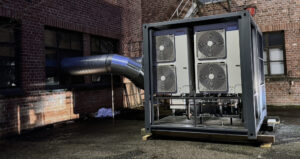
Fixed condition management systems are permanently installed as part of a building’s infrastructure, requiring civil works, dedicated plant rooms, and permanent connections to electrical and distribution networks. Mobile, containerised condition management systems are pre-configured units that connect on site within a single working day and are fully operational within 4 hours of arriving on site (when no heat distribution network is required), without permanent infrastructure commitments.
Fixed Systems: Strengths and Limitations
Fixed installations are well-suited to established facilities with stable, long-term heating and cooling requirements. They can be optimised for the specific building envelope, integrated deeply into existing building management systems, and sized precisely for a permanent load profile. Their limitation is inflexibility: when operational requirements change, relocating or reconfiguring a fixed system involves significant cost, lead time, and civil disruption.
Containerised Systems: Deployment Speed and Operational Flexibility
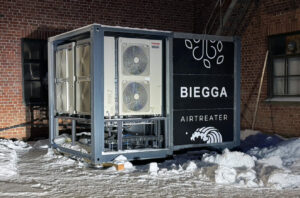
Containerised condition management systems address the scenarios where fixed infrastructure is impractical, unavailable, or insufficient. A containerised air-to-air heat pump like AirTreater Biegga delivers up to 165 kW of nominal heating capacity and at least 81 kW at all outdoor temperatures, and connects to site in a single working day. When the project ends or requirements change, the system moves with the operation rather than becoming a stranded asset.
The distinction matters most in three scenarios: construction projects where permanent infrastructure does not yet exist, temporary industrial operations where site tenure is defined and limited, and situations where an existing fixed system has failed or is undergoing maintenance and a guaranteed backup is required. In each case, the containerised system’s deployment speed and relocatability are not conveniences – they are the operational requirement.
How does remote monitoring support continuous operational readiness?
Remote monitoring supports continuous operational readiness by giving operators real-time visibility into system performance and the ability to adjust settings without requiring physical presence on site. When condition management systems are monitored continuously, deviations from setpoint are detected and addressed before they escalate into process interruptions or equipment failures.
The operational value is clearest on unmanned or remotely staffed sites. A facility running a continuous process overnight, over a weekend, or across a holiday period cannot rely on on-site observation to catch a heating or cooling anomaly. Automated remote management platforms that route alerts to a staffed service centre close this gap: when a parameter moves outside its acceptable range, a qualified operator receives the alert and can diagnose or adjust the system immediately.
AirTreater systems are managed via an automated remote management platform, which provides real-time operational data and full settings control through a standard web browser, accessible from any location with a GSM connection or network bus. Named end users can also have access to the automation system. The 24/7/365 help-desk service means that fault analysis and corrective adjustments are available at any hour – not only during business hours. For facilities where condition management is operationally critical, this level of remote oversight is not an optional add-on. It is a baseline requirement.
When should a facility consider upgrading its condition management solution?
A facility should consider upgrading its condition management solution when the existing system can no longer guarantee nominal performance at actual operating conditions, when energy consumption has increased without a corresponding increase in output, when the system lacks remote monitoring capability, or when operational requirements have changed beyond the scope of what the installed infrastructure was designed to handle.
Performance degradation in cold weather is one of the clearest indicators. Conventional heat pumps are typically rated at nominal conditions – meaning their specified output applies at a defined outdoor temperature, often +7 °C or higher. When outdoor temperatures fall very low, many systems derate significantly, delivering a fraction of their rated capacity at precisely the time when full output is required. If a facility’s heating system struggles during winter peaks, the solution is a system that guarantees nominal capacity at all outdoor temperatures, not one that is rated at conditions that rarely occur during peak demand.
Operational expansion is a second trigger. When a production area grows, a new process is introduced, or a facility takes on a higher-value product line with tighter environmental tolerances, the existing condition management infrastructure may no longer match the load or the required precision. Upgrading before the gap becomes a production problem is the operationally sound approach.
Finally, facilities that still operate without remote monitoring should treat that absence as an upgrade priority. The inability to observe system status, receive fault alerts, or adjust settings remotely represents a structural gap in operational readiness – one that becomes critical the first time a condition management fault occurs outside staffed hours.