Your organisation has committed to a green transition strategy. Leadership has signed off. The targets are written down. But six months in, the question no one can answer clearly is: how do you actually know if it is working?
Measuring sustainability progress is harder than setting sustainability goals. The gap between a stated commitment and a verifiable outcome is where most green transition strategies quietly fail.
The Metrics That Actually Reveal Transition Progress
Not all sustainability metrics are equally useful. Many organisations track what is easy to count rather than what actually reflects progress toward decarbonisation.
The metrics that genuinely reveal green transition progress share one characteristic: they connect energy or emissions outcomes directly to operational decisions. That means moving beyond carbon offset purchases and renewable energy certificates toward measures that reflect what your systems are actually doing.
The most informative energy transition metrics include:
- Actual energy consumption per unit of output, tracked continuously rather than annually
- The proportion of total energy demand met by non-fossil sources, measured at the point of use
- Hours of compressor-free or combustion-free operation in heating and cooling systems
- Reduction in peak demand load, which reflects both efficiency and grid resilience
- Verified emissions reduction against a fixed baseline, not against a projected business-as-usual scenario
The distinction matters because a metric like “renewable energy purchased” can look strong while actual site emissions remain unchanged. Operational metrics close that gap.
Why Baseline Data Determines Measurement Accuracy
A green transition KPI is only as credible as the baseline it measures against. Without a fixed, verified starting point, any improvement figure is an estimate at best and a convenient fiction at worst.
Establishing an accurate baseline requires metered, time-stamped consumption data from before the transition begins. Estimated or averaged historical figures introduce error that compounds over time, making it impossible to attribute genuine progress to specific interventions.
For industrial heating and cooling specifically, baseline accuracy depends on capturing performance across seasonal variation. A system that appears efficient in mild autumn conditions may consume significantly more energy during a sustained cold period. Finnish heat pump market data consistently shows that real-world seasonal performance diverges from laboratory ratings when outdoor temperatures drop below -10 °C, which is why continuous metering rather than spot-checking is the standard for credible sustainability measurement.
Set your baseline before you change anything. Meter at the system level, not the building level. Record outdoor temperature alongside consumption data so performance can be normalised across seasons.
Operational Benchmarks vs. Strategic Milestones
Green transition measurement operates at two distinct levels, and conflating them produces misleading reports.
Operational benchmarks are short-cycle, system-level indicators that tell you whether your equipment is performing as specified right now. They include daily or weekly energy consumption figures, coefficient of performance readings, and the ratio of free-cooling hours to compressor-on hours in climate control systems.
Strategic milestones are longer-horizon markers that confirm the transition is on track toward declared targets. They include annual verified emissions reductions, the percentage of fossil fuel systems replaced by electrified alternatives, and alignment with EU Energy Efficiency Directive requirements.
Both levels are necessary. Operational benchmarks catch problems early, before they compound into missed strategic milestones. Strategic milestones provide the accountability structure that operational benchmarks serve.
A practical approach is to review operational benchmarks monthly and strategic milestones quarterly. If operational data shows consistent deviation from the expected performance curve, investigate at the system level before the quarterly review, not after.
How Technology Choices Shape Measurability
The equipment you deploy determines how precisely you can measure your green transition progress. This is a selection criterion that most procurement processes underweight.
Systems with integrated remote monitoring provide continuous, structured data streams that feed directly into sustainability reporting. Systems without it require manual logging, which introduces gaps, errors, and reporting lag. The difference is not marginal when you are trying to demonstrate verified progress to auditors, regulators, or financing partners.
For industrial heating and cooling, the measurability gap between conventional and modern systems is particularly significant. Conventional fossil-fuel-based systems typically offer limited telemetry. Modern heat pump systems with remote management platforms deliver real-time data on energy input, thermal output, and coefficient of performance, exactly the figures needed to populate a credible sustainability measurement framework.
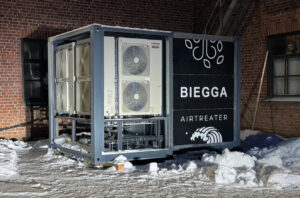
AirTreater systems are managed via Ouman’s remote management platform, which provides continuous operational data accessible through a standard web browser. Every kilowatt-hour consumed and every kilowatt of heat or cooling delivered is logged, timestamped, and available for export into sustainability reporting systems. That data trail is the foundation of verifiable green transition measurement, not an add-on, but a built-in capability.
The revised EU F-Gas Regulation (EU 2024/573) adds a further dimension: the refrigerants your systems use are themselves a measurable emissions variable. Equipment operating on high global warming potential refrigerants carries a regulatory and reporting liability that low-GWP alternatives eliminate. Technology choices made today determine whether your sustainability measurement framework will be complicated or straightforward by 2027 and beyond.
Start Measuring Your Green Transition Today
Waiting for the perfect measurement framework before beginning is the most common reason organisations fall behind their own transition timelines. The measurement infrastructure and the transition itself should develop in parallel.
The practical starting point is not a software platform or a reporting standard. It is a decision about which systems to meter first, and what baseline data to capture before any changes are made.
For industrial sites where heating and cooling represent a significant share of total energy consumption, that means auditing your current climate control systems against three questions:
- Do you have continuous, metered consumption data at the system level, or only at the building or site level?
- Does your current equipment provide performance data in real time, or only when a technician is on site?
- Can you verify actual thermal output against energy input, or only estimate it from nameplate ratings?
If the answer to any of these is no, the measurement gap is a more immediate problem than the emissions gap. You cannot manage what you cannot measure.
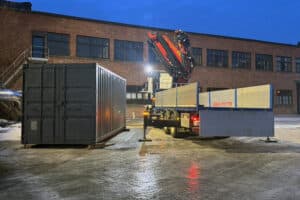
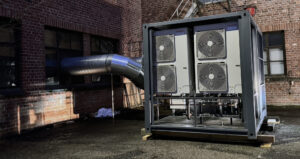
AirTreater containerised heating and cooling systems are designed to make this straightforward. Nominal heating and cooling capacity is guaranteed at all outdoor temperatures, not rated at optimal conditions and derated in practice. The Ouman remote management platform delivers continuous operational data from the moment the system connects on site, which can be within a single working day of arrival. That means your green transition measurement starts immediately, with verified data, not estimates.
If your organisation is evaluating heating or cooling infrastructure as part of a broader green transition strategy, speak with the AirTreater team about how our systems integrate with sustainability reporting requirements. Contact us to discuss your site requirements and receive technical documentation for your evaluation.