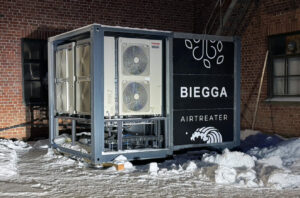
Air treatment technology works in critical infrastructure by delivering guaranteed heating, cooling, or process temperature control under the exact outdoor conditions the facility actually experiences, not under laboratory-optimised assumptions. For critical applications, the operative word is guaranteed: systems must maintain nominal capacity at all outdoor temperatures, because a process interruption carries consequences that conventional HVAC equipment is not designed to absorb. The sections below address the most common technical questions about how these systems function, what they can withstand, and why their design characteristics matter in demanding environments.
What types of facilities count as critical infrastructure for air treatment?
Critical infrastructure, in the context of industrial air treatment technology, refers to any facility where a loss of heating or cooling directly interrupts an essential process, threatens equipment integrity, or creates a safety hazard. This includes biogas and energy production plants, data centres, defense installations, pharmaceutical manufacturing, power generation facilities, and continuous-process industrial operations where there is no acceptable downtime window.
The defining characteristic is consequence. In a standard commercial building, a heating failure is an inconvenience. In a biogas plant, it can halt anaerobic digestion and cause irreversible process damage. In a defense installation, it can compromise the operability of mission-critical equipment. In a pharmaceutical production environment, it can render an entire batch non-compliant. Air treatment technology selected for these environments must be specified accordingly, with guaranteed performance thresholds rather than rated-at-optimal-conditions figures.
Remote and off-grid sites present a further category of criticality. Where no backup infrastructure exists and no technician can reach the site within hours, the air treatment system itself must be self-sufficient, remotely manageable, and designed to operate continuously without intervention. These sites include telecommunications relay stations, mining operations, and temporary industrial installations in geographically isolated locations.
How does an air-to-water heat pump deliver heating and cooling in one system?
An air-to-water heat pump extracts thermal energy from outdoor air and transfers it into a liquid circuit, which then distributes that energy through a hydronic network for space heating, process heating, or cooling. The same refrigeration cycle that moves heat into the liquid in heating mode can be reversed to extract heat from the liquid and reject it to outdoor air in cooling mode, making a single system capable of both functions.
The liquid circuit is the key differentiator from air-to-air systems. Because the heat transfer medium is water rather than air, energy can be distributed across large floor areas, multiple zones, or process equipment through pipework, without the duct losses and airflow limitations of forced-air systems. This makes liquid-cycle systems particularly well-suited to large industrial facilities, production halls, and sites where precise temperature control at specific process points is required.
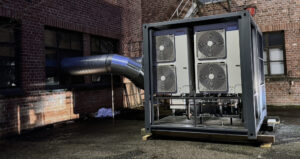
AirTreater Čáhci operates on this principle, maintaining outlet water temperatures of +75 °C at outdoor temperatures as low as -15 °C using compressors alone. The system delivers 120 kW of nominal heating capacity at -15 °C, with a maximum output of 420 kW available at the same temperature threshold. The heat pump operates down to -28 °C, and below -28 °C the integrated backup system guarantees at least 300 kW of heating capacity even without external electric power in hazardous situations, ensuring continuous operation through the most severe northern winters without performance compromise.
How does air treatment technology perform in extreme cold?
The performance of air treatment technology in extreme cold depends entirely on how the system was specified and guaranteed. Conventional heat pumps are rated at nominal conditions, typically around +7 °C outdoor temperature, and their output falls significantly as temperatures drop. At -15 °C, a standard market heat pump may deliver only 50 to 60 percent of its nominal capacity. Systems designed for critical infrastructure must eliminate this performance gap through engineering, not assumption.
The critical distinction is between a rated capacity and a guaranteed capacity. A rated capacity describes what a system delivers under optimal test conditions. A guaranteed capacity is what the system delivers at every outdoor temperature it will actually encounter. For critical infrastructure, only the latter is operationally relevant.
AirTreater systems are guaranteed to deliver at least nominal heating or cooling capacity at all outdoor temperatures. AirTreater Čáhci maintains its 120 kW nominal heating capacity at -15 °C using compressors alone, with no auxiliary heat strips and no reduction in output. The heat pump operates down to -28 °C, and below -28 °C the integrated backup system activates to maintain at least 300 kW of guaranteed heating capacity even without external electric power in hazardous situations. This guarantee is not a rated condition, but a design baseline, and it reflects the engineering philosophy developed through decades of operation in Finnish winter conditions.
What is free cooling and when does it apply to process cooling systems?
Free cooling is an HVAC engineering function in which a chiller or process cooling system rejects heat to the outdoor environment without engaging mechanical refrigeration compressors, using the temperature differential between the process fluid and the ambient air to drive heat transfer directly. When outdoor temperatures are sufficiently low, the ambient air can absorb process heat without the energy cost or mechanical wear associated with compressor operation.
Free cooling applies to process cooling systems when the outdoor temperature drops below the threshold at which the ambient air can absorb the required heat load without compressor assistance. The specific threshold depends on the system design and the process setpoint temperature. For systems designed to operate in northern climates, this threshold is reached for a substantial portion of the year, creating significant energy savings and eliminating compressor operating hours during those periods.
AirTreater Prosea is designed per project and site, with cooling capacity determined by specific application requirements. It integrates a free-cooling function that delivers the full required process cooling capacity energy-efficiently, without engaging compressors when cold outdoor conditions allow ambient air to absorb the process heat load directly. This eliminates the primary mechanical failure point of conventional chiller systems during cold-weather operation and reduces energy consumption to a fraction of compressor-driven alternatives. When outdoor temperatures rise sufficiently, the compressor circuit engages to maintain the required process setpoint. The result is a process cooling system that is simultaneously more energy-efficient and more mechanically reliable than single-mode alternatives, because it removes compressor dependency during the extended cold periods that northern European sites experience throughout autumn, winter, and spring.
How does remote monitoring work in industrial air treatment systems?
Remote monitoring in industrial air treatment systems works by connecting the system’s control unit to a cloud-based management platform, which transmits real-time operational data including temperatures, pressures, energy consumption, and alarm states to a web-accessible dashboard. Authorised operators can view system status, adjust setpoints, and respond to alerts from any location with a standard internet connection, without requiring physical access to the site.
For critical infrastructure applications, remote monitoring is not a convenience feature. It is an operational requirement. Sites where continuous process cooling or heating is essential cannot rely on periodic manual inspection. The monitoring platform must provide real-time visibility into system parameters, with alert thresholds that notify operators immediately when any value deviates from the specified operating range.
AirTreater systems are managed via an automated remote management platform, which provides a real-time view of all operational parameters and allows full settings adjustment through a standard web browser. Named end users can also have access to the automation system. No specialist software or site visit is required to modify setpoints or review system performance. This is particularly relevant for remote or unmanned installations, where the combination of a self-contained containerised system and continuous remote visibility through the automation platform delivers the operational continuity that critical applications demand. AirTreater’s service centre supports this with 24/7/365 help desk availability, ensuring that remote monitoring data translates into responsive action when it matters.
What makes a containerised air treatment unit suitable for critical applications?
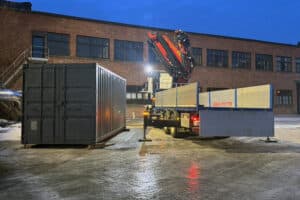
A containerised air treatment unit is suitable for critical applications because it arrives on site as a self-contained, pre-configured system that requires no permanent civil works, no plant room construction, and no extended commissioning period. Where no heat distribution network is required, the system is fully operational within 4 hours of arrival on site. Commissioning including electrical connection takes one working day. This deployment timeline is not achievable with fixed installation alternatives.
Beyond speed, the containerised format eliminates several categories of infrastructure dependency that introduce risk in critical applications.
- No permanent plant room means no structural construction lead time and no site modification required before the system can operate.
- Self-contained packaging means all major components arrive pre-assembled and factory-tested, reducing on-site installation variables.
- Relocatability means the system can be redeployed as operational needs change, without writing off the capital investment or undertaking demolition works.
- Standard container logistics means the unit can be transported by road, rail, or sea using existing freight infrastructure, enabling rapid deployment to remote or geographically constrained sites.
For defense and security sector procurement, the containerised format also aligns with the operational doctrine of deployable, relocatable infrastructure. AirTreater holds NATO supplier registration with NCAGE code A04WG, confirming compliance with the quality and reliability standards required for deployment in mission-critical environments. This registration is a prerequisite for defense procurement in many NATO member contexts, and it reflects the engineering standard to which AirTreater’s containerised systems are built and verified.
Contact the AirTreater technical team to discuss site requirements and request specification documentation for procurement review.