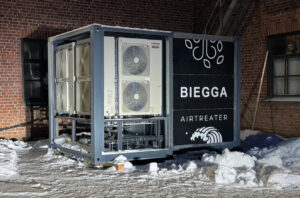
AirTreater Biegga reduces energy costs in warehouses and halls primarily by operating as an air-to-air heat pump that delivers significantly more thermal energy per unit of electricity consumed than direct electric heating. With 84 kW of heat pump capacity and a total maximum heating output of 165 kW, Biegga is designed for large, open spaces where conventional electric heating is both undersized and inefficient. The sections below address the most common operational and procurement questions about Biegga’s energy performance in warehouse and hall environments.
How much energy can a heat pump save in a large warehouse?
A heat pump delivers multiple units of thermal energy for every unit of electrical energy it consumes, measured as the coefficient of performance (COP). In practical terms, a warehouse heated by direct electric resistance elements converts one kilowatt of electricity into one kilowatt of heat. A heat pump operating at an average COP of between 1.5 to 2.5 delivers on average 2 or more units of heat from the same electrical input, reducing heating energy costs significantly compared to resistance heating under equivalent conditions.
For large warehouse and industrial hall environments, the savings compound because the spaces are typically high-volume and poorly insulated relative to their floor area. Heat loss is continuous, and the heating system runs for extended periods. A system that draws less electricity to maintain the same indoor temperature generates measurable savings across every operating hour. Over a full heating season in a northern climate, the cumulative difference between heat pump operation and resistance heating is substantial.
The actual saving depends on the local electricity tariff, the outdoor temperature profile across the season, and the thermal characteristics of the building envelope. What does not vary is the fundamental thermodynamic advantage: heat pumps extract energy from outdoor air and transfer it indoors, rather than generating heat through resistance. That mechanism is the source of the efficiency gain, not a marketing claim.
How does Biegga’s air-to-air system work in large spaces?
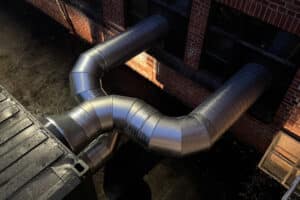
AirTreater Biegga operates as an air-to-air heat pump: it extracts thermal energy from outdoor air, upgrades that energy through a refrigeration cycle using compressors, and delivers conditioned air directly into the heated space. Unlike liquid-cycle systems that distribute heat through water circuits and radiators or underfloor networks, Biegga circulates heated air directly, making it well suited to large, open volumes where ductwork or air distribution infrastructure can reach across the full floor area.
The system delivers 84 kW of heat pump capacity under nominal operating conditions. When outdoor temperatures drop to levels where compressor output alone is insufficient to meet thermal demand, Biegga’s integrated 81 kW electric backup system activates to supplement the heat pump output. The combined maximum heating capacity is 165 kW, and at least 81 kW is guaranteed at all outdoor temperatures, which covers the peak demand of a large warehouse even during cold periods.
For cooling, Biegga operates the refrigeration cycle in reverse, extracting heat from the indoor air and rejecting it outdoors. Maximum cooling capacity is 81 kW, delivered through the same air distribution system used for heating. This dual-mode operation means a single containerised system covers both the winter heating requirement and the summer cooling load, without separate infrastructure for each function.
What makes Biegga different from conventional warehouse heating?
The primary differentiator is guaranteed nominal capacity at all outdoor temperatures. Conventional heat pumps are rated at standard test conditions, typically around +7 °C outdoor temperature, and their output degrades significantly as outdoor temperatures fall. By the time outdoor conditions reach -15 °C, a conventionally rated system may deliver a fraction of its stated capacity, like 40% of rated output. AirTreater Biegga guarantees its nominal heating capacity of 165 kW at all outdoor temperatures, and at least 81 kW at all outdoor temperatures. That guarantee is not a rated condition; it is a performance commitment.
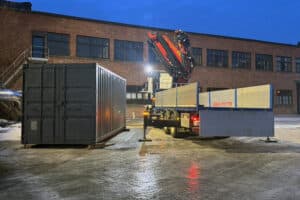
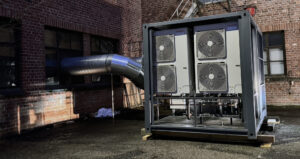
The second differentiator is the containerised form factor. Conventional warehouse heating systems require fixed installation: permanent plant rooms, civil works, commissioning lead times measured in weeks, and infrastructure that cannot be relocated when operational requirements change. AirTreater Biegga arrives in a standard container, connects on site in a single working day, and is fully operational within 4 hours of arriving on site when no heat distribution network is required. When the site requirement changes, the system moves with it.
The third differentiator is the integration of backup heating capacity within the same system. The 81 kW electric backup operates as part of the integrated system architecture, not as a separate boiler or resistance array. This means there is no separate control system to manage, no additional installation work, and no gap in heating coverage during the transition between heat pump and backup operation.
When does Biegga switch to backup heating, and does it cost more?
Biegga’s integrated backup system activates when the heat pump compressors alone cannot meet the thermal demand set by the operating conditions and the setpoint temperature. This is not a fixed outdoor temperature threshold but a function of the balance between outdoor conditions, building heat loss, and the required indoor temperature. The transition is managed by the system’s control logic and is transparent to the operator.
Running the backup system does cost more per kilowatt-hour of heat delivered, because the electric backup converts electricity to heat at a COP of 1, compared to the heat pump’s higher COP under normal operating conditions. However, the backup operates only when required and only to the degree required to supplement the heat pump output. It does not replace the heat pump; it supplements it. The total energy cost during backup-assisted operation is higher than pure heat pump operation, but the alternative is an undersized system that fails to maintain the required temperature at all.
The operational cost of backup activation is a known and plannable factor. For facilities in northern climates where extreme cold periods are predictable and finite, the additional energy cost during those periods is a manageable and quantifiable element of the total heating budget, not an unpredictable variable.
Can Biegga also reduce cooling costs in summer?
Yes. AirTreater Biegga delivers up to 81 kW of cooling capacity by operating the refrigeration cycle in reverse during warmer months. The same air distribution infrastructure used for winter heating serves the cooling function in summer, which means there is no separate cooling system to install, maintain, or operate. For warehouse and hall environments that experience both cold winters and warm summers, this dual-mode capability eliminates the need for two separate climate control systems.
The energy cost reduction in cooling mode follows the same logic as in heating mode: the heat pump moves thermal energy rather than generating or absorbing it through resistance. This is more efficient than direct electric cooling or portable evaporative coolers, which are common in warehouse environments where permanent air conditioning has not been installed.
For facilities that have previously managed summer temperatures with portable fans or temporary cooling units, replacing that approach with Biegga’s 81 kW mechanical cooling capacity produces a measurable improvement in both temperature control and energy efficiency. The cooling output is consistent and controllable, rather than dependent on outdoor conditions as evaporative cooling is.
How quickly can Biegga be deployed to start saving energy?
AirTreater Biegga connects on site in a single working day. If no additional heat distribution network is required, the system is fully operational within 4 hours of arriving on site. This deployment timeline applies to the containerised system as delivered, without the civil works, plant room construction, or extended commissioning processes associated with fixed installation heating systems.
The practical implication for energy cost reduction is that savings begin within hours of the deployment decision, not weeks or months. For a warehouse currently heated by electric resistance systems or temporary diesel-fired heaters, replacing that load with Biegga’s heat pump capacity starts reducing the energy cost per degree of heating from the first day of operation.
Once operational, AirTreater systems are managed via an automated remote management platform, which provides real-time operational data and full settings control through a standard web browser. Named end users can also have access to the automation system. Operators can monitor energy consumption, adjust setpoints, and review system performance from any location. This visibility supports ongoing energy optimisation without requiring on-site presence, which is particularly relevant for warehouse facilities that operate with limited on-site technical staff. AirTreater’s 24/7/365 help-desk service is available through the service centre for any operational questions that arise after deployment.