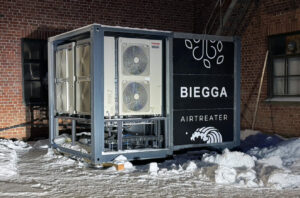
AirTreater Čáhci achieves near-zero CO₂ emissions by operating as an air-to-water heat pump – moving heat rather than generating it through combustion. Because the system runs entirely on electricity, its direct carbon output is zero at the point of operation. Its overall emissions profile depends on the carbon intensity of the electricity grid supplying it, which is why the designation is near-zero rather than zero.
For industrial and commercial operators who need guaranteed heating performance without fossil fuel dependency, Čáhci delivers up to 420 kW of heating capacity at outdoor temperatures down to -15 °C – without a single combustion process in the circuit. The sections below address the specific mechanisms, edge cases, and operational factors that determine exactly how low Čáhci’s carbon output goes in practice.
What technology allows Čáhci to produce so little CO₂?
AirTreater Čáhci produces near-zero CO₂ because it is an air-to-water heat pump – a system that extracts thermal energy from outdoor air and transfers it into a liquid circuit, using electricity as the only energy input. No fuel is burned at any stage. The compressors, which are the primary energy-consuming components, run on electricity, and the refrigerant circuit moves heat rather than creating it through combustion.
The thermodynamic efficiency of this process is measured as a coefficient of performance (COP): for every unit of electrical energy consumed, a heat pump delivers several units of thermal energy. This ratio is what makes heat pump technology fundamentally different from electric resistance heating or fossil fuel boilers. Čáhci’s liquid-cycle architecture distributes that heat through a hydronic network, which is well-suited to large industrial spaces where even temperature distribution across a wide area is a process requirement rather than a comfort preference.
The integrated backup system – available as an electric boiler where sufficient grid capacity exists, or as a ground-source heat pump where a borehole field is present – also operates without combustion. The entire heating chain from energy source to heat distribution remains fossil-free, which is the engineering basis for the near-zero emissions claim.
How does Čáhci perform at low outdoor temperatures without backup combustion?
AirTreater Čáhci maintains 120 kW of nominal heating capacity at -15 °C using compressors alone – no combustion, no gas backup, no performance compromise. At maximum output, the system delivers 420 kW at outdoor temperatures down to -15 °C. The heat pump operates down to -28 °C, and below -28 °C the integrated backup system guarantees at least 300 kW even without external electric power in hazardous situations. These are guaranteed figures, not laboratory ratings.
Conventional air-source heat pumps derate significantly as outdoor temperatures fall, because the temperature differential between the air and the refrigerant narrows, reducing the system’s ability to extract heat efficiently. AirTreater Čáhci is engineered specifically for northern European operating conditions, where -15 °C is a realistic winter temperature rather than an edge case. The system’s compressor configuration and refrigerant circuit are sized to maintain nominal capacity across that entire temperature range.
Where a borehole field is available on site, Čáhci can be configured with a ground-source heat pump instead of an air-source unit. Ground temperatures remain stable at around +5 °C to +8 °C year-round in Finnish conditions, which eliminates the cold-air extraction challenge entirely and allows consistent COP values regardless of outdoor air temperature. In either configuration, combustion plays no role.
What is the difference between near-zero and zero CO₂ emissions for heat pumps?
A heat pump produces zero direct CO₂ emissions because it burns no fuel. The near-zero designation reflects indirect emissions – specifically, the carbon intensity of the electricity used to power the compressors. If that electricity comes from a coal-heavy grid, the upstream emissions are significant. If it comes from nuclear, wind, or hydropower, the total lifecycle carbon footprint approaches zero.
This distinction matters for industrial operators calculating Scope 1 and Scope 2 emissions under frameworks such as the EU’s Corporate Sustainability Reporting Directive. Scope 1 emissions from a Čáhci installation are zero – there is no on-site combustion. Scope 2 emissions, which account for the carbon intensity of purchased electricity, depend on the energy mix of the grid or on-site generation source.
In Finland, where the electricity grid has one of the lowest carbon intensities in Europe due to a high share of nuclear and renewable generation, the gap between near-zero and zero is operationally narrow. For operators procuring renewable electricity directly or generating it on site, Čáhci’s total carbon output can reach zero in practical terms. The system’s architecture makes that outcome achievable – the remaining variable is the electricity source, which is within the operator’s control.
How does the ground-source option affect Čáhci’s carbon output?
Configuring AirTreater Čáhci with a ground-source heat pump, where a borehole field exists on site, reduces carbon output in two ways: it improves the system’s COP relative to air-source operation in cold conditions, and it reduces total electricity consumption for the same heat output. Lower electricity consumption means lower Scope 2 emissions for any given grid carbon intensity.
Ground-source heat extraction operates at a stable temperature regardless of outdoor air conditions. In Finnish ground conditions, the thermal source temperature remains consistent through winter, which means the compressors operate at a lower pressure differential and consume less electricity to deliver the same outlet water temperature. The result is a more efficient system that draws less power from the grid – directly reducing the indirect emissions associated with each kilowatt-hour of heating delivered.
For sites where long-term operation is planned and borehole infrastructure can be justified, the ground-source configuration represents the lowest-carbon variant of the Čáhci platform. It is not universally applicable – borehole fields require geological suitability and upfront civil investment – but where conditions allow, the emissions reduction over the system’s operational life is measurable and substantial.
Which industries benefit most from Čáhci’s low-emission heating?
Industries with large, continuous heating demands and regulatory or commercial pressure to reduce fossil fuel consumption benefit most from Čáhci’s low-emission profile. These include food and beverage production, pharmaceutical manufacturing, biogas and energy generation facilities, large-scale construction projects, and any industrial process requiring stable high-temperature hydronic heating across a wide floor area.
For energy sector operators and biogas plant managers, the combination of guaranteed heating capacity and zero direct emissions aligns with both process requirements and sustainability reporting obligations. Many of these facilities operate continuously, meaning even brief heating interruptions carry production costs – which makes Čáhci’s guaranteed nominal capacity at all outdoor temperatures as operationally significant as its emissions profile.
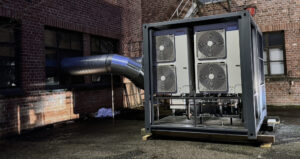
Construction project managers working on large-scale sites also represent a strong fit. Temporary heating infrastructure on construction sites has historically relied on diesel-fired or gas-fired equipment, which generates both direct emissions and fuel logistics complexity. Čáhci’s containerised format is ready for startup within 4 hours of arriving on site when no heat distribution network is required, with commissioning including electrical connection completed within one working day, and operates without any combustion fuel supply chain – eliminating both the emissions and the logistics overhead that come with fossil fuel heating.
For facilities subject to EU industrial emissions regulations or internal carbon reduction targets, replacing combustion-based heating with a Čáhci installation produces a direct, auditable reduction in Scope 1 emissions from day one of operation.
How does remote monitoring help maintain Čáhci’s emissions efficiency over time?
AirTreater Čáhci systems are managed via an automated remote management platform, which provides real-time operational data and full settings control through a standard web browser. Named end users can also have access to the automation system. Maintaining emissions efficiency over time depends on the system operating at its designed parameters – correct setpoints, efficient compressor cycling, and early identification of performance drift. The automation platform makes all of those factors visible and adjustable without requiring on-site attendance.
A heat pump that is running outside its optimal operating range – delivering more heat than the setpoint requires, cycling compressors unnecessarily, or maintaining outlet temperatures higher than the distribution system needs – consumes more electricity per unit of heat delivered. That excess electricity consumption translates directly into higher Scope 2 emissions. Remote visibility into outlet water temperature, compressor status, and energy consumption allows operators to identify and correct these inefficiencies before they accumulate into a meaningful emissions and cost impact.
AirTreater’s 24/7/365 help-desk service, accessible through the service centre, provides a direct escalation path when the automation platform indicates a parameter outside the expected range. For unmanned or remote sites where no on-site engineer is available, this combination of continuous remote monitoring and around-the-clock technical support ensures that the system’s emissions performance is maintained to the same standard as its heating performance – both of which are guaranteed from the point of installation.