Supply chains in 2026 are under pressure from two directions at once. Regulators are tightening emissions requirements across the EU, and procurement partners are demanding documented sustainability credentials before contracts are signed.
If your operations still depend on fossil-fuel heating, high-GWP refrigerants, or energy-intensive climate control, the green transition is not an abstract future risk. It is a present compliance and commercial liability.
What the Green Transition Demands from Supply Chains in 2026
The regulatory environment has shifted materially. The revised F-gas Regulation (EU) 2024/573 entered into force in early 2024, and the HFC phase-down began in 2025. Systems using refrigerants with a global warming potential above 675 are no longer eligible for EU support schemes.
At the same time, the Energy Efficiency Directive sets a binding target to reduce EU energy consumption by 11.7% by 2030. That target cascades directly into industrial operations through energy savings obligations.
Green transition supply chain compliance now means three things in practice:
- Documented reduction in operational carbon output across facilities and logistics nodes
- Refrigerant compliance with current GWP thresholds across all climate control equipment
- Energy efficiency standards that satisfy both internal ESG targets and external procurement requirements
Supply chain sustainability in 2026 is no longer a reporting exercise. It is an operational and procurement prerequisite.
Where Supply Chains Are Most Exposed to Green Transition Risk
The exposure is concentrated at the infrastructure level. Warehouses, distribution hubs, temporary construction sites, and industrial processing facilities all rely on climate control systems that were specified before current regulatory thresholds existed.
The most common failure points include:
- Fixed heating and cooling installations using refrigerants that no longer meet GWP requirements
- Diesel or gas-fired heating at logistics and storage sites where electrification has not yet been implemented
- Climate control equipment rated at nominal conditions that underperforms in cold weather, increasing energy consumption and carbon output during peak demand periods
- Temporary site infrastructure with no remote monitoring, making energy waste invisible until the utility bill arrives
The Energy Performance of Buildings Directive targets a 60% emissions reduction in the buildings sector between 2015 and 2030. Supply chain facilities are not exempt from that trajectory.
Supply chain decarbonization risk is highest where the equipment is oldest, least monitored, and most difficult to replace quickly. That is precisely where containerised, deployable solutions create operational advantage.
How Industrial Climate Control Reduces Supply Chain Carbon Liability
The most direct path to reducing carbon liability in climate control is replacing fuel-fired or electrically inefficient systems with heat pump technology that delivers measurable output per unit of energy consumed.
Heat pumps operating at temperatures down to -15 °C can still deliver a coefficient of performance well above 2.0, meaning more than two units of thermal energy for every unit of electricity consumed. That ratio is structurally impossible with resistance heating or combustion-based systems.
AirTreater systems are designed around a single operational guarantee: nominal heating and cooling capacity is delivered at all outdoor temperatures. This is not a rated condition. It is a guarantee. For supply chain operators calculating carbon intensity per unit of output, the difference between a system that derates in cold weather and one that does not is measurable in both energy consumption and emissions reporting.
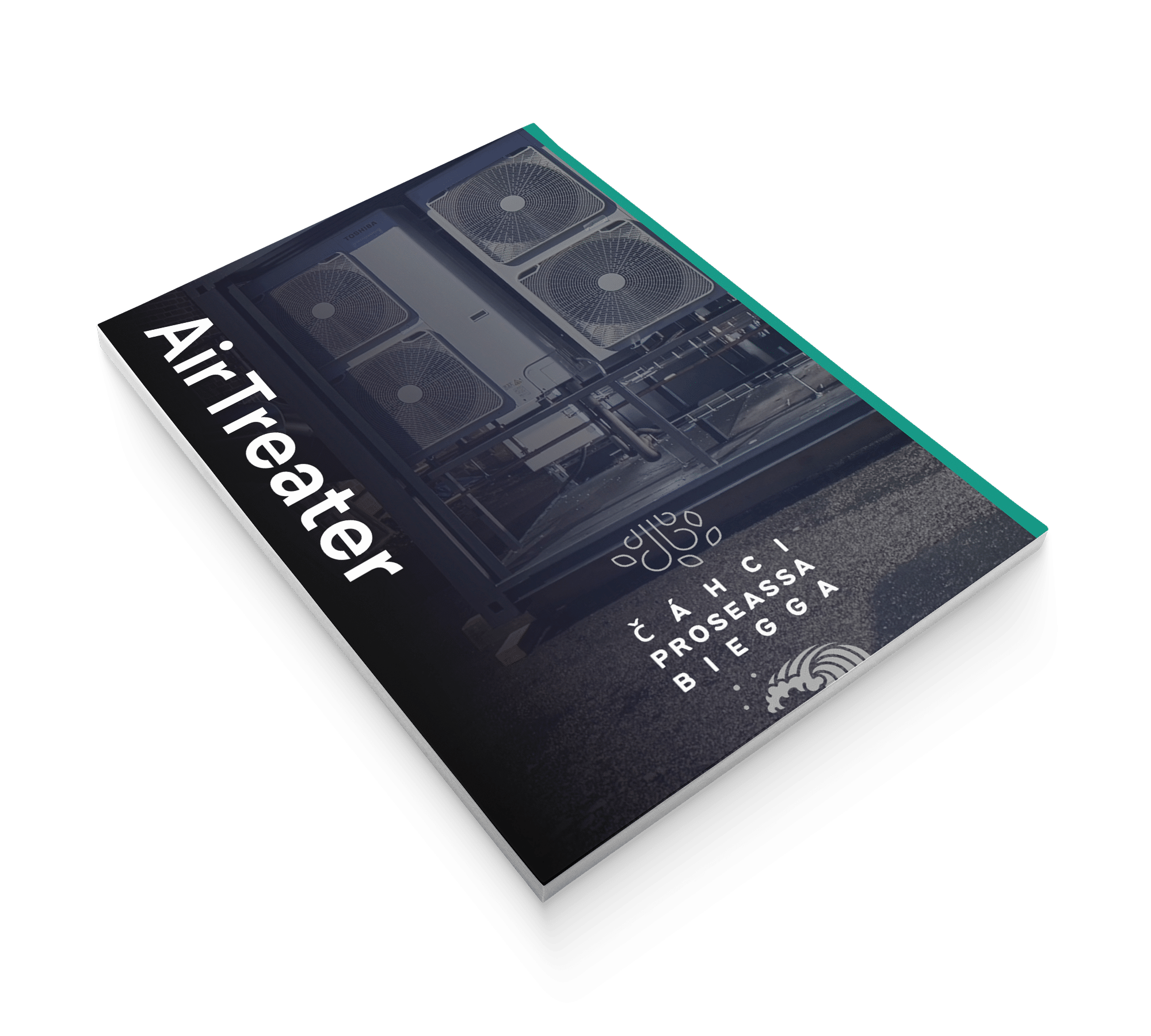
AirTreater Čáhci, the air-to-water heat pump, maintains 120 kW of nominal heating capacity at -15 °C using compressors alone, with a maximum output of 420 kW available when conditions allow. For facilities with existing liquid-cycle heat distribution infrastructure, this translates directly into lower carbon intensity without requiring a change to the distribution system itself.
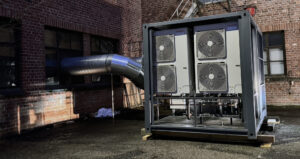
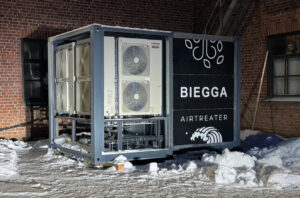
AirTreater Biegga, the air-to-air containerised solution, delivers 84 kW of heat pump output for large open-plan spaces, with an integrated 81 kW electric backup that activates only when required. The system eliminates combustion entirely from the heating equation.
Portable and Scalable Solutions for Fast-Changing Supply Chain Needs
Supply chains are not static. Distribution networks expand, contract, and relocate. Temporary logistics hubs open for project durations measured in months, not years. Fixed climate control infrastructure is incompatible with that operational reality.
AirTreater’s containerised solutions connect on site in a single working day. Where no heat distribution network is required, the system is fully operational within two working days of arrival. When the project ends or the site relocates, the system moves with it. No civil works are abandoned. No capital asset is stranded.
The operational benefits for supply chain sustainability are concrete:
- No permanent infrastructure commitment at temporary or transitional sites
- Immediate compliance with current refrigerant and energy efficiency requirements from day one of deployment
- Real-time energy monitoring via Ouman’s remote management platform, accessible from any browser at any location
- 24/7/365 help-desk support through AirTreater’s service centre, ensuring operational continuity at unmanned or remote logistics nodes
- Full integration with existing building automation and management systems where infrastructure is already in place
For supply chain operators managing multiple sites across varying climates and regulatory jurisdictions, the ability to deploy, monitor, and redeploy a fully compliant climate control system without specialist civil works is a material operational advantage.
The portable HVAC equipment market is growing at a compound annual rate above 5% through 2032, driven specifically by demand for high-capacity, modular industrial units. The direction of the market reflects the direction of supply chain operations: towards flexibility, compliance, and verifiable energy performance.
Take the Next Step Toward a Greener Supply Chain
The green transition is not a future planning exercise. The regulatory thresholds are in force. The procurement requirements are live. The energy efficiency obligations are binding.
The question for supply chain operators in 2026 is not whether to act on supply chain decarbonization, but how quickly the transition can be made without disrupting operations.
AirTreater systems are designed to answer that question with precision:
- Guaranteed nominal capacity at all outdoor temperatures, eliminating cold-weather performance gaps
- Refrigerant compliance with current EU GWP thresholds
- Containerised deployment that connects in one working day and relocates without permanent infrastructure
- Remote management and 24/7 support that keeps operations running without on-site supervision
If your supply chain includes facilities, logistics nodes, or temporary sites where climate control is currently a carbon or compliance liability, the practical next step is a direct technical conversation about your site requirements.
Contact the AirTreater team to discuss your site conditions, capacity requirements, and deployment timeline. Bring your specifications. The conversation will be technical, direct, and focused on what your operation actually needs.