AirTreater Čáhci connects on site in a single working day, and where no heat distribution network needs to be installed, the system reaches full operational status within 4 hours of arriving on site. The sections below address the practical questions that site managers and procurement engineers most commonly raise before committing to a deployment.
What does the Čáhci deployment process actually involve?
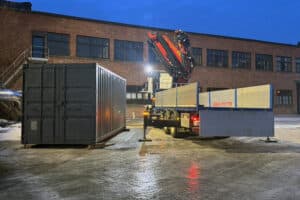
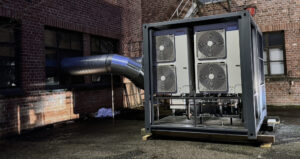
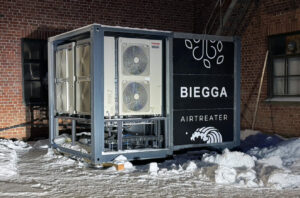
The AirTreater Čáhci deployment process involves positioning the containerised unit on site, making the hydraulic and electrical connections to the heat distribution circuit, configuring the control system, and confirming nominal output before handing over to the site operator. Because Čáhci is shipped as a pre-configured containerised solution, no plant room construction or permanent civil works are required.
The system arrives factory-built and pre-tested. The compressor circuit, integrated backup system, and automated remote management platform are all configured before the unit leaves the factory. On site, the work is connection work, not assembly work. The hydraulic circuit connects to whatever heat distribution infrastructure the site uses, and the electrical supply is terminated at the container’s connection point. Once those connections are verified and the system is commissioned, Čáhci is operational.
This approach eliminates the lead time and coordination overhead that fixed installations require. There is no concrete plant room to build, no specialist civil contractor to schedule, and no long commissioning sequence involving multiple trade disciplines. The containerised format is a genuine operational differentiator for sites where time to heat or cool is a project-critical constraint.
How long does it take to get Čáhci operational on site?
Where no heat distribution network is required, AirTreater Čáhci is fully operational within 4 hours of arriving on site. Commissioning including electrical connection takes one working day. If the site already has a heat distribution network in place, or if no distribution network is required, the system delivers nominal heating or cooling capacity on the same basis.
Where a heat distribution circuit needs to be installed as part of the same project, the overall timeline extends by however long that infrastructure work takes. The Čáhci unit itself is not the limiting factor in those cases. The container is ready to connect the moment it arrives; the distribution network determines when the first kilowatt reaches the space being conditioned.
For procurement teams comparing Čáhci against fixed-installation alternatives, the contrast is significant. Permanent air-to-water heat pump installations typically require weeks of civil and mechanical works before commissioning can begin. Čáhci’s containerised format compresses that timeline dramatically, which matters directly in construction projects, temporary industrial operations, and any situation where the heating or cooling need has a defined start date.
What site preparations are needed before Čáhci arrives?
Before AirTreater Čáhci arrives on site, three things must be in place: a stable, level surface capable of bearing the container’s weight, an adequate electrical supply connection point, and a prepared hydraulic interface for the liquid circuit. The specific requirements for each depend on the site configuration and the nominal capacity being deployed.
The surface preparation requirement is straightforward. Čáhci is a heavy industrial unit shipped in a standard container format, and the ground must be capable of supporting that load without settlement. A concrete pad or compacted hardcore base is the typical solution. The exact bearing capacity requirement should be confirmed with the AirTreater technical team during the pre-delivery site survey.
The electrical connection must match the unit’s power input specification. Čáhci draws significant power at full load, and the site’s incoming supply must be rated accordingly. This is a detail that should be resolved during the planning phase, not on the day of delivery.
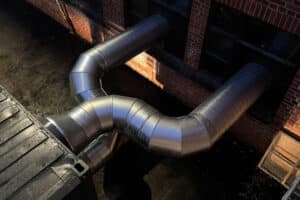
The hydraulic interface is the connection point between Čáhci’s liquid circuit and the site’s heat distribution network. If that network already exists, the interface preparation involves isolating the relevant section, installing the connection flanges or couplings, and pressure-testing the circuit before the container arrives. If the distribution network is being installed as part of the same project, that work should be sequenced to complete before or alongside the Čáhci delivery date.
Does Čáhci need to be connected to existing building automation?
AirTreater Čáhci does not require connection to an existing building automation system to operate. The unit runs on its own control architecture and is managed via an automated remote management platform from day one. Integration with an existing building management system is supported, but it is optional, not a prerequisite for deployment or operation.
The automated remote management platform gives operators real-time visibility into system performance and full settings control through a standard web browser, accessible from any location. Named end users can also have access to the automation system. This means Čáhci can be monitored and adjusted remotely without any local automation infrastructure in place. For sites that have no existing building management system, or where the Čáhci unit is operating as a standalone installation, this is the standard operational model.
For sites where integration with an existing automation system is required, AirTreater Čáhci supports connection to standard industrial automation protocols. The integration work is carried out as part of the commissioning process and does not extend the core deployment timeline significantly when planned in advance. For procurement teams specifying Čáhci into a larger facility with a central SCADA or BMS platform, the integration requirements should be discussed with the AirTreater technical team during the pre-delivery phase to confirm protocol compatibility and connection point specifications.
What backup heating options are available during Čáhci setup?
During the Čáhci setup period, site heating requirements are typically managed by whatever temporary heating source the site already has in place. Because Čáhci reaches operational status within 4 hours of arrival where no heat distribution network is required, the window during which backup heating is needed is short. Once commissioned, Čáhci itself incorporates an integrated backup system that maintains nominal heating capacity at all outdoor temperatures.
It is worth distinguishing between two separate questions here: backup heating during the initial deployment window, and backup heating as a permanent feature of the installed system.
Backup heating during deployment
The deployment window is brief. Where no heat distribution network is required, startup is achievable within 4 hours of arriving on site, with full commissioning including electrical connection taking one working day. For most sites, existing temporary heating equipment covers this period without requiring a separate contingency plan. If the site has no existing heating and the Čáhci installation is the primary heat source from day one, the deployment should be scheduled to account for the ambient conditions during that window. The AirTreater project team can advise on sequencing to minimise exposure.
Backup heating within the Čáhci system
Once operational, AirTreater Čáhci guarantees nominal heating capacity at all outdoor temperatures through its integrated backup system. The heat pump operates down to -28 °C. Below -28 °C, the backup system guarantees at least 300 kW of heating capacity even without external electric power in hazardous situations. Maximum heating capacity reaches 420 kW, and the integrated backup system guarantees at least 300 kW of heating capacity across all operating conditions.
Two integrated backup configurations are available depending on site infrastructure. Where the site has a geothermal borehole field, Čáhci can be equipped with a ground-source heat pump to supplement the air-source compressor circuit. Where sufficient electrical capacity is available, an electric boiler serves as the backup system. Both configurations are specified at the order stage, not retrofitted after deployment, so the backup strategy should be confirmed as part of the pre-delivery technical review.
To discuss site-specific deployment requirements or confirm technical specifications for your project, contact the AirTreater technical team directly.