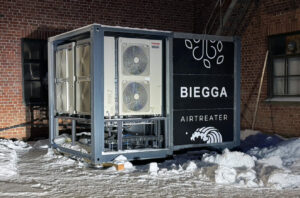
Industrial heating and cooling differs from commercial systems in one fundamental way: performance cannot be conditional. In commercial buildings, a heat pump that loses 30% capacity at -15 °C is an inconvenience. In an industrial process, it is a production stoppage. The questions below address the technical distinctions, engineering principles, and operational criteria that matter most when specifying climate control for industrial environments.
What makes industrial heating and cooling different from commercial systems?
Industrial heating and cooling systems are designed to maintain guaranteed nominal capacity under actual operating conditions, not laboratory-rated conditions. Commercial HVAC systems are typically specified for comfort heating and cooling in occupied buildings, where some performance variation is tolerable. Industrial systems serve processes, equipment, and critical infrastructure where temperature deviation carries direct operational consequences.
The distinction runs deeper than scale. A commercial heat pump rated at 100 kW may deliver 60 kW at -15 °C outdoor temperatures, and that shortfall is absorbed by building mass and occupant tolerance. An industrial process cooling system serving a biogas plant or power generation facility has no such buffer. The process runs continuously, and the cooling load does not reduce because the weather is extreme.
Industrial HVAC systems are also specified differently. Procurement engineers evaluate nominal capacity guarantees, minimum operating temperature thresholds, integrated redundancy, and remote management capability. The evaluation criteria are closer to capital equipment procurement than to building services specification. Containerised form factors, deployment timelines, and asset relocatability are relevant considerations that simply do not arise in commercial building projects.
How do industrial heat pumps maintain performance in extreme cold?
Industrial heat pumps maintain performance in extreme cold through a combination of oversized compressor capacity, integrated backup systems, and engineering designed for sub-zero operation as the norm rather than the exception. Conventional heat pumps derate progressively as outdoor temperatures fall because their refrigerant circuits are optimised for moderate conditions. Industrial systems are specified to deliver at least nominal capacity at all outdoor temperatures.
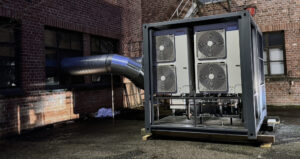
AirTreater Čáhci illustrates the engineering approach directly. The system maintains 120 kW of nominal heating capacity at -15 °C using compressors alone, with no auxiliary heat strips engaged. Maximum output reaches 420 kW at temperatures down to -15 °C. The heat pump operates down to -28 °C, and below -28 °C an integrated backup system activates to guarantee at least 300 kW of heating capacity even without external electric power in hazardous situations. This is not a rated condition with a tolerance band – it is a guaranteed minimum.
The engineering principle behind this performance is straightforward: systems designed for the harshest conditions will never underperform in ordinary ones. Finnish winters provide a natural validation environment that most climate control manufacturers never encounter in development or testing. Systems that carry genuine cold-weather performance guarantees have been designed from the outset for sub-zero operation, not retrofitted with auxiliary heat strips to cover a performance gap.
What is free cooling and when does it apply to process cooling?
Free cooling is a specific HVAC engineering function in which heat is rejected to the ambient environment without engaging mechanical refrigeration compressors. When outdoor temperatures are sufficiently low, the temperature differential between the process fluid and the outside air is large enough to transfer heat passively through a heat exchanger, eliminating the need for compressor-driven refrigeration entirely.
Free cooling applies to process cooling whenever outdoor temperatures fall below the threshold at which ambient air can absorb the process heat load without mechanical assistance. AirTreater Prosea is designed per project and site, and in cold conditions it delivers its full cooling capacity energy-efficiently, without engaging compressors. The operational implications are significant: energy consumption drops substantially, and the primary mechanical failure point of conventional chiller systems is eliminated entirely during extended cold-weather operation.
Process cooling applications that run continuously through northern winters – biogas digesters, power electronics cooling, industrial refrigeration support – accumulate substantial free-cooling hours annually. Each of those hours represents compressor-off operation: lower energy cost, zero compressor wear, and no risk of compressor-related failure. When outdoor temperatures rise and ambient conditions no longer support passive heat rejection, Prosea’s compressor circuit engages to maintain the cooling setpoint. The transition between modes is managed automatically, with no operator intervention required.
What’s the difference between air-to-water heat pumps and process chillers?
An air-to-water heat pump extracts heat energy from outdoor air and transfers it to a liquid circuit for distribution as heating or cooling. A process chiller is a refrigeration system designed to remove heat from a specific process fluid or equipment at a controlled temperature. The key distinction is application: air-to-water heat pumps serve space heating and cooling distribution networks, while process chillers serve defined thermal loads at precise temperature setpoints.
Air-to-Water Heat Pumps: Liquid-Cycle Distribution
Air-to-water heat pumps like AirTreater Čáhci connect to hydronic distribution networks, heating or cooling water that circulates through radiators, underfloor systems, fan coil units, or process heat exchangers. Čáhci maintains outlet water temperatures of +75 °C at -15 °C outdoor conditions, enabling direct integration with high-temperature hydronic systems without supplementary heating. This makes air-to-water systems well suited to large industrial facilities, construction site heating, and any application where heat distribution infrastructure already exists or can be deployed alongside the heat pump.
Process Chillers: Precision Cooling for Defined Loads
Process chillers remove heat from a specific fluid or equipment at a controlled setpoint, regardless of ambient conditions. AirTreater Prosea is a containerised process cooling package, designed per project and site, that combines mechanical refrigeration with a free-cooling function. It is designed for applications where the cooling load is continuous, the temperature setpoint is fixed, and interruption is not acceptable. The distinction from a comfort cooling system is that Prosea serves the process, not the building – the cooling load is defined by equipment heat rejection or reaction chemistry, not by occupant comfort.
What should you look for in a portable industrial climate control unit?
A portable industrial climate control unit must deliver guaranteed nominal capacity at all outdoor temperatures, connect to site services within one working day, and operate without requiring permanent civil infrastructure. Units that meet only rated conditions at optimal temperatures are not suitable for industrial applications where weather is a variable the process cannot accommodate.
The evaluation criteria for a containerised industrial climate control system should include:
- Nominal capacity guarantee at all temperatures: The system must deliver at least its specified heating or cooling output at the minimum outdoor temperature for the deployment site, not only at standard rating conditions.
- Deployment timeline: The container should connect to site services in a single working day, including electrical connection. Full operational status should be achievable within 4 hours of arrival on site where no heat distribution network is required, without permanent plant room space or specialist civil works.
- Integrated redundancy: For applications where interruption carries operational consequences, the system should include an integrated backup capability that activates automatically under extreme conditions.
- Remote management capability: Systems deployed at remote or unmanned sites require browser-based remote visibility and control, with real-time operational data accessible from any location.
- Relocatability: A containerised system should be recoverable and redeployable as project or operational requirements change, without asset write-off or complex decommissioning.
- Support availability: For continuous-process applications, 24/7 technical support is a procurement requirement, not an optional service level.
The containerised form factor is a meaningful operational differentiator only when it is backed by genuine performance guarantees. A unit that deploys quickly but derates in cold weather has exchanged one operational risk for another.
How does remote monitoring improve industrial HVAC reliability?
Remote monitoring improves industrial HVAC reliability by giving operators continuous visibility into system performance without requiring physical presence on site. Faults, setpoint deviations, and efficiency anomalies are identified in real time, allowing intervention before a condition becomes a failure. For systems operating at remote sites or in unmanned facilities, this visibility is the difference between a managed response and an undetected outage.
AirTreater systems are managed via an automated remote management platform, which provides real-time operational data and full settings control through a standard web browser, accessible from any location at any time. Named end users can also have access to the automation system. Operators can monitor outlet water temperatures, system status, and operating parameters, and adjust setpoints directly from the browser without dispatching a technician to site. This capability is particularly relevant for containerised systems deployed at temporary industrial sites, remote energy facilities, or locations where on-site staffing is limited.
Remote management also supports proactive maintenance. Continuous data logging through the automation platform creates an operational record that enables pattern recognition – identifying gradual performance drift before it reaches a threshold that affects process continuity. Combined with 24/7/365 help-desk support through AirTreater’s service centre, remote monitoring converts reactive fault response into a managed operational discipline. For industrial processes where a heating or cooling interruption carries measurable production consequences, that shift in operational posture is a direct reliability improvement.