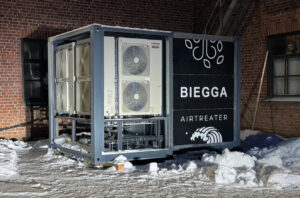
Uptime-driven maintenance is a structured approach to industrial equipment servicing where maintenance schedules, service agreements, and response commitments are built around a facility’s specific uptime requirements, not around a generic calendar or a supplier’s convenience. For industrial operations where heating, cooling, or process climate control runs continuously, the cost of an unplanned stoppage makes reactive maintenance economically indefensible. The sections below address the most common questions procurement engineers and facility managers ask when designing a maintenance strategy around operational continuity.
What does uptime-driven maintenance actually involve?
Uptime-driven maintenance is a maintenance strategy where every service decision (frequency, scope, response time, and escalation path) is determined by the operational consequences of equipment failure rather than by a fixed calendar. The central question is not “when is maintenance due?” but “what level of downtime is acceptable, and what does the maintenance programme need to guarantee to stay within that threshold?”
In practice, this means starting with a criticality assessment of each system. Equipment that, if it fails, halts a production process or compromises a temperature-sensitive environment is treated differently from ancillary systems. For industrial climate control equipment (heat pumps, chillers, air handling units, and process cooling systems), criticality is often high because the systems run continuously and the processes they support cannot tolerate interruption.
From that criticality assessment, a maintenance programme is built that specifies inspection intervals, component replacement schedules, performance verification checks, and emergency response commitments. The programme is not static: it should be reviewed when operational conditions change, when equipment ages, or when failure patterns emerge from monitoring data.
How does planned maintenance reduce unplanned downtime?
Planned maintenance reduces unplanned equipment downtime by identifying and correcting degradation before it becomes failure. Scheduled inspections, filter replacements, refrigerant checks, and performance verification catch developing faults at a point where they can be addressed during a controlled service window, not during a production run when the consequences are most severe.
The mechanism is straightforward. Most industrial equipment failures do not occur instantaneously. Compressor wear, refrigerant leakage, heat exchanger fouling, and electrical component degradation all follow progressive patterns. A planned maintenance programme creates regular opportunities to detect these patterns early. Catching a refrigerant pressure deviation during a scheduled quarterly inspection costs a service visit. Missing it costs a compressor replacement, a process interruption, and whatever downstream losses the interruption produces.
Remote monitoring accelerates this further. AirTreater systems managed through Ouman’s remote management platform provide continuous operational data (outlet temperatures, pressure readings, compressor run hours, and alarm states) accessible through a standard web browser at any time. When monitoring data shows a trend that deviates from baseline, a service response can be dispatched before the system reaches a fault condition. That is the practical difference between planned maintenance informed by real-time data and planned maintenance based on calendar intervals alone.
What’s the difference between a service agreement and on-call maintenance?
A service agreement is a contracted, proactive maintenance arrangement that defines scheduled inspection visits, response time commitments, and the scope of covered work in advance. On-call maintenance is reactive: a technician is called only after a fault occurs, with no pre-agreed response time or scope. For industrial equipment operating continuously, the distinction determines whether maintenance is a cost management tool or an emergency expense.
Under a service agreement, the supplier commits to specific obligations: visit frequency, response time for unplanned faults, parts availability, and escalation procedures. The facility operator gains cost predictability and a defined standard of care. The supplier, in turn, gains continuous visibility into equipment condition, which enables more efficient service planning.
On-call maintenance carries no such commitments. When equipment fails at 02:00 on a Sunday, the facility manager is negotiating response time and labour rates from a position of urgency. In operations where climate control directly supports a continuous process (biogas production, pharmaceutical manufacturing, data centre cooling), that negotiation happens while the process is degrading. The cost differential between a service agreement and on-call maintenance is rarely just the labour rate: it includes every hour of lost production and every consequence of operating outside temperature specification.
For facilities that require 24/7/365 support availability, a service agreement is the only arrangement that guarantees it. AirTreater’s service centre operates on that basis, providing help desk access at all hours, because industrial processes do not observe business hours.
Which industrial systems are most critical to include in a maintenance plan?
The industrial systems most critical to include in a maintenance plan are those whose failure directly halts production, compromises product quality, or creates a safety hazard. In climate control infrastructure, this typically means process cooling systems, heat pumps providing primary heating to large facilities, air handling units in controlled-environment production spaces, and any system with no redundant backup.
Criticality should be assessed on two axes: the probability of failure and the consequence of failure. High-consequence, high-probability systems demand the most intensive maintenance coverage. High-consequence, low-probability systems still warrant inclusion in the maintenance plan: the consequence axis alone justifies it.
For industrial heating and cooling infrastructure specifically, the following systems typically sit at the top of any criticality assessment:
- Primary heat pumps and chillers supplying process or facility climate control
- Compressor circuits, which carry the highest mechanical wear and the highest replacement cost
- Refrigerant circuits, where leakage affects both performance and regulatory compliance under EU F-gas regulation
- Heat exchangers, where fouling progressively degrades capacity without triggering immediate alarms
- Control and automation systems, including remote management interfaces, where a fault can mask developing equipment problems
- Integrated backup systems, which must be verified to be operational before the primary system needs to rely on them
Systems with integrated backup capability (such as the AirTreater Čáhci, which maintains nominal heating capacity at -15 °C using compressors alone and activates its integrated backup system in more extreme conditions) still require the backup to be included in the maintenance scope. A backup that has not been tested and serviced is not a backup: it is an assumption.
How should maintenance intervals be set for industrial climate control equipment?
Maintenance intervals for industrial climate control equipment should be set based on manufacturer specifications, operating environment conditions, equipment run hours, and the criticality of the system to the process it supports. A system running continuously in a demanding environment requires more frequent servicing than the same equipment operating seasonally in a controlled indoor space.
Manufacturer specifications provide a starting baseline (typically expressed as calendar intervals or operating hours, whichever comes first). These baselines assume standard operating conditions. Where conditions deviate from standard (high ambient dust, temperature extremes, continuous operation at high load, or outdoor installation in a harsh climate), intervals should be shortened accordingly.
Remote monitoring data provides the most accurate basis for interval adjustment over time. When operational data shows consistent performance within specification, some intervals can be extended without increasing risk. When data shows increased compressor cycling, rising outlet temperature variance, or declining COP, intervals should be shortened and a targeted inspection scheduled. The IEA’s analysis of heat pump performance consistently highlights that monitored systems outperform unmonitored equivalents in both energy efficiency and service life, because degradation is caught earlier.
As a practical framework for industrial heat pump and chiller systems, maintenance intervals typically include:
- Monthly: remote performance data review, alarm log check, filter inspection
- Quarterly: on-site inspection of refrigerant circuit, compressor operation, heat exchanger condition, control system verification
- Annually: full service including refrigerant charge verification, electrical connection inspection, backup system test, and performance benchmarking against baseline
These intervals are a starting point, not a fixed prescription. The maintenance programme should be reviewed annually and adjusted based on observed equipment condition and operational history.
What should an industrial maintenance SLA include?
An industrial maintenance SLA should include defined response time commitments for both planned and unplanned service events, a clear scope of covered equipment and work, performance benchmarks that define what “operational” means, escalation procedures for faults that cannot be resolved within the initial response, and explicit exclusions so that both parties understand what falls outside the agreement.
Response time commitments are the most operationally significant element. The SLA should specify the maximum time from fault notification to technician on site, and separately, the maximum time to system restoration. For continuous-process operations, a 24-hour response commitment may be acceptable for a non-critical system and completely unacceptable for primary process cooling. The response time tier should match the criticality classification established in the maintenance plan.
Beyond response times, a well-structured industrial maintenance SLA should address:
- Scope of scheduled visits: What is inspected, tested, and recorded at each planned service event
- Parts availability: Whether critical spare parts are held in stock by the service provider or subject to lead times
- Performance standards: The minimum operational parameters (capacity, outlet temperature, COP range) that define satisfactory system performance
- Remote monitoring obligations: Who monitors the system, at what frequency, and what triggers a proactive service response
- Reporting: What operational data is reported to the facility operator, and how frequently
- Escalation path: The sequence of actions if first-line response does not resolve the fault within the committed timeframe
- Exclusions: Damage caused by operator error, third-party interference, or conditions outside the agreed operating envelope
For facilities operating in Nordic climates where heat pump systems are a primary heating source, the SLA should also specify winter performance obligations explicitly, confirming that nominal capacity guarantees hold at the lowest expected outdoor temperatures, not just at rated conditions. A maintenance agreement that does not address cold-weather performance leaves the most operationally critical period unprotected.
If your facility requires a maintenance and support structure built around specific uptime requirements (including 24/7/365 help desk access and Ouman-based remote monitoring), contact the AirTreater team to discuss your site’s requirements at airtreater.com/yhteydenotto.