AirTreater holds NATO supplier registration with NCAGE code A04WG, qualifying its containerised heating and cooling systems for procurement in defense and mission-critical environments where certified, verifiable quality standards are a prerequisite. This registration confirms that AirTreater’s systems meet the operational reliability and documentation requirements demanded by NATO procurement frameworks. The questions below address how that certification applies across specific environments, performance conditions, and deployment scenarios.
What environments qualify as mission-critical for air treatment?
A mission-critical environment is any operational setting where a failure in heating, cooling, or climate control causes immediate consequences to safety, equipment integrity, or process continuity. These include defense installations, military forward operating bases, data centers, biogas and power generation facilities, field hospitals, and continuous industrial processes where temperature deviation is not operationally tolerable.
The defining characteristic is not the severity of the environment itself but the consequence of climate control failure. A biogas plant that loses process cooling faces fermentation disruption and potential equipment damage. A military command installation that loses heating at -20 °C faces an immediate threat to personnel and communications equipment. In both cases, the system must perform without interruption regardless of external conditions.
Conventional HVAC equipment is typically rated at nominal conditions, meaning its published capacity applies at moderate outdoor temperatures. When ambient temperatures drop to -15 °C or below, most standard systems derate significantly. For mission-critical environments, that performance gap is unacceptable. AirTreater Čáhci maintains 120 kW of nominal heating capacity at -15 °C using compressors alone, reaches a maximum output of 420 kW at temperatures down to -15 °C, and its integrated backup system guarantees at least 300 kW of heating capacity even below -28 °C — and below -28 °C the backup system guarantees at least 300 kW even without external electric power in hazardous situations. That is not a rated condition. It is a guarantee.
What does NATO certification mean for HVAC equipment?
NATO supplier registration, indicated by a NATO Commercial and Government Entity (NCAGE) code, confirms that a supplier has been formally registered within NATO’s supply chain management system and meets the baseline quality and traceability standards required for procurement by NATO member nations and affiliated defense organizations. AirTreater holds NCAGE code A04WG as a registered NATO supplier.
It is important to be precise about what this registration means. NCAGE registration is not a product-level certification of individual units. It is a supplier-level registration that confirms the company is an approved participant in NATO procurement processes. For defense and critical infrastructure procurement officers, this status is a prerequisite for engaging a supplier, not a guarantee of product performance on its own.
What makes AirTreater’s NATO registration operationally meaningful is that it is combined with performance guarantees that defense procurement frameworks demand. Systems deployed in military environments must deliver specified output under actual field conditions. AirTreater’s guarantee of at least nominal heating and cooling capacity at all outdoor temperatures aligns directly with the reliability standards that NATO procurement evaluations require. Registration opens the procurement channel; the performance specification closes it.
How does certified air treatment perform in extreme cold?
AirTreater systems are guaranteed to deliver at least nominal heating or cooling capacity at all outdoor temperatures, including extreme sub-zero conditions. AirTreater Čáhci maintains 120 kW of nominal heating capacity at -15 °C using compressors alone, reaches a maximum output of 420 kW at temperatures down to -15 °C, and its integrated backup system guarantees at least 300 kW even at very low temperatures. The heat pump operates down to -28 °C, and below -28 °C the backup system guarantees at least 300 kW even without external electric power in hazardous situations.
This performance profile is the product of engineering for Finland’s climate reality, where -20 °C to -28 °C winter temperatures are operational conditions, not edge cases. Most conventional heat pumps experience significant capacity reduction below -10 °C because their refrigerant cycle efficiency drops as the temperature differential between the ambient air and the heat sink increases. AirTreater systems are designed and tested to maintain output across that full temperature range, not only at the moderate conditions where most equipment is rated.
For cooling applications in cold environments, AirTreater Prosea operates its free-cooling function energy-efficiently without engaging compressors during cold outdoor conditions. This eliminates the mechanical load and associated failure risk of compressor operation during extended cold periods. When temperatures rise, the compressor circuit engages to maintain the setpoint. The result is a system that is simultaneously more energy-efficient and more reliable than single-mode alternatives across the full annual temperature range.
What’s the difference between portable and fixed air treatment systems for military use?
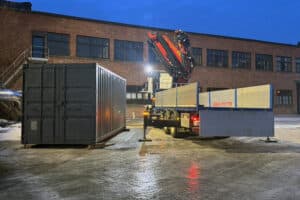
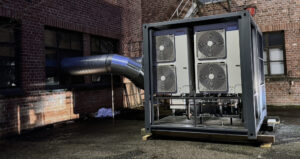
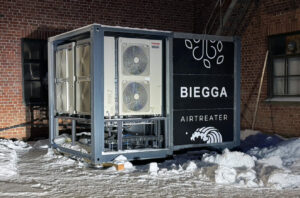
The key distinction is deployment flexibility versus infrastructure integration. Fixed air treatment systems require permanent plant room space, civil works, and site-specific installation, making them appropriate for established bases with stable long-term requirements. Containerised solutions like AirTreater’s systems ship in standard containers, connect on site, and are fully operational within 4 hours of arrival on site (when no heat distribution network is required), with no permanent infrastructure commitment required.
Fixed Systems: Established Bases and Permanent Infrastructure
Fixed HVAC installations are appropriate where the operational requirement is long-term and the site infrastructure is stable. They can be sized and integrated directly into existing heat distribution networks, and their permanent installation allows for more complex system configurations. The trade-off is lead time, civil works cost, and the inability to relocate the asset when operational requirements change.
Containerised Systems: Deployable and Relocatable
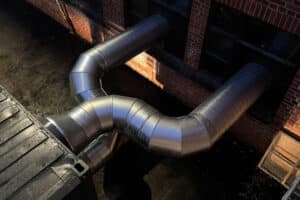
AirTreater’s containerised solutions are designed for environments where mobility, speed of deployment, and operational flexibility are decision factors. The container format means the system arrives pre-configured and ready to connect. No permanent plant room is required. When the operational requirement changes, the system relocates with the mission. For forward operating bases, temporary installations, and rapidly evolving deployment scenarios, this form factor eliminates the lead time and infrastructure dependency that fixed systems impose. AirTreater Čáhci uses a liquid-cycle distribution system, which means it integrates directly into existing heat distribution networks where they exist, or operates as a standalone heating source where they do not.
How does remote monitoring work in mission-critical climate systems?
Remote monitoring in mission-critical climate systems provides operators with real-time visibility into system performance and the ability to adjust operational parameters without requiring physical presence on site. AirTreater systems are managed via an automated remote management platform, which delivers a real-time operational view and full settings control through a standard web browser, accessible from any location at any time. Named end users can also have access to the automation system.
For defense and industrial applications, remote management is not a convenience feature. It is an operational requirement. Many mission-critical sites are unmanned for extended periods, located in remote or access-restricted areas, or operate continuously without on-site technical staff during off-hours. The automated remote management platform allows operators to monitor outlet temperatures, system status, and operational parameters in real time, and to adjust setpoints or respond to alerts without dispatching personnel to site.
AirTreater supports this capability with 24/7/365 help-desk service through its service center. For a system deployed in a critical environment, the combination of continuous remote visibility and around-the-clock technical support means that operational anomalies are identified and addressed before they become failures. That is the operational model that mission-critical procurement requires, and it is the model AirTreater delivers as standard.
Which industrial applications benefit most from NATO-certified air treatment?
The industrial applications that benefit most from NATO-registered, mission-critical air treatment are those where climate control interruption carries immediate operational, financial, or safety consequences. These include defense and military installations, biogas and anaerobic digestion plants, power generation facilities, data centers, field hospitals, and temporary industrial operations in remote or extreme-climate locations.
Biogas plants represent a directly relevant application. Anaerobic digestion is a temperature-sensitive biological process. A loss of process heating in winter conditions disrupts fermentation, reduces gas yield, and can cause extended recovery periods. AirTreater Čáhci’s guaranteed nominal heating capacity at all outdoor temperatures, including at least 300 kW backup capacity — with the heat pump operating down to -28 °C and the backup system guaranteeing at least 300 kW even without external electric power in hazardous situations below -28 °C — eliminates the weather-dependent performance gap that conventional systems introduce into this process.
Defense installations and forward operating bases require climate control that meets NATO procurement standards, deploys rapidly without civil works, and operates reliably in the full range of northern European and Arctic temperature conditions. AirTreater’s NCAGE A04WG registration addresses the procurement compliance requirement, while the containerised format and guaranteed cold-weather performance address the operational ones.
For process cooling applications in continuous industrial environments, AirTreater Prosea’s free-cooling function delivers cooling capacity energy-efficiently without compressor operation in cold outdoor conditions, as each Prosea system is designed per project and site. In northern climates, this translates to a significant portion of annual operating hours where full cooling capacity is maintained at a fraction of conventional chiller energy consumption. For operators managing continuous processes where cooling interruption is not an option, that combination of reliability and energy efficiency defines the operational case for certified industrial air treatment.
To discuss NATO procurement requirements or request technical documentation for a specific application, contact the AirTreater technical team directly.