Predictive maintenance for industrial heating and cooling systems works by continuously monitoring equipment condition data in real time and using that data to identify developing faults before they cause unplanned downtime. It applies to heat pumps, chillers, compressors, and associated distribution equipment. The sections below address the most common questions industrial facility managers and plant engineers ask when evaluating a condition-based maintenance strategy.
How does predictive maintenance work in industrial HVAC systems?
Predictive maintenance in industrial HVAC systems works by collecting continuous operational data from sensors installed on critical components, then analysing that data to detect anomalies that indicate developing faults. Instead of servicing equipment on a fixed schedule, maintenance is triggered by actual equipment condition. The result is intervention before failure, not after it.
The process follows a clear operational logic. Sensors measure parameters such as refrigerant pressure, compressor discharge temperature, vibration levels, power draw, and fluid flow rates. This data is transmitted to a monitoring platform, where it is compared against established baseline values. When a reading deviates beyond a defined threshold, the system flags it for investigation. A maintenance engineer can then inspect the specific component and address the fault while it is still manageable.
In industrial heat pump and chiller applications, this approach is particularly valuable because the consequences of failure are not limited to the HVAC system itself. A heating or cooling interruption in a production environment can halt an entire process, damage temperature-sensitive equipment, or trigger a costly restart sequence. Predictive maintenance reduces that risk by converting unplanned failures into planned interventions.
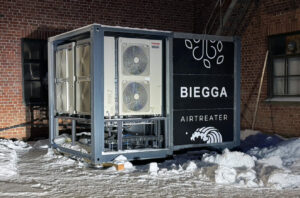
Remote management platforms accelerate this process significantly. AirTreater systems — covering heating, cooling, filtration, and process cooling — are monitored via an automated remote management platform, which provides real-time operational data through a standard web browser. Named end users can also have access to the automation system. This gives operators and service engineers immediate visibility into system behaviour without requiring a site visit to diagnose a developing issue.
What are the most common failure signals in industrial heat pumps?
The most common failure signals in industrial heat pumps are abnormal compressor discharge pressure, elevated vibration levels in rotating components, refrigerant circuit anomalies, unusual power consumption patterns, and abnormal outlet water temperature deviations from the setpoint. Each of these signals a specific failure mode that, if caught early, can be corrected without full system shutdown.
Compressor and refrigerant circuit signals
Compressor health is the most critical monitoring priority in any heat pump system. Rising discharge temperature at a fixed load indicates potential lubrication degradation or valve inefficiency. A drop in suction pressure without a corresponding change in load suggests refrigerant loss or a developing expansion valve fault. These signals typically appear weeks before a compressor failure, giving maintenance teams time to act.
Electrical and thermal signals
Abnormal current draw on compressor motors or circulation pumps indicates mechanical resistance, bearing wear, or winding degradation. In liquid-cycle systems, a widening gap between the setpoint and actual outlet water temperature, under constant load conditions, points to heat exchanger fouling or flow restriction. Both are detectable through continuous monitoring before they escalate to failure.
Vibration monitoring is particularly relevant for systems operating in industrial environments where mechanical stress is higher than in commercial applications. A gradual increase in vibration amplitude on a compressor or pump is a reliable early indicator of bearing wear. Catching this signal early eliminates the risk of a bearing seizure that could damage adjacent components and extend repair time significantly.
What’s the difference between predictive and preventive maintenance for cooling systems?
Preventive maintenance follows a fixed time-based schedule regardless of equipment condition. Predictive maintenance is triggered by actual equipment condition data. In cooling systems, the practical difference is that preventive maintenance may service components that do not yet need attention while missing developing faults that fall between scheduled intervals. Predictive maintenance targets interventions precisely where and when they are needed.
Preventive maintenance has clear advantages: it is straightforward to plan, easy to budget, and does not require sensor infrastructure. For simple systems with predictable wear patterns, it remains a viable approach. However, in industrial cooling applications where equipment operates continuously under varying loads and outdoor temperatures, the fixed-interval model has a fundamental limitation. A fault that develops three weeks after a scheduled service will not be detected until the next service interval, or until it causes a failure.
Predictive maintenance eliminates this gap. Because it monitors equipment condition continuously, it detects faults as they develop rather than at the next scheduled inspection. The trade-off is that it requires an investment in sensor infrastructure and a monitoring platform capable of interpreting the data. For industrial facilities where a cooling interruption carries significant operational cost, this investment is typically justified by the reduction in unplanned downtime alone.
A hybrid approach is common in practice: a baseline preventive schedule handles consumable replacements and statutory inspections, while condition monitoring handles the early detection of developing mechanical and electrical faults. This combines the administrative simplicity of scheduled maintenance with the fault-detection precision of predictive monitoring.
What sensors and tools are used to monitor industrial heating equipment?
Industrial heating equipment is monitored using temperature sensors, pressure transducers, vibration sensors, current transformers, flow meters, and refrigerant leak detectors. These instruments feed data to a central monitoring platform, where it is logged, trended, and compared against operational baselines to identify deviations that indicate developing faults.
The specific sensor configuration depends on the system type. In air-to-water heat pump systems, the most critical monitoring points are compressor discharge and suction pressure, outlet water temperature, circulation pump flow rate, and compressor motor current. These five parameters together give a comprehensive picture of system health and capture the majority of fault conditions before they escalate.
Vibration sensors are standard on compressors and circulation pumps in continuous-duty applications. They provide data on bearing condition and mechanical imbalance that is not visible in pressure or temperature readings. In systems operating at sub-zero outdoor temperatures, temperature sensors on refrigerant lines also serve as indicators of defrost cycle performance, which is a common source of efficiency loss in cold-climate heat pump operation.
The monitoring platform is as important as the sensors themselves. Raw sensor data has limited value without the analytical layer that identifies trends, applies thresholds, and generates alerts. An automated remote management platform integrates this analytical function with remote access, allowing engineers to review operational data and respond to alerts from any location. Named end users can also have access to the automation system. This is particularly relevant for industrial sites where on-site staffing is limited or intermittent.
How much downtime can predictive maintenance prevent in industrial systems?
Predictive maintenance consistently reduces unplanned downtime in industrial systems compared to time-based preventive maintenance because it detects developing faults before they cause failures. The reduction depends on system complexity, monitoring coverage, and how quickly the organisation responds to alerts. In continuous-process industrial environments, the more relevant measure is the cost of each avoided failure event, not a percentage figure.
The value calculation for industrial heating and cooling systems is straightforward. An unplanned compressor failure in a heat pump system typically requires component sourcing, specialist labour, and a system-down period measured in days, not hours. A predictive alert that identifies the same developing fault weeks earlier converts that event into a planned repair during a scheduled maintenance window, at a fraction of the cost and with zero unplanned process interruption.
For facilities where heating or cooling continuity is operationally critical, such as biogas plants, power generation sites, or continuous manufacturing processes, the cost of a single unplanned failure can exceed the entire annual cost of a condition monitoring programme. In these environments, the question is not whether predictive maintenance delivers value, but how quickly the monitoring infrastructure can be deployed and integrated.
It is also worth noting that predictive maintenance reduces over-maintenance costs, not just failure costs. Time-based schedules often result in servicing components that are operating within normal parameters, consuming maintenance labour and consumables unnecessarily. Condition-based intervention eliminates this waste by directing maintenance resources only where the data indicates a genuine need.
When should industrial facilities switch to a predictive maintenance strategy?
Industrial facilities should consider switching to a predictive maintenance strategy when the cost of unplanned downtime in their heating or cooling system exceeds the cost of continuous monitoring, when equipment complexity makes fixed-interval schedules unreliable, or when systems operate in conditions that accelerate wear unpredictably. For most continuous-process industrial environments, these conditions are already met.
The transition is most straightforward for facilities that already have remote monitoring infrastructure in place. If operational data is already being collected and transmitted, extending that data set to include condition monitoring parameters requires relatively modest additional investment. The analytical layer, whether a dedicated platform or an extension of existing building management systems, is typically the primary implementation step.
For facilities evaluating new heating or cooling equipment, the most efficient approach is to specify condition monitoring capability as part of the initial system procurement. Systems designed with integrated monitoring from the outset avoid the retrofitting costs and data gaps that arise when monitoring is added to equipment that was not designed to support it. AirTreater systems, monitored via an automated remote management platform, provide this capability as standard, giving operators real-time visibility into system performance from day one of operation. Named end users can also have access to the automation system. All AirTreater systems are guaranteed to deliver at least their nominal heating or cooling capacity at all outdoor temperatures.
Facilities that operate in extreme temperature environments have an additional reason to prioritise predictive monitoring. Systems working continuously even at very low temperatures experience thermal and mechanical stresses that are not present in moderate-climate applications. Condition monitoring in these environments is not a premium feature. It is the most reliable way to ensure that performance guarantees translate into actual operational continuity across the full range of operating conditions the system will encounter.