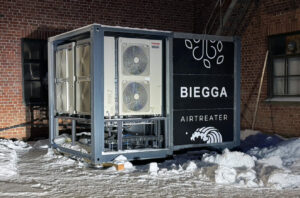
Construction sites do not wait for the weather to cooperate. Concrete curing schedules, material storage conditions, worker welfare requirements, and finishing work all depend on controlled temperatures — and when the heating or cooling fails, the project stops. Every hour of downtime on a construction site carries a cost that no contractor budgets for.
The question is not whether you need reliable HVAC for your construction site. The question is whether your current solution will actually deliver when outdoor temperatures drop and the schedule cannot slip.
What construction sites demand from HVAC systems
Construction site conditions are among the most demanding environments any HVAC system will face. Temporary structures, uninsulated envelopes, large open volumes, and Finnish winters create a combination that exposes every weakness in underspecified equipment.
A system that performs adequately in September becomes a liability in January. Conventional temporary heating units are typically rated at optimal conditions — meaning their stated capacity is measured at mild outdoor temperatures, not at the temperatures where you actually need the output.
What construction sites require from temporary HVAC is specific:
- Guaranteed heating and cooling output at all outdoor temperatures, not just ideal ones
- Rapid deployment that does not delay the project programme
- Sufficient capacity to cover large, open floor areas without multiple units
- Remote visibility so problems are caught before they become stoppages
- A system that moves when the project moves — or transfers to the next site when this one is complete
These are not aspirational requirements. They are the baseline for construction site climate control that does not create its own project risk.
Guaranteed output at every temperature, not just ideal conditions
This is where most temporary HVAC solutions fail construction sites. Capacity figures on a specification sheet are often rated at +7 °C outdoor temperature — a condition that represents a mild autumn day, not a Finnish construction winter.
AirTreater Biegga delivers a minimum of 81 kW at all outdoor temperatures. That is not a rated condition. It is a guarantee.
At maximum output, AirTreater Biegga delivers 165 kW of heating capacity — combining 84 kW from the air-to-air heat pump circuit with 81 kW from the integrated electric heating element. When outdoor temperatures are moderate, the heat pump operates efficiently. When conditions become extreme, the integrated backup system activates to maintain the setpoint without interruption.
For construction site heating and cooling, this means:
- A single AirTreater Biegga unit covers spaces up to approximately 1,000 m²
- Maximum cooling capacity of 81 kW for summer concrete work and material protection
- Heating and cooling in the same unit, eliminating the need for separate seasonal equipment
- No performance cliff when outdoor temperatures fall below the threshold where conventional systems begin to derate — like 40% — while AirTreater Biegga guarantees at least 81 kW at all outdoor temperatures
The industrial heat pump construction sector has long accepted that temporary systems will underperform in cold weather. AirTreater Biegga eliminates that acceptance as a requirement.
Portable systems that deploy as fast as sites move
Construction project timelines do not accommodate long equipment lead times or complex installation processes. A portable HVAC construction solution that takes two weeks to commission is not a solution — it is a delay.
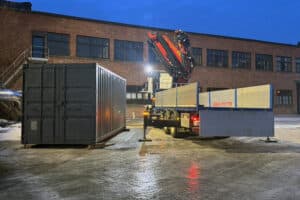
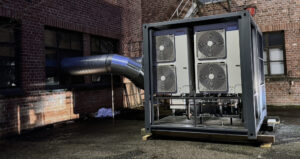
AirTreater Biegga arrives on site as a fully pre-configured containerised solution. The container connects in a single working day. Where no separate heat distribution network is required, the system is fully operational within 4 hours of arriving on site.
When the project phase ends or the site relocates, the system relocates with it. No permanent civil works. No equipment written off against a single project. The containerised format means the asset moves as efficiently as it was deployed.
For construction project managers evaluating temporary HVAC solutions, the operational timeline looks like this:
- Container delivered to site
- Connection completed within one working day
- Where no heat distribution network is required, system fully operational within 4 hours of arrival on site
- Remote management active from day one of operation
- System relocated or redeployed when the project phase is complete
This deployment speed is not a marketing claim. It is the specified commissioning timeline, verified against the containerised architecture of the system.
Remote monitoring so problems get caught before they cost you
An unmonitored HVAC system on a construction site is a liability. Temperature excursions that damage freshly poured concrete, humidity spikes that compromise stored materials, or heating failures during overnight frost — these are the failures that generate claims, delays, and rework costs.
AirTreater Biegga integrates an automated remote management platform as standard. The platform provides real-time operational data and full settings control through a standard web browser, accessible from any location at any time via GSM connection or bus interface. Named end users can also have access to the automation system.
The practical outcomes for construction site management are direct:
- Site managers monitor temperature and system status without being physically present on site
- Alarms route directly to AirTreater’s service centre, which operates 24/7/365
- Fault analysis and parameter adjustments happen remotely, reducing call-out requirements
- System settings adjust in response to changing site conditions without requiring an on-site visit
For sites operating outside standard working hours — which describes most construction sites during critical pour and cure windows — 24/7/365 remote monitoring is not a convenience. It is the difference between catching a fault at 02:00 and discovering the consequences at 07:00.
Get your site climate-controlled — request a configuration
Construction site heating and cooling requirements are specific to the site. Floor area, structural envelope, intended use during the project phase, and local temperature conditions all affect the correct system configuration.
AirTreater’s technical team assesses each site individually to confirm the right system specification — including whether a single AirTreater Biegga unit covers the required area or whether a multi-unit configuration is needed.
The next step is straightforward. Contact AirTreater’s team with your site parameters — floor area, project timeline, heating and cooling requirements — and receive a site-specific configuration recommendation with full technical specifications.
There is no commitment involved in the initial configuration review. There is, however, a direct cost to operating a construction site through a Finnish winter on equipment that was not specified for the actual conditions. Request a configuration assessment and confirm that your site climate control will perform when the schedule depends on it.