Winter construction does not pause for weather. Concrete pours, adhesive curing, plasterwork, and enclosed structure work all have temperature requirements that Finnish winters ignore. When the heating fails or underperforms, the project schedule slips and the costs follow.
A heat pump on a construction site is not a luxury consideration. In 2026, with tighter project margins and stricter environmental compliance requirements, it is the operationally and economically rational choice. The question is whether the unit you select will actually maintain its capacity when the temperature drops to -20 °C at 06:00 on a Monday morning.
Winter construction heating that actually holds even at very low temperatures
Conventional heat pumps are rated at nominal conditions. In practice, that means capacity drops as outdoor temperatures fall. At -15 °C, many units deliver a fraction of their specified output. At -20 °C, some stop functioning altogether.
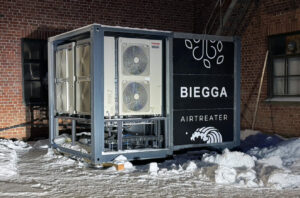
AirTreater Čáhci is guaranteed to deliver at least nominal heating capacity at all outdoor temperatures. That is not a rated condition or a laboratory figure. It is a performance guarantee.
The specifications that matter for winter construction heating:
- 120 kW nominal heating capacity maintained at -15 °C using compressors alone, with no auxiliary heat strips required
- Maximum output of 420 kW available at temperatures down to -15 °C when project conditions demand it
- The heat pump operates down to -28 °C. Below -28 °C, an integrated backup system activates automatically and guarantees at least 300 kW even without external electric power in hazardous situations
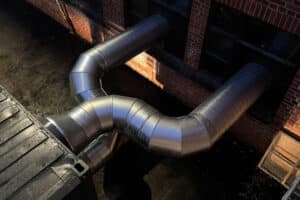
- Outlet water temperatures sufficient for liquid-cycle heat distribution across large enclosed structures
For heat pump winter construction applications in northern climates, the performance floor matters more than the performance ceiling. Čáhci’s floor is guaranteed. That distinction separates it from every conventional unit on the market.
How portable heat pump units outperform diesel on a job site
Diesel heating is familiar. It is also expensive to fuel, emission-intensive, and increasingly subject to regulatory scrutiny on urban and sensitive construction sites.
A containerised heat pump construction site deployment eliminates the fuel logistics, the exhaust management, and the carbon liability. It replaces them with a system that draws from the electrical supply and operates with near-zero direct emissions.
The operational comparison is direct:
- No fuel deliveries to schedule or storage to manage on site
- No combustion exhaust in enclosed or partially enclosed structures
- No fuel cost exposure to price fluctuations across a multi-month project
- Remote monitoring and control via an automated remote management platform, accessible from any web browser, at any time, with access also available to named end users
- 24/7/365 help-desk support through AirTreater’s service centre, so a fault at 03:00 does not wait until 09:00 for a response
For construction project managers evaluating temporary heating for a construction site, the total cost of operation over a project window consistently favours the heat pump. The capital cost comparison shifts further when the unit can be redeployed to the next project rather than written off.
Container-integrated design: on site in hours, not days
Speed of deployment is not a secondary consideration on a construction site. The heating window is often narrow, and delays in getting the system operational translate directly into schedule risk.
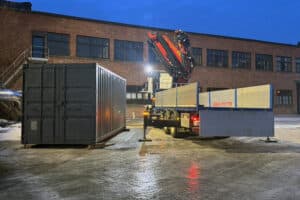
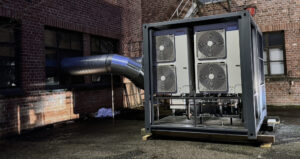
AirTreater Čáhci ships in a standard container, pre-configured and ready to connect. Commissioning including electrical connection takes one working day. Without a heat distribution network requirement, the system is fully operational within 4 hours of arriving on site.
What that means in practice:
- No permanent plant room space required on site
- No specialist civil works before the system can be commissioned
- No long lead times associated with fixed installation projects
- Full asset redeployment when the project completes, to the next site or the next phase
When the project moves, the system moves with it. That is the operational logic of a containerised construction site heat pump, and it is what distinguishes it from any fixed or semi-fixed heating infrastructure.
What to consider before choosing a heating solution for your site
Not every site has the same requirements. Before specifying a portable heat pump for construction, the following factors determine which configuration is appropriate.
Site size and heat demand. Čáhci’s 120 kW nominal capacity covers large enclosed structures. Smaller phases or sections may require a different configuration. Matching the unit to the actual demand prevents both undersupply and unnecessary capital deployment.
Minimum outdoor temperature. The guaranteed performance floor covers the majority of Finnish and northern European winter conditions. Confirm the site’s historical temperature range to validate the specification against actual operating conditions.
Heat distribution infrastructure. Čáhci operates on a liquid cycle. If no existing heat distribution network is in place, factor the installation timeline into the deployment plan. For sites where air-to-air distribution is more practical, a different product configuration may be more appropriate.
Project duration and redeployment intent. A containerised solution makes the strongest economic sense on projects of sufficient duration to recover the deployment cost, and where the asset can be redeployed afterward. For very short-duration heating requirements, discuss the timeline with the AirTreater team before specifying.
Remote management requirements. For sites that are not continuously staffed, the automated remote management platform provides real-time operational visibility and full settings control from any web browser, with access also available to named end users. This eliminates the need for on-site personnel to monitor system operation around the clock.
Get a heat pump deployed on your construction site
The specification process is straightforward. AirTreater’s team works directly with project engineers and site managers to match the system to the site’s heating demand, outdoor temperature conditions, and deployment timeline.
There are no permanent infrastructure commitments. Commissioning including electrical connection takes one working day. Without a heat distribution network requirement, the system is operational within 4 hours of arriving on site. When the project completes, the asset redeploys.
To discuss your site’s requirements and confirm which configuration is appropriate, contact the AirTreater team directly. Provide the site location, estimated heated area, project duration, and minimum expected outdoor temperature. The team will return a specification recommendation with a deployment timeline and operational parameters.
Contact AirTreater to request a technical specification for your construction site heating requirement.