Continuous remote fault detection stops reactive repairs by identifying abnormal operating conditions in real time, before they escalate into equipment failures. Instead of waiting for a system to break down and then dispatching a technician, remote fault detection flags deviations in temperature, pressure, flow rate, or energy consumption the moment they appear. The sections below address the most common questions industrial facility managers and plant engineers have about how this works in practice.
How does continuous remote fault detection actually work?
Continuous remote fault detection works by collecting live operational data from sensors embedded in heating and cooling equipment, comparing that data against defined performance parameters, and generating alerts when readings fall outside acceptable thresholds. The monitoring system runs without interruption, processing data streams in real time so that deviations are caught within minutes rather than discovered during the next scheduled inspection.
In a well-configured system, sensors measure variables such as outlet water temperature, refrigerant pressure, compressor operating cycles, flow rates, and electrical consumption. These readings feed into a central platform that applies logic rules: if outlet temperature drops below the setpoint while the compressor is running at full load, that pattern signals a specific fault condition rather than normal variation. The system does not simply alert on any deviation; it interprets the combination of signals to distinguish genuine faults from transient fluctuations.
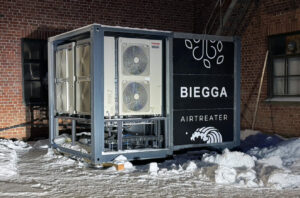
AirTreater systems use an automated remote management platform to deliver this capability. The platform provides a real-time operational dashboard accessible through a standard web browser, giving operators and support teams a continuous view of system behaviour without requiring anyone to be physically present on site. Named end users can also have access to the automation system. When a fault condition is detected, the platform generates an alert that can be acted on immediately, whether the site is staffed or unmanned.
What are the most common faults caught early by remote monitoring?
The most common faults caught early by continuous remote monitoring in industrial heating and cooling systems are refrigerant pressure anomalies, compressor performance degradation, heat exchanger fouling, flow rate reduction in liquid circuits, and sensor drift. Each of these develops gradually and produces measurable data signals well before the fault causes a system shutdown or process interruption.
Refrigerant pressure faults are among the earliest detectable issues. A slow refrigerant leak will cause suction pressure to drop progressively over days or weeks, reducing cooling or heating capacity before any visible symptom appears. Remote monitoring catches this trend and allows a technician to intervene while the system is still operational.
Compressor performance degradation follows a similar pattern. As a compressor loses efficiency, it draws more electrical current to achieve the same output. Monitoring energy consumption alongside outlet temperature reveals this mismatch early, enabling planned maintenance rather than emergency replacement.
Heat exchanger fouling reduces heat transfer efficiency, which appears in the data as a widening gap between expected and actual outlet temperatures at a given load. Flow rate reduction in liquid-cycle systems, caused by pump wear or partial blockages, shows up as reduced differential pressure across the circuit. Both are detectable weeks before they cause a measurable drop in delivered heating or cooling capacity.
What’s the difference between reactive repairs and predictive maintenance?
Reactive repairs address a fault after it has already caused a system failure or performance shortfall. Predictive maintenance uses continuous monitoring data to identify developing faults before failure occurs, scheduling intervention at a planned time with the correct parts and personnel already prepared. The operational and financial difference between these two approaches is significant for any facility where heating or cooling continuity is non-negotiable.
Reactive repairs carry several compounding costs beyond the repair itself. Unplanned downtime stops production processes or disrupts environmental conditioning. Emergency call-out rates for technicians are typically higher than scheduled service rates. Parts sourced urgently often carry premium costs. And if a compressor or heat exchanger fails completely rather than degrading gradually, the replacement scope and cost increase substantially.
Predictive maintenance eliminates most of these compounding costs. Because the fault is identified early, the maintenance window can be scheduled to minimise process disruption. The required parts are ordered in advance at standard pricing. The technician arrives knowing exactly what the fault is, reducing diagnostic time on site. The system continues operating at reduced efficiency rather than shutting down entirely.
For industrial cooling systems running continuous processes, the distinction is not merely financial. A system that fails unexpectedly at a biogas plant, a power generation facility, or a critical manufacturing process creates consequences that extend well beyond the cost of the repair itself. Predictive maintenance converts an unpredictable risk into a managed event.
How does remote fault detection reduce downtime in industrial cooling systems?
Remote fault detection reduces downtime in industrial cooling systems by compressing the time between fault onset and corrective action. Without remote monitoring, a fault develops undetected until it causes a performance failure or system shutdown, at which point diagnosis, parts procurement, and repair all happen sequentially under time pressure. With continuous remote fault detection, the same fault is identified at its earliest stage, and the response is planned rather than reactive.
The reduction in downtime comes from three specific mechanisms. First, early detection means the system often remains operational during the fault development period, so there is no unplanned shutdown at all. Second, remote diagnosis allows the support team to identify the fault type and likely cause before dispatching a technician, eliminating the diagnostic phase from the on-site visit. Third, because the fault is known in advance, the correct replacement parts arrive with the technician rather than requiring a second visit after diagnosis.
AirTreater’s 24/7/365 help desk service operates in direct connection with the automated remote management platform, meaning that when the platform generates a fault alert outside business hours, the response is not delayed until the next working day. For industrial cooling applications where process continuity is critical, this around-the-clock coverage is the operational difference between a managed intervention and an unplanned shutdown.
What data does a remote monitoring system need to detect faults reliably?
A remote monitoring system needs continuous data from at least four categories of measurement to detect faults reliably in industrial heating and cooling equipment: thermal performance data, mechanical operating data, electrical consumption data, and environmental condition data. Monitoring any single category in isolation produces incomplete fault signals that generate either missed detections or false alarms.
Thermal performance data includes outlet water temperature, return temperature, and the differential between them. This data confirms whether the system is delivering its nominal heating or cooling capacity under the current load and ambient conditions. A deviation here is the most direct indicator of a performance fault.
Mechanical operating data covers compressor run hours, refrigerant pressures on both the high and low side, and flow rates in liquid circuits. These measurements reveal the internal condition of the refrigeration cycle and the liquid distribution system, flagging developing faults in compressors, expansion valves, pumps, and heat exchangers.
Electrical consumption data, measured as power draw against expected values at a given operating point, identifies efficiency degradation. A compressor consuming more power than its performance curve predicts at a given pressure ratio is a reliable early indicator of mechanical wear.
Environmental condition data, specifically outdoor ambient temperature, is essential for contextualising all other readings. A heating system’s outlet temperature and compressor load are expected to vary with ambient conditions. Without ambient data, the monitoring system cannot distinguish between normal load-following behaviour and a genuine performance fault.
When should industrial facilities switch to continuous remote monitoring?
Industrial facilities should switch to continuous remote monitoring when the cost of unplanned downtime in their heating or cooling systems exceeds the cost of the monitoring infrastructure, or when process continuity requirements make any unplanned interruption operationally unacceptable. For most industrial cooling and heating applications, this threshold is reached well before the facility experiences its first major equipment failure.
There are specific operational scenarios where the case for continuous remote monitoring is immediate rather than gradual. Facilities running 24-hour processes with no scheduled maintenance windows cannot afford to discover faults during production. Remote or unmanned sites where no on-site personnel can observe equipment behaviour in real time have no alternative means of fault detection. Sites operating in extreme climates, where heating or cooling failure creates not just a process interruption but a safety or equipment protection issue, require continuous visibility as a baseline operational requirement.
The timing question also has a lifecycle dimension. Heating and cooling equipment that is within its first few years of operation may produce few fault signals, making continuous monitoring appear unnecessary. The value of the monitoring data accumulates over time, however, as the system builds a baseline of normal operating behaviour against which deviations become more precisely detectable. Facilities that implement continuous remote monitoring early establish this baseline before the equipment enters the higher-risk phase of its operating life.
For facilities evaluating this transition in 2026, the operational case is reinforced by the maturity of remote management platforms and the availability of integrated monitoring as a standard service offering rather than a custom installation. Contact the AirTreater team to discuss your site’s monitoring requirements and review the automated remote management platform capabilities for your specific heating or cooling application.