The pressure to go green is real. Regulations are tightening, energy costs are rising, and customers increasingly ask about sustainability credentials before signing contracts. For small businesses, the question is not whether to act; it is how to act without derailing operations or draining capital reserves.
The barriers to the green transition for small businesses are not due to a lack of willingness. They are structural, financial, and technical. Understanding them clearly is the first step toward overcoming them.
The Real Costs Blocking Small Business Sustainability
Upfront capital is the most immediate obstacle. Energy-efficient heating and cooling infrastructure carries a significant purchase price, and most small businesses do not have the balance sheet flexibility to absorb that investment in a single budget cycle.
The hidden costs compound the problem:
- Civil works and permanent installation requirements that add weeks of disruption and five-figure contractor fees
- Downtime during switchover from legacy systems to new infrastructure
- Maintenance contracts and specialist servicing for unfamiliar technology
- Energy audits, compliance documentation, and third-party verification costs
For small businesses with tight operating margins, these costs make the green transition feel less like an investment and more like a risk. The financial case for sustainability only holds if the transition itself does not destabilise the business that is supposed to benefit from it.
Knowledge Gaps and Regulatory Complexity
The EU regulatory landscape around energy efficiency is dense and accelerating. The revised Energy Performance of Buildings Directive, the Energy Efficiency Directive, and the F-gas Regulation all create overlapping compliance obligations, and the requirements are not static.
Small businesses rarely have a dedicated sustainability officer to track these changes. The result is a knowledge gap that creates two problems simultaneously:
- Uncertainty about which technologies qualify for grants, tax incentives, or regulatory compliance
- Risk of investing in equipment that becomes non-compliant as standards tighten
The EU buildings directive sets a 60% emissions reduction target for the buildings sector between 2015 and 2030. For a small business owner trying to run day-to-day operations, translating that regulatory target into a practical equipment decision is genuinely difficult without expert guidance.
Choosing the wrong technology, one that underperforms in real operating conditions or fails to meet emerging efficiency standards, is a costly mistake that delays the green transition rather than advancing it.
Operational Disruption and Technology Adoption Risks
Even when the financial case is clear and the regulatory picture is understood, small businesses face a third barrier: the operational risk of getting it wrong.
Conventional heating and cooling systems are often rated at optimal laboratory conditions. In practice, particularly in northern European climates where winter temperatures regularly fall below -10 °C, standard heat pumps derate significantly. A system specified at nominal output in controlled conditions may deliver a fraction of that capacity on the coldest days of the year, precisely when reliable performance is most critical.
The technology adoption risk for small businesses includes:
- Systems that cannot maintain setpoint temperatures in extreme cold, forcing expensive supplementary heating
- Complex integrations with existing building management or process control systems
- Remote or unmanned sites where equipment faults go undetected until they become operational failures
- Suppliers who are unavailable outside business hours when problems occur
The IEA heat pump analysis highlights that real-world performance gaps between rated and actual output remain one of the primary reasons businesses delay or abandon heat pump adoption. For small businesses with no margin for error, that gap is not acceptable.
How Industrial-Grade Climate Solutions Lower the Transition Threshold
The barriers above are real, but they are not insurmountable. The right equipment architecture directly addresses each one.
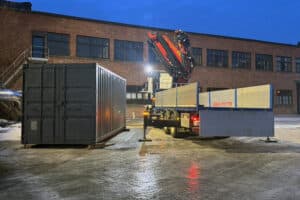
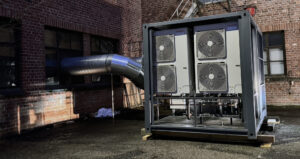
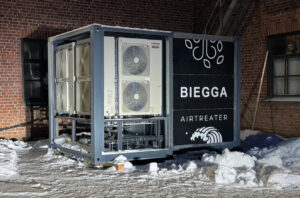
Containerised climate solutions eliminate the civil works problem. A system that arrives pre-configured, connects on site in a single working day, and reaches full operation within two working days of arrival does not require a construction project. It requires a connection point.
Guaranteed nominal capacity at all outdoor temperatures eliminates the performance risk. AirTreater Čáhci, for example, maintains 120 kW nominal heating output at -15 °C using compressors alone, with an integrated backup system that guarantees 300 kW of heating capacity even in the most demanding conditions. That is not a rated condition. It is a guarantee.
Remote management eliminates the monitoring gap. AirTreater systems operate via Ouman’s remote management platform, giving operators real-time visibility and full settings control through a standard web browser, from any location, at any time. A 24/7/365 help desk service means that when an alert triggers at 2 a.m. on a Sunday, support is available.
For small businesses evaluating the green transition, these operational characteristics change the risk calculation fundamentally:
- No permanent infrastructure commitment: the system relocates as operational needs change
- Guaranteed performance in actual northern European operating conditions, not laboratory conditions
- Real-time remote oversight without requiring on-site personnel
- Integration with existing automation systems, reducing switchover disruption
- Energy-efficient operation that translates directly to lower running costs from day one
The green transition barriers for small businesses are primarily about risk: financial risk, performance risk, and operational risk. Industrial-grade containerised solutions are designed to remove each of those risks from the equation.
Take the Next Step Toward a Greener Operation
The barriers to the green transition are genuine. But waiting for conditions to be perfect, for capital to be more available, for regulations to stabilise, for technology to mature, means paying higher energy costs and facing stricter compliance obligations in the interim.
The right question is not whether to transition, but how to do it without operational disruption or financial overexposure.
AirTreater’s team works with small and mid-sized businesses to assess site requirements, identify the right containerised solution, and plan a deployment that minimises disruption from day one. There is no obligation, only a technical conversation about what your operation actually needs.
Contact the AirTreater team to discuss your site requirements and get a clear picture of what a practical, guaranteed-performance green transition looks like for your operation.