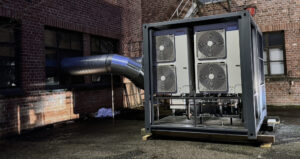
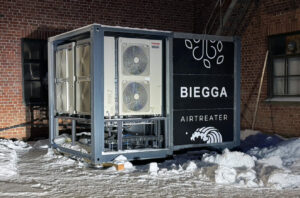
AirTreater Biegga is a containerised, air-to-air heat pump designed for large open spaces that require direct forced-air heating or cooling without a liquid distribution network. It delivers 84 kW of heat pump capacity, backed by an 81 kW electric heating element, for a maximum combined heating output of 165 kW. The sections below answer the most common technical questions about how Biegga works, what it is built for, and how it compares to AirTreater’s liquid-cycle alternative.
How does an air-to-air heat pump actually transfer heat?
An air-to-air heat pump extracts thermal energy from outdoor air and transfers it directly into an indoor space as conditioned airflow. A refrigerant circuit absorbs heat from the outside air through an evaporator coil, compresses the refrigerant to raise its temperature, then releases the heat through an indoor condenser coil into the supply air stream. The same cycle runs in reverse for cooling.
In heating mode, the compressor raises the refrigerant temperature high enough that the indoor coil delivers warm air even when outdoor temperatures are well below freezing. In cooling mode, the cycle extracts heat from the indoor air and rejects it outside. Because the system moves heat rather than generating it through resistance, it delivers significantly more thermal energy per unit of electricity consumed than a conventional electric heater. This coefficient of performance advantage is the core engineering reason heat pumps are preferred over direct electric heating in high-capacity applications.
AirTreater Biegga uses this refrigerant-cycle mechanism to condition large volumes of air directly, distributing heated or cooled air through the space without any intermediate water loop or hydronic pipework.
What are Biegga’s heating and cooling capacity figures?
AirTreater Biegga delivers 84 kW of heat pump heating capacity. Its integrated backup heating element adds a further 81 kW, bringing the maximum combined heating output to 165 kW. On the cooling side, Biegga delivers a maximum of 81 kW. These figures represent guaranteed nominal capacity, not laboratory-condition ratings.
The distinction between nominal capacity and peak or rated capacity matters in practice. Conventional heat pumps are typically specified at optimal ambient conditions, and their output drops as outdoor temperatures fall — like 40% at -15 °C for some competitor systems. AirTreater systems are designed and guaranteed to deliver at least nominal capacity at all outdoor temperatures. For Biegga, the heat pump compressors maintain their 84 kW heating output regardless of outdoor conditions, with the integrated electric element available as a backup when additional thermal load is required, and at least 81 kW at all outdoor temperatures.
The 165 kW maximum heating figure therefore reflects the combined output of both systems operating simultaneously under the most demanding conditions, not an optimistic headline number that requires specific weather to achieve.
What types of spaces is Biegga designed for?
AirTreater Biegga is designed for large, open-plan spaces where air can be distributed directly without a liquid heating or cooling network. Warehouses, production halls, temporary construction enclosures, logistics facilities, and large maintenance buildings are typical applications. The air-to-air format means no hydronic pipework, no buffer tanks, and no heat exchangers are required in the target space.
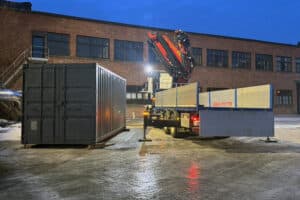
The containerised form factor makes Biegga particularly well suited to sites where permanent infrastructure is not available or where the climate control requirement is temporary. Because the system ships as a complete, pre-configured unit, it can start up within 4 hours of arriving on site when no heat distribution network is required, with full commissioning including electrical connection completed within one working day. When the project or operational requirement moves, the container moves with it.
Biegga is less suited to spaces that already have a hydronic distribution network, or to applications requiring precise zone-by-zone temperature control through separate air handling units. For those scenarios, AirTreater Čáhci, which produces heated or chilled water for distribution through existing pipework, is the more appropriate choice.
How does Biegga’s backup heating system work?
Biegga’s integrated backup system is an 81 kW electric heating element built into the unit. It activates to supplement the heat pump compressors when the thermal load exceeds what the refrigerant circuit alone can deliver, or when conditions require additional output to maintain the target setpoint. The backup element and the heat pump compressors can operate simultaneously, which is how Biegga reaches its 165 kW maximum heating output.
The integrated backup system is not a separate appliance or an afterthought add-on. It is designed as part of the system’s capacity architecture, ensuring that the guaranteed nominal heating output is maintained under all operating conditions. This matters in environments where outdoor temperatures drop to levels that would cause a standalone heat pump to derate, because the electric element compensates for any shortfall in heat pump output and holds the total delivered capacity at or above the nominal figure.
From an operational standpoint, the backup element engages automatically based on the control system’s assessment of load and setpoint. Operators do not need to intervene manually to activate supplementary heating.
What’s the difference between Biegga and Čáhci?
The core difference is the heat distribution medium. AirTreater Biegga is an air-to-air system that delivers conditioned air directly into the target space. AirTreater Čáhci is an air-to-water system that produces heated or chilled water for circulation through a liquid distribution network. The right choice depends on whether the site has existing hydronic infrastructure and how heat needs to be distributed.
When Biegga is the appropriate choice
Biegga suits open spaces where direct forced-air delivery is sufficient and no liquid distribution network exists or is planned. Its simpler site connection requirements mean faster deployment and lower installation complexity. With a maximum heating output of 165 kW and a maximum cooling output of 81 kW, it covers large single-zone spaces without requiring additional site infrastructure.
When Čáhci is the appropriate choice
AirTreater Čáhci is the correct selection for sites where heat or cooling needs to be distributed through pipework to multiple zones or air handling units, or where the site already has a hydronic network. Čáhci maintains 120 kW of nominal heating capacity at -15 °C using compressors alone, with a maximum output of 420 kW at -15 °C. The heat pump operates down to -28 °C, and below -28 °C the integrated backup system guarantees at least 300 kW of heating output even without external electric power in hazardous situations. It can also be configured with a ground source heat pump if a borehole field is available on site, or with an electric boiler as the backup heat source. For applications where heat distribution infrastructure already exists, Čáhci typically delivers better efficiency and more even temperature distribution than an air-to-air approach.
Can Biegga be monitored and controlled remotely?
Yes. AirTreater Biegga integrates with an automated remote management platform, which gives operators real-time visibility of system operation and full settings control through a standard web browser. No specialist software or on-site presence is required to monitor performance or adjust setpoints. The system is accessible from any location at any time. Named end users can also have access to the automation system.
The automation platform displays live operational data, including temperature readings and system status, and allows parameter adjustments to be made directly from the browser interface. This is particularly relevant for sites that are unmanned or remotely located, where on-site intervention for routine adjustments would be impractical.
Beyond the remote management platform, AirTreater operates a 24/7/365 help-desk service through its service centre. If a fault condition arises outside standard business hours, support is available without delay. Biegga can also be integrated into existing building automation or industrial control systems, allowing it to operate within a broader site management architecture rather than as a standalone unit.