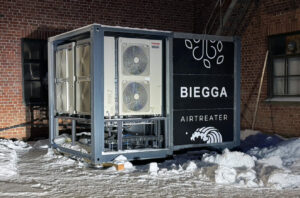
AirTreater Čáhci is a containerised air-to-water heat pump designed for large industrial and commercial sites that require guaranteed heating or cooling capacity delivered through a liquid distribution network. It maintains 120 kW of nominal heating capacity even at very low temperatures using compressors alone, with a maximum output of 420 kW at the same outdoor temperature. The sections below address how the system works, where it is used, and how it is managed and deployed.
What makes Čáhci different from standard heat pumps?
AirTreater Čáhci guarantees nominal heating and cooling capacity at all outdoor temperatures. Conventional heat pumps are rated under optimal laboratory conditions and derate significantly as temperatures drop. Čáhci delivers 120 kW of nominal capacity even at very low temperatures using compressors alone, with a maximum output of 420 kW at the same threshold. That is not a rated condition — it is a guarantee.
Most standard air-source heat pumps on the market lose a substantial portion of their output as outdoor temperatures fall below 0 °C. At very low temperatures, many conventional systems operate well below their nominal specification, forcing operators to add supplementary heating or accept reduced output. Čáhci is engineered so that the performance cliff simply does not exist. The system is built to perform in Finnish winter conditions, where sub-zero temperatures are not edge cases — they are the operating reality for months at a time.
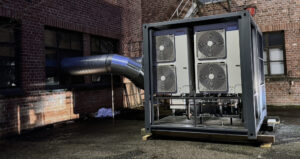
The containerised format reinforces this differentiation. Čáhci ships as a pre-configured unit in a standard container, requiring no permanent plant room, no civil works, and no specialist infrastructure for commissioning. This separates it from fixed installations that demand long lead times and site-specific construction before a single kilowatt is delivered.
How does the Čáhci air-to-water system work?
AirTreater Čáhci operates as an air-to-water heat pump, extracting thermal energy from outdoor air and transferring it into a liquid circuit. That heated or chilled water then circulates through the site’s heat distribution network — underfloor systems, radiators, fan coil units, or process heat exchangers — to deliver energy precisely where it is needed.
The liquid-cycle approach is what distinguishes Čáhci from air-to-air systems. Rather than conditioning air directly, Čáhci produces a stable flow of heated or cooled water that can be distributed across large floor areas or between multiple zones from a single central unit. This makes it particularly effective in facilities where even temperature distribution matters and where the distribution infrastructure already exists or can be installed as part of a project.
At the core of the system are compressors that maintain performance across the full outdoor temperature range. The refrigerant circuit extracts heat from ambient air even at very low temperatures, where the temperature differential between the refrigerant and the air remains sufficient to drive the heat transfer process. The outlet water temperature is maintained at levels compatible with high-temperature hydronic systems, enabling direct integration with existing heating networks without supplementary heating under normal operating conditions.
What sites and applications is Čáhci designed for?
AirTreater Čáhci is designed for large sites that require stable, high-capacity heating or cooling through a liquid distribution network. Typical applications include industrial production halls, construction site welfare and process heating, temporary infrastructure at energy facilities, and any location where a hydronic heat distribution system is in place or planned.
The system is particularly well suited to sites where permanent installation is impractical or undesirable. Because Čáhci is containerised, it can serve a construction project for its full duration and then be redeployed to the next site when the project is completed. No plant room is required, and no infrastructure investment is left behind.
For sites where a borehole field is available, Čáhci can be configured with a ground-source heat pump in place of the air-source circuit, improving efficiency in conditions where ground temperatures are more stable than outdoor air. This configuration suits permanent or semi-permanent installations where the site has existing geothermal infrastructure or where drilling a borehole field is part of the project scope.
What backup and hybrid options does Čáhci support?
AirTreater Čáhci supports two integrated backup configurations: an electric boiler and a ground-source heat pump. The heat pump operates down to -28 °C. Below -28 °C, the integrated backup system guarantees at least 300 kW of heating capacity even without external electric power in hazardous situations, ensuring that nominal output is maintained regardless of outdoor temperature extremes.
The electric boiler option is appropriate for sites where sufficient electrical capacity is available and where a simple, reliable backup is required. It activates automatically when conditions demand it, maintaining the setpoint without operator intervention. The ground-source option suits sites with an existing borehole field, delivering higher efficiency than resistance heating while providing the same operational continuity guarantee.
Both configurations are integrated at the system level — not bolted on as afterthoughts. The backup circuit is part of the Čáhci system architecture, which means switchover is managed automatically and the operator sees a single unified system rather than two separate units requiring independent management. For procurement engineers evaluating total system reliability, this integration is a meaningful distinction from solutions that pair a primary unit with a separate backup appliance.
How is Čáhci monitored and controlled remotely?
AirTreater Čáhci is monitored and controlled via an automated remote management platform. The platform provides a real-time view of system operation and allows operators to adjust settings directly from a standard web browser, from any location, at any time. No specialist software or on-site presence is required for routine monitoring or parameter adjustments. Named end users can also be granted access to the automation system.
The automation platform delivers the operational data that facility managers and plant engineers need to verify that the system is running within specification: outlet water temperature, compressor status, backup circuit activity, and energy consumption figures are all accessible through the dashboard. For sites that are unmanned for extended periods, this visibility is not a convenience — it is a prerequisite for safe, continuous operation.
Beyond remote management, AirTreater operates a 24/7/365 help-desk service through its service centre. If an alarm condition arises or an operator needs technical guidance outside standard working hours, support is available immediately. For industrial processes and facilities where a heating or cooling interruption carries real operational consequences, this round-the-clock availability is a baseline requirement that AirTreater meets as standard.
Čáhci is also designed to integrate with existing building management and industrial automation systems. Sites that already operate a SCADA or BMS infrastructure can incorporate Čáhci into their existing monitoring environment rather than managing it as a separate system.
How quickly can a Čáhci unit be deployed on site?
AirTreater Čáhci connects on site in a single working day, including electrical connection. Where no heat distribution network is required or the network is already in place, the system is fully operational within 4 hours of arriving on site. No civil works, no permanent plant room construction, and no specialist groundwork are required before the unit can be commissioned.
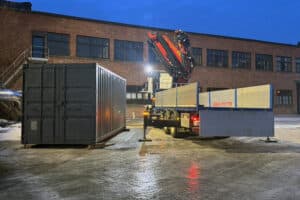
The container format is the enabler of this timeline. Čáhci ships pre-configured and ready to connect, which means the on-site work is limited to positioning the container, making the electrical and hydraulic connections, and commissioning the controls. The logistics are straightforward: standard container handling equipment is sufficient, and the unit can be positioned wherever the site layout requires.
For construction project managers and industrial operators working to a fixed schedule, this deployment timeline has direct cost implications. A system that is operational within 4 hours of delivery (where no heat distribution network is required) eliminates the weeks or months of lead time associated with fixed installations, and it removes the risk of a heating or cooling gap during a critical project phase. When the project is completed or operational requirements change, the container is disconnected and redeployed — leaving no infrastructure behind and no asset stranded on site.