Climate control in military and defense facilities refers to the engineered management of temperature, humidity, and air quality across operational spaces that cannot tolerate system failure. Unlike commercial buildings, defense facilities include environments ranging from weapons storage vaults to active command centers, where climate conditions directly affect both equipment reliability and personnel readiness. The sections below address the specific technical and operational requirements that distinguish defense facility HVAC from standard building services.
What makes climate control in defense facilities different from commercial buildings?
Climate control in defense facilities differs from commercial buildings primarily in its operational criticality and the consequences of failure. In a commercial office, a heating or cooling interruption is an inconvenience. In a defense facility, it can mean degraded communications equipment, compromised weapons storage conditions, or reduced personnel effectiveness during active operations. The systems must perform continuously, not just adequately.
Defense facility HVAC systems also operate under stricter reliability requirements because many spaces run 24 hours a day, 365 days a year, with no scheduled downtime windows. Commercial buildings can tolerate planned maintenance outages during off-hours. Military climate control systems must maintain setpoints during those same periods, which drives the requirement for redundant systems and integrated backup capacity.
Security constraints add another layer of complexity. Defense facilities often restrict who can access mechanical plant rooms, which limits the pool of qualified service personnel. This makes remote management capability and self-diagnosing systems operationally important in ways that simply do not apply to a commercial office block.
What types of environments inside military facilities require climate control?
Military facilities contain several distinct environment types, each with specific temperature and humidity requirements. Command and communications centers require stable, cool conditions to protect sensitive electronics. Weapons and ammunition storage areas require precise humidity control to prevent corrosion and degradation. Barracks and personnel areas require heating and cooling for occupant readiness. Vehicle maintenance workshops require frost-free conditions and ventilation for fume extraction.
Beyond these core spaces, defense facilities increasingly include server rooms and data infrastructure supporting battlefield management systems, which demand cooling loads comparable to civilian data centers. Medical facilities on military bases require sterile, temperature-controlled environments aligned with clinical standards. Fuel and hazardous material storage areas require ventilation systems designed to prevent vapor accumulation.
The challenge for defense facility HVAC design is that these environments often exist within the same installation, requiring different climate zones, independent control circuits, and the ability to prioritize critical spaces during partial system operation.
How do military-grade climate control systems handle extreme outdoor temperatures?
Military-grade climate control systems handle extreme outdoor temperatures by guaranteeing nominal heating and cooling capacity at all outdoor conditions, not just at rated laboratory conditions. Conventional heat pumps derate significantly at low ambient temperatures, delivering progressively less output as outdoor temperatures fall. Systems designed for defense applications maintain their specified output regardless of what the thermometer reads outside.
This performance guarantee is achieved through a combination of oversized heat exchanger surface area, compressor selection optimized for low ambient operation, and integrated backup systems that activate automatically when outdoor temperatures push beyond the primary circuit’s efficient operating range. The backup capacity is not a separate system bolted on as an afterthought – it is engineered into the overall heat balance from the design stage.
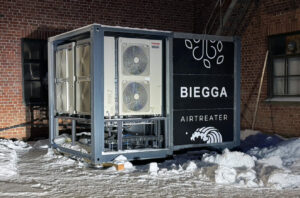
For installations in northern Europe, Scandinavia, or high-altitude environments, the ability to maintain full output even at very low temperatures is not an edge case requirement – it is a baseline operational specification. AirTreater Biegga, for example, guarantees a minimum of 81 kW output at all outdoor temperatures, with a maximum heating capacity of 165 kW delivered through 84 kW of heat pump capacity combined with 81 kW of electric resistance backup. The system does not ask the operator to plan around weather conditions.
What are the key requirements for HVAC systems in defense applications?
The key requirements for HVAC systems in defense applications are guaranteed performance at all operating temperatures, system redundancy, rapid deployability, compliance with procurement standards, and remote management capability. Each of these requirements reflects a specific operational reality of defense environments that standard commercial HVAC specifications do not address.
- Guaranteed nominal capacity at all temperatures: Performance must be specified as a guarantee under actual site conditions, not as a laboratory rating that degrades in cold weather.
- Integrated redundancy: Primary and backup heating or cooling capacity must be built into the same system, not dependent on a separate unit that may not be available.
- Rapid deployment capability: Forward operating bases and temporary installations require systems that can be operational within hours of arriving on site, not weeks. Containerised systems that connect within a single working day meet this requirement directly.
- Procurement compliance: Defense procurement requires verifiable quality and reliability documentation. NATO supplier registration, such as NCAGE code A04WG held by AirTreater, is a prerequisite for many defense procurement processes.
- Remote management: Unmanned or restricted-access sites require systems that can be monitored and adjusted remotely without requiring on-site technical personnel for every operational change.
- Integration with existing automation: Defense facilities often operate building management systems that new climate control equipment must integrate with, rather than replace.
What’s the difference between fixed and portable climate control in military use?
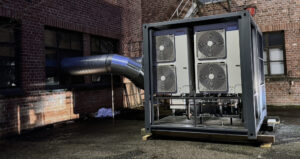
Fixed climate control systems in military use are permanently installed in purpose-built plant rooms and are designed around the specific heat loads and distribution infrastructure of a single facility. Portable, or more accurately containerised, climate control systems are self-contained units that can be transported, deployed at a new location, connected within a single working day, and redeployed when operational requirements change.
Fixed systems: permanence and integration depth
Fixed systems offer the advantage of full integration with a building’s structural fabric – hydronic pipework, air handling units, and building management systems can all be designed around the central plant. They are appropriate for permanent garrison facilities, established air bases, and long-term military infrastructure where the installation will serve the same purpose for decades. The trade-off is that they require civil works, long lead times, and cannot be relocated if the facility’s function changes or if the installation is decommissioned.
Containerised systems: mobility and deployment speed
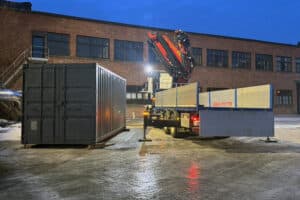
Containerised climate control systems are designed for the operational reality that military requirements change. A forward operating base may need full heating capacity within 48 hours of site establishment. A temporary command post may need cooling during a summer exercise and then need to be relocated. A permanent facility may need supplementary capacity during a planned maintenance outage of its fixed plant. Containerised systems address all three scenarios without requiring permanent infrastructure investment. A well-specified containerised unit connects on site in a single working day and can be fully operational within 4 hours of arriving on site when no heat distribution network is required, without requiring specialist civil works or a dedicated plant room.
How is remote monitoring used in military climate control systems?
Remote monitoring in military climate control systems gives operators real-time visibility into system performance, active fault alerts, and full settings control from any location with a network connection. This capability is operationally significant in defense contexts because many military sites are either unmanned, access-restricted, or located in environments where deploying a service technician on short notice is impractical or operationally inappropriate.
In practice, automated remote management platforms allow facility managers or contracted service teams to view outlet temperatures, compressor status, energy consumption, and alarm histories through a standard web browser. Settings adjustments – setpoint changes, operating mode switches, scheduled overrides – can be made remotely without requiring physical access to the unit. When an alarm condition occurs, the system can route alerts directly to a service center that responds immediately, rather than waiting for the next scheduled site visit.
For defense applications specifically, the ability to maintain climate conditions in a communications facility or weapons storage area without requiring a technician to enter a secure zone is both a security and an operational efficiency benefit. Systems that integrate with existing building automation infrastructure via standard communication protocols extend this capability across entire installations, not just individual units.
AirTreater systems connect via an automated remote management platform, which provides 24/7/365 access through GSM or bus connection. Named end users can also have access to the automation system. The platform supports real-time fault analysis and remote adjustment, with alerts routed to a service center that initiates corrective action without waiting for a site visit request. For procurement teams evaluating climate control for defense or critical infrastructure applications, contact our team to discuss NATO procurement documentation and technical specifications.