Air-to-air and air-to-water heat pumps differ in how they transfer and distribute thermal energy: air-to-air systems deliver conditioned air directly into a space, while air-to-water systems transfer heat into a liquid circuit for distribution through radiators, underfloor networks, or process equipment. In industrial settings, this distinction determines which applications each system can serve, how efficiently it operates at scale, and how reliably it performs under demanding conditions.
The sections below address the specific questions that industrial facility managers and procurement engineers encounter when evaluating these two heat pump types.
Which industries use air-to-water heat pumps instead of air-to-air?
Industries that require precise temperature control across large areas, or that need heat delivered to process equipment rather than directly into a space, consistently choose air-to-water heat pumps over air-to-air systems. Liquid-cycle distribution is more practical wherever a single heat source must serve multiple zones, where heat must travel significant distances, or where the end application is a process rather than a room.
The most common industrial sectors that specify air-to-water systems include:
- Manufacturing and production facilities where process heating or cooling is integrated into equipment rather than delivered to the ambient environment
- Biogas and energy production plants where continuous process cooling at a defined temperature setpoint is critical to plant operation
- Construction sites requiring temporary heating of large enclosed structures through a portable hydronic network
- Defence and military installations where containerised, deployable infrastructure must heat multiple connected structures from a single unit
- Remote and off-grid industrial operations where a self-contained liquid-cycle system eliminates the need for permanent plant room infrastructure
Air-to-air systems remain appropriate for smaller, single-zone commercial or light industrial spaces where direct air conditioning is sufficient and no process heating or cooling requirement exists. Once a site requires multi-zone distribution or process-level temperature control, the hydronic circuit of an air-to-water system becomes operationally necessary rather than merely preferable.
How does heat distribution work differently in each system?
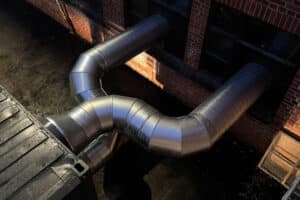
In an air-to-air heat pump, the refrigerant circuit transfers heat directly to or from the air inside a space via an indoor fan coil unit. Distribution is immediate but limited to the area served by that unit. In an air-to-water heat pump, the refrigerant transfers heat to a water or glycol circuit, which then carries thermal energy to radiators, underfloor heating, fan coil units, or process heat exchangers anywhere the pipework reaches.
The practical consequence of this difference is significant at industrial scale. An air-to-air system heats or cools one zone per indoor unit. Covering a large facility requires multiple independent refrigerant circuits, each with its own outdoor unit. An air-to-water system, by contrast, uses a single heat source to supply an entire hydronic network. This makes liquid-cycle distribution inherently more scalable for large or multi-zone sites.
Liquid circuits also allow heat to be delivered to applications that cannot receive conditioned air at all, such as process tanks, heat exchangers embedded in equipment, or district heating networks connecting separate buildings. Air-to-air systems have no equivalent capability. For any application where the end use is thermal energy transfer rather than space conditioning, air-to-water is the only viable heat pump category.
What are the efficiency differences between air-to-air and air-to-water heat pumps?
At equivalent outdoor temperatures, air-to-air and air-to-water heat pumps operate at broadly similar refrigeration cycle efficiencies. The meaningful efficiency differences emerge from distribution losses, operating temperature requirements, and performance at low ambient temperatures. Air-to-water systems distributing heat at lower temperatures, such as underfloor heating circuits, can achieve higher coefficients of performance than systems supplying high-temperature radiators or process heat.
Distribution losses are a key variable. Air distribution systems lose energy through duct leakage and thermal transfer across duct surfaces. Hydronic systems lose energy through pipe heat loss, but well-insulated pipework in a compact industrial installation typically performs well in this regard. For large industrial buildings, hydronic distribution generally delivers more consistent temperatures across the space than ducted air systems, which tend to produce temperature gradients.
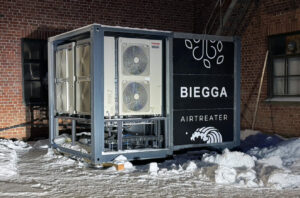
Cold-weather performance is where the efficiency comparison becomes operationally critical. Conventional heat pumps of both types derate significantly as outdoor temperatures fall, because the refrigerant cycle becomes less effective as the temperature differential between source and output increases. Systems that guarantee nominal capacity at all outdoor temperatures eliminate this performance cliff entirely. AirTreater Čáhci, for example, maintains 120 kW of nominal heating capacity even at very low temperatures using compressors alone, with a maximum output of 420 kW, and the heat pump operates down to -28 °C. Below -28 °C, an integrated backup system guarantees at least 300 kW of heating capacity even without external electric power in hazardous situations. This is a guarantee, not a rated condition.
Can air-to-water heat pumps handle both heating and cooling in industrial processes?
Air-to-water heat pumps can operate in both heating and cooling modes, making them capable of serving industrial processes that require temperature control in both directions. In heating mode, the system extracts heat from outdoor air and transfers it to the liquid circuit. In cooling mode, the refrigerant cycle reverses, extracting heat from the liquid circuit and rejecting it to outdoor air. The same hydronic distribution network serves both functions.
For process cooling specifically, air-to-water systems offer an additional efficiency advantage in cold climates: a free-cooling function. When outdoor temperatures fall sufficiently, the system can reject heat from the liquid circuit directly to ambient air without engaging the compressor circuit at all. This delivers cooling capacity energy-efficiently at a fraction of the energy consumption of compressor-based operation, while simultaneously eliminating the mechanical wear associated with continuous compressor use.
AirTreater Prosea demonstrates this capability directly: it delivers cooling without engaging compressors when outdoor temperatures are sufficiently low, as each Prosea system is designed for the specific demands of the project and site it serves. For process cooling applications in northern climates, this means compressor-free operation for a substantial portion of the year, with the compressor circuit engaging only when ambient temperatures rise above the free-cooling threshold. The result is a system that handles both heating and cooling demands while minimising energy consumption and mechanical failure risk across the full operating year.
When should an industrial site choose air-to-water over air-to-air?
An industrial site should choose an air-to-water heat pump when heat distribution must reach multiple zones, when the end application is process equipment rather than a space, when the site requires both heating and cooling through a single system, or when the distribution network already exists in hydronic form. Air-to-air systems are appropriate only when direct space conditioning of a single zone is the sole requirement.
Specific decision criteria that consistently point toward air-to-water selection include:
- The facility has or can install a hydronic distribution network connecting multiple spaces or buildings
- Process equipment requires liquid-side thermal control at a defined temperature setpoint
- The site operates in a cold climate where guaranteed nominal capacity at all outdoor temperatures, including sub-zero conditions, is a procurement requirement
- The installation is temporary or must be relocatable, making a containerised air-to-water unit operationally preferable to multiple fixed air-to-air units
- The site requires both heating and cooling, with the efficiency gains of a free-cooling function during cold months being operationally or commercially significant
- A single heat source supplying a large or multi-zone area is preferable to managing multiple independent refrigerant circuits
For sites where heat distribution infrastructure already exists, a liquid-cycle system will typically deliver better efficiency and more even temperature distribution than an air-to-air system. For sites where no infrastructure exists, the deployment of a containerised air-to-water system with its own hydronic circuit remains viable and is frequently faster to commission than installing multiple air-to-air units across a large facility.
What installation and logistics factors differ between the two heat pump types?
Air-to-air heat pump installation requires indoor fan coil units in each zone served, refrigerant pipework between indoor and outdoor units, and electrical connections. Air-to-water installation requires an outdoor heat pump unit, a hydronic distribution circuit, and connections to terminal units such as radiators, fan coils, or process heat exchangers. The hydronic circuit adds complexity at the distribution level but simplifies the heat source: one outdoor unit can serve an entire building rather than one unit per zone.
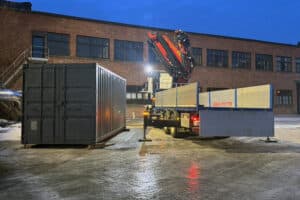
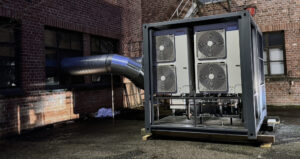
For temporary or mobile industrial applications, the logistics difference becomes more pronounced. Air-to-air systems are typically fixed installations that require civil works for mounting and cannot be relocated without significant labour. Containerised air-to-water systems are shipped as complete, pre-configured units that connect to site services and a hydronic circuit on arrival.
AirTreater’s containerised systems connect on site in a single working day. Where no heat distribution network is required, the system is fully operational within 4 hours of arrival. When the project completes or operational requirements change, the container is disconnected and relocated without permanent infrastructure commitment. This deployment model is not achievable with conventional air-to-air installations, which are fixed to the structure they serve. For construction sites, temporary industrial operations, or any application where asset redeployment is a future requirement, the logistics case for a containerised air-to-water system is direct and measurable.