AirTreater Čáhci is not a chiller replacement in the conventional sense — it is a fundamentally different category of equipment. Where a traditional chiller produces only chilled water, Čáhci is an air-to-water heat pump that delivers both heating and cooling through the same liquid-cycle system, with nominal capacity guaranteed at all outdoor temperatures. The sections below address the most common technical questions procurement engineers and facility managers raise when evaluating Čáhci against a conventional chiller.
Can a Čáhci replace a chiller in an industrial facility?
AirTreater Čáhci can replace a traditional chiller in most industrial facilities where the primary requirement is process cooling or temperature-controlled liquid distribution. Čáhci delivers up to 420 kW of total capacity and maintains its nominal output regardless of outdoor temperature, making it a direct functional substitute for chiller systems in a wide range of process and comfort cooling applications.
The more precise answer is that Čáhci does not simply replace a chiller — it replaces a chiller and a boiler simultaneously. Because Čáhci operates as an air-to-water heat pump, the same containerised system that produces chilled water in summer delivers heated water in winter. For facilities currently running separate heating and cooling plants, this consolidation has meaningful implications for capital cost, footprint, and operational complexity.
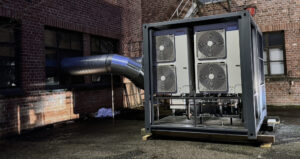
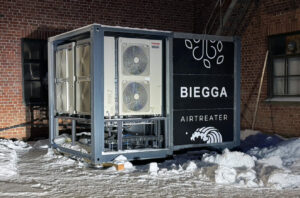
Where Čáhci diverges from a conventional chiller is in its form factor and deployment model. The system ships in a standard container, connects to an existing liquid distribution network in a single working day, and is operational within 4 hours of arriving on site when no heat distribution network is required. There is no permanent plant room required and no civil works commitment. When operational requirements change, the unit can be relocated with the project.
How does a traditional chiller work compared to Čáhci?
A traditional chiller removes heat from a liquid — typically water or a glycol mix — by passing it through a refrigerant circuit that transfers that heat to the ambient air via a condenser. The process produces chilled water for distribution through a facility’s cooling network. Chillers are single-function machines: they cool. AirTreater Čáhci uses the same refrigerant-cycle principle but operates as a reversible air-to-water heat pump, extracting heat from outdoor air to produce either heated or chilled water on demand.
The mechanical architecture is comparable: both systems use compressors, refrigerant circuits, and heat exchangers. The key engineering difference is directionality. A chiller always moves heat out of the building. Čáhci moves heat in either direction depending on the setpoint, using the outdoor air as both the heat source in heating mode and the heat sink in cooling mode.
A second structural difference is the integrated backup system. Čáhci carries an integrated backup that ensures a guaranteed minimum of at least 300 kW of heating capacity even under extreme sub-zero conditions. The heat pump operates down to -28 °C, and below -28 °C the backup system guarantees at least 300 kW even without external electric power in hazardous situations. A conventional chiller has no equivalent redundancy for heating — because it was never designed to heat.
What are the energy efficiency differences between Čáhci and a chiller?
Čáhci delivers significantly better energy efficiency than a conventional chiller for facilities that require both heating and cooling across the year. In heating mode, an air-to-water heat pump like Čáhci moves heat rather than generating it, which means the energy output substantially exceeds the electrical input — a characteristic conventional chillers do not share because they do not produce useful heat output at all.
In cooling mode, the efficiency comparison is more site-specific. A well-specified chiller operating at its design conditions can be highly efficient. The critical variable is outdoor temperature. Chillers are rated at a defined set of ambient conditions, and their efficiency degrades as outdoor temperatures rise or fall from those design points. Čáhci is engineered and guaranteed to maintain nominal capacity at all outdoor temperatures — including extreme cold — which removes the performance variability that makes chiller efficiency calculations difficult in northern climates.
For facilities in Finland and other northern European locations, the seasonal efficiency advantage of Čáhci is compounded by the extended heating season. A facility running a chiller for summer cooling and a separate boiler for winter heating is operating two separate energy systems. Čáhci consolidates that load into a single heat pump circuit, eliminating the energy losses and capital costs associated with running parallel infrastructure.
What happens to a chiller’s performance in cold weather?
A traditional chiller’s performance degrades in cold weather, and in extreme cold it may shut down entirely. Chillers are rated at specific ambient conditions — typically around +35 °C ambient for peak load calculations — and their capacity and efficiency both decline as outdoor temperatures drop significantly below or rise above those design points. At sub-zero temperatures, many chiller models require low-ambient kits, head pressure controls, or operational restrictions to function at all.
This is not a marginal concern in northern climates. A chiller specified for a peak summer cooling load may deliver significantly reduced capacity during shoulder-season operation when outdoor temperatures are low but process cooling is still required. Procurement engineers evaluating chillers for year-round industrial process cooling need to request performance curves across the full ambient temperature range — not just at rated conditions.
AirTreater Čáhci operates under a different guarantee. The system maintains 120 kW of nominal heating capacity even at very low temperatures using compressors alone, with the heat pump operating down to -28 °C and the integrated backup system ensuring at least 300 kW of heating capacity is available below -28 °C even without external electric power in hazardous situations. For cooling applications in cold weather, the refrigerant circuit continues to operate within its designed parameters without the low-ambient performance cliff that affects conventional chiller designs.
Which is better for sites that need both heating and cooling?
For sites that require both heating and cooling — whether seasonally or simultaneously — AirTreater Čáhci is the more operationally efficient choice. A single Čáhci installation delivers up to 420 kW in combined heating and cooling capacity through one liquid-cycle system, eliminating the need to procure, install, and maintain separate heating and cooling plants. Conventional chillers produce only chilled water and must be paired with a separate heat source for any heating requirement.
The operational argument is straightforward: fewer systems mean fewer failure points, lower maintenance overhead, and simpler operational management. The capital argument is also clear for new installations or projects where permanent infrastructure does not yet exist. For retrofit scenarios where a heating plant is already in place and functioning well, the calculus depends on the remaining service life of that existing equipment and the cost of integrating a new liquid-cycle distribution network.
Čáhci also supports integration with existing automation systems and is managed via an automated remote management platform, which provides real-time operational data and full settings control through a standard web browser. Named end users can also have access to the automation system. For facilities with combined heating and cooling requirements across multiple zones or buildings, centralised remote management of a single system is a meaningful operational advantage over managing separate heating and cooling plants independently.
When should a facility still choose a traditional chiller over Čáhci?
A traditional chiller remains the appropriate choice when a facility requires very low chilled water temperatures that exceed the operating range of an air-to-water heat pump, or when the facility operates exclusively in a warm climate where heating is never required and the single-function efficiency of a purpose-built chiller at stable ambient conditions is the dominant selection criterion. Process industries with highly specific chilled water temperature requirements — such as certain pharmaceutical or data centre applications — may also require chiller technology that is purpose-engineered for those setpoints.
Facilities with existing, fully depreciated chiller infrastructure and a separate heating system that is also performing well may find limited financial justification for replacing both with a Čáhci installation until end-of-life. In those cases, Čáhci is better evaluated as the replacement strategy for the next capital refresh cycle rather than an immediate substitution.
The decision also depends on whether liquid-cycle distribution infrastructure exists on site. Čáhci requires a hydronic distribution network to deliver its heating and cooling output. For facilities that currently use direct expansion or air-to-air systems throughout, the cost of installing a liquid distribution network must be factored into the comparison. AirTreater Biegga, the air-to-air counterpart in the AirTreater product range, may be the more appropriate starting point for those sites.