Defense-grade HVAC systems differ from commercial ones primarily in their performance guarantees, construction standards, and operational requirements. Where commercial HVAC equipment is typically rated at optimal ambient conditions and derated in extreme cold or heat, defense-grade systems must deliver nominal capacity across every operating condition — without exception. The sections below address the specific technical, regulatory, and procurement questions that separate these two categories.
What makes defense-grade HVAC systems different from standard commercial ones?
Defense-grade HVAC systems are built to deliver guaranteed nominal capacity under extreme conditions, meet rigorous military standards, and operate continuously in environments where failure is not acceptable. Standard commercial HVAC systems are designed and rated for typical building environments, where performance degradation in sub-zero temperatures is tolerated as a normal operating characteristic.
The most consequential difference is how performance is specified. Commercial systems publish capacity figures measured at standard test conditions — typically around +7 °C outdoor temperature for heating. In practice, output drops significantly as temperatures fall. A unit rated at 100 kW may deliver 60 kW or less at -15 °C. For a heated office building, this is an inconvenience. For a forward operating base, a fuel storage facility, or a field command post, it is an operational failure.
Defense-grade systems are engineered so that nominal capacity is a floor, not a peak. Integrated backup systems activate in extreme sub-zero conditions to maintain output. The mechanical construction uses materials and coatings rated for shock, vibration, and corrosive environments. Electrical components meet electromagnetic compatibility requirements relevant to military installations. The entire system is designed around the assumption that conditions will be harsh and that downtime is unacceptable.
What standards and certifications apply to military HVAC equipment?
Military HVAC equipment must comply with a combination of NATO standards, national defense procurement requirements, and applicable industrial safety regulations. In NATO member countries, supplier registration through the NATO Codification System is a baseline prerequisite — suppliers receive a NATO Commercial and Government Entity (NCAGE) code that identifies them as verified, approved vendors within the alliance’s procurement framework.
Beyond supplier registration, the equipment itself may need to meet standards covering environmental performance, electromagnetic compatibility, and shock and vibration resistance. Specific requirements vary by application and contracting authority, but common frameworks include STANAG (Standardization Agreements) documents that govern interoperability and environmental performance across NATO member forces.
For procurement officers, supplier NCAGE registration is a practical starting point for qualification. It confirms that the vendor has been assessed within the NATO supply chain framework and can be engaged through standard defense procurement channels. AirTreater holds NATO supplier registration with NCAGE code A04WG, which positions its containerised systems for evaluation under defense and critical infrastructure procurement processes where this credential is a prerequisite.
How do defense HVAC systems handle extreme operating conditions?
Defense HVAC systems handle extreme operating conditions through a combination of robust mechanical construction, integrated redundancy, and guaranteed minimum output specifications that apply regardless of ambient temperature. Rather than relying on a single operating mode optimised for mild conditions, defense-grade systems incorporate backup capacity that activates automatically when primary systems approach their thermal limits.
In cold climates, the primary challenge is maintaining heating output as outdoor temperatures fall below -15 °C. Conventional heat pumps lose efficiency and output progressively as the temperature differential between the refrigerant circuit and the ambient air increases. Defense-grade systems address this through integrated backup systems — electric boilers, resistance heating elements, or supplementary heat sources — that maintain total output at or above the nominal specification even when compressor-only operation would fall short.
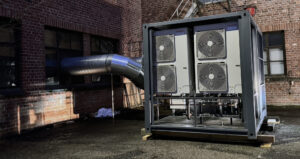
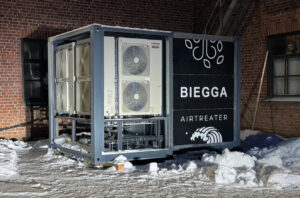
Physical construction is equally important. Heat exchangers, control enclosures, and refrigerant circuits must withstand temperature cycling, mechanical vibration from transportation and nearby equipment, and potentially corrosive or dusty environments. Containerised formats provide an additional layer of protection, housing all mechanical and electrical components within a sealed, structurally robust enclosure that can be transported by road, rail, or air without specialist handling.
Why do defense applications require guaranteed output at rated capacity?
Defense applications require guaranteed output because the consequences of heating or cooling failure are operationally significant — compromised personnel safety, equipment damage, or mission interruption. Unlike commercial facilities where a temporary shortfall in climate control is an inconvenience, defense installations often house sensitive electronics, fuel systems, medical facilities, or personnel in environments where temperature control is directly linked to operational readiness.
The distinction between rated capacity and guaranteed capacity matters enormously in this context. A commercial heat pump rated at 80 kW is rated at that figure under specific test conditions. The actual output in a Finnish winter at -20 °C may be substantially lower. A defense-grade system that guarantees full capacity without temperature limitations delivers at least that figure at every operating temperature — the specification is a commitment, not a laboratory measurement.
This requirement extends to continuous operation. Defense sites frequently operate 24 hours a day, 365 days a year, with no planned downtime window for maintenance or system recovery. HVAC systems must therefore be designed with redundancy built in, so that a component failure or extreme weather event does not result in total capacity loss. Guaranteed output is not a marketing claim — it is an engineering specification that procurement teams can verify and hold suppliers accountable to.
Can commercial HVAC systems be adapted for military or industrial use?
Standard commercial HVAC systems can be adapted for some military or industrial applications, but the modifications required to meet defense-grade performance and compliance standards often make adaptation less practical than specifying purpose-built equipment from the outset. The core limitations of commercial systems — performance derating in extreme temperatures, standard-grade construction, and the absence of defense procurement documentation — are structural, not cosmetic.
In practice, adaptation attempts typically involve adding supplementary heating capacity to compensate for cold-weather derating, upgrading control systems to meet electromagnetic compatibility requirements, and retrofitting the physical enclosure for transport and environmental protection. Each of these modifications adds cost, complexity, and integration risk. The resulting system may meet minimum performance thresholds but will lack the unified engineering, documentation trail, and supplier accountability of a purpose-built defense-grade unit.
For applications where procurement compliance is a hard requirement — NATO supply chain qualification, for example — commercial systems without verified NCAGE supplier registration cannot be procured through standard defense channels regardless of their technical characteristics. The procurement pathway and the technical specification are both prerequisites, and neither can substitute for the other.
What should procurement teams look for in a defense-grade HVAC system?
Procurement teams evaluating defense-grade HVAC systems should assess five primary criteria: guaranteed nominal capacity at all operating temperatures, supplier NATO registration status, containerised or deployable form factor, integrated redundancy, and remote management capability. Each of these criteria maps directly to the operational requirements of defense and critical infrastructure deployments.
- Guaranteed nominal capacity at all temperatures: The supplier must be able to document that the system delivers at least its nominal heating or cooling output at the lowest expected ambient temperature on site — not under test conditions, but under the actual operating conditions the system will face.
- NATO supplier registration: For defense procurement, verify the supplier’s NCAGE code through the NATO Codification System. This confirms the vendor is registered within the alliance’s supply chain framework and can be engaged through standard defense procurement channels.
- Containerised, deployable format: Systems that ship and deploy in standard container formats eliminate the civil works, lead times, and permanent infrastructure dependencies of fixed installations. Evaluate connection time and time-to-operational-readiness as specific, verifiable figures — including startup within 4 hours of arriving on site where no heat distribution network is required, with full commissioning including electrical connection completed within one working day.
- Integrated backup system: Confirm that redundancy is built into the system architecture, not bolted on as an afterthought. The backup system should activate automatically and maintain nominal output without operator intervention.
- Remote management and 24/7 support: Defense and critical infrastructure sites require real-time operational visibility and support availability outside standard business hours. Verify that the supplier offers an automated remote management platform and documented 24/7/365 support coverage, with access to the automation system available for named end users.
Procurement teams should also request technical documentation that specifies performance at the extreme end of the expected temperature range — not just at standard test conditions. Suppliers who can provide verified capacity figures at very low temperatures, with an integrated backup specification, are demonstrating the engineering depth that defense applications require. For teams operating within NATO procurement frameworks, requesting the supplier’s NCAGE code and reviewing their registration status through official NATO channels is a straightforward first qualification step.