Most organisations treat the green transition and sustainability as interchangeable terms. They are not. Confusing the two leads to environmental strategies that sound coherent on paper but fail to produce measurable results in practice.
For industrial decision-makers evaluating energy infrastructure in 2026, the distinction matters operationally, not just conceptually.
Green transition vs. sustainability: core distinctions explained
Sustainability is a long-term state. It describes a condition in which human activity operates within the regenerative capacity of natural systems. It is a destination, not a process.
The green transition is the process of getting there. It refers to the active, structured shift away from fossil fuel dependence toward low-emission energy sources, technologies, and operational models. It is time-bound, policy-driven, and measurable.
In practical terms:
- Sustainability defines the goal: an operating model that does not deplete resources faster than they can be renewed
- Green transition defines the path: replacing carbon-intensive systems with low-emission alternatives within a defined timeframe
- Environmental strategy is how an organisation navigates both: setting targets, selecting technologies, and sequencing investments to move from the current state to sustainable operations
The difference between the green transition and sustainability is, at its core, the difference between a direction and a destination. An organisation can be committed to sustainability as a value while still being in the early stages of its green transition. Both positions are honest. Conflating them is where strategy breaks down.
How the two concepts interact in practice
Green transition initiatives generate sustainability outcomes. But the relationship is not automatic. A technology switch that reduces emissions in one area while increasing energy consumption in another does not advance sustainability, even if it qualifies as a transition step.
Effective environmental strategy requires both frameworks working together:
- The green transition sets the immediate action agenda: which systems to replace, in what order, and by when
- Sustainability principles set the evaluation criteria: does each transition step reduce the total environmental burden, or does it shift it elsewhere?
- The two concepts create a feedback loop: transition actions are measured against sustainability outcomes, and strategy is adjusted accordingly
For industrial operators, this interaction is most visible in energy infrastructure decisions. Replacing a diesel-powered heating system with an electric heat pump is a green transition action. Whether that action advances sustainability depends on the energy source powering the pump, the system’s efficiency across its full operating range, and the lifecycle impact of the equipment itself.
Genuine progress requires both the action and the evaluation. Neither alone is sufficient.
What these concepts mean for industrial energy decisions
Industrial facilities face a specific version of this challenge. Climate control infrastructure, whether for heating, cooling, filtration, or process temperature management, represents a significant share of operational energy consumption. Decisions made about that infrastructure in 2026 will determine an organisation’s emissions profile for the next decade or more.
The green transition, in this context, means replacing fossil fuel-dependent heating and cooling systems with alternatives that operate on electricity from renewable sources. The sustainability question is whether those alternatives deliver their specified performance across all operating conditions, or whether they require supplementary fossil-fuel backup when temperatures drop.
This is where the distinction becomes operationally consequential. A heat pump system that meets its rated capacity under optimal conditions but requires diesel backup at very low temperatures does not represent a complete green transition. It represents a partial one, with a fossil-fuel dependency embedded in the design.
Industrial operators evaluating their environmental strategy need to ask:
- Does the system deliver its nominal capacity at all outdoor temperatures, without fossil-fuel supplementation?
- Does it operate efficiently enough across its full duty cycle to reduce total energy consumption, not just shift it?
- Can it be deployed without the civil works and permanent infrastructure that lock in a single site and limit future flexibility?
- Does it support remote monitoring and management, reducing the operational overhead of running low-emission infrastructure at scale?
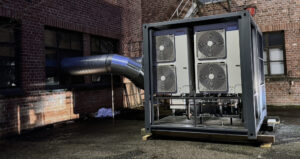
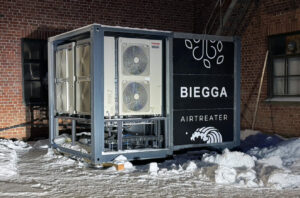
AirTreater systems are designed to answer each of these questions with a direct specification rather than a conditional claim, and all systems are guaranteed to deliver at least their nominal heating or cooling capacity at all outdoor temperatures. AirTreater Čáhci, for example, maintains 120 kW of nominal heating capacity at -15 °C using compressors alone, with a maximum output of 420 kW at temperatures down to -15 °C. The heat pump operates down to -28 °C, and below -28 °C an integrated backup system guarantees at least 300 kW even without external electric power in hazardous situations. No fossil-fuel supplementation. No performance cliff at the temperatures that matter most in northern operating environments.
AirTreater Prosea addresses the process cooling side of the same equation. Its free-cooling function operates energy-efficiently without engaging compressors during cold-weather periods, eliminating the primary energy cost and mechanical failure point of conventional chiller operation. Prosea systems are designed per project and site, ensuring the solution is matched precisely to each application’s requirements.
These are not sustainability aspirations. They are guaranteed performance specifications, verified in the operating conditions where the gap between green transition intent and sustainable outcome is most visible.
Take the next step toward low-emission industrial climate control
Understanding the difference between the green transition and sustainability is the starting point. Selecting infrastructure that delivers on both is the decision that determines whether your environmental strategy produces measurable outcomes or remains a framework document.
AirTreater containerised heating and cooling systems connect on site in a single working day and are fully operational within 4 hours of arriving on site. They require no permanent infrastructure commitment, which means the investment moves with your operational priorities rather than being locked to a single site.
Remote management via an automated remote management platform provides real-time operational visibility and full settings control from any browser, with named end users also able to access the automation system directly. 24/7/365 help-desk support is available through the AirTreater service centre.
If your organisation is evaluating industrial climate control infrastructure as part of a green transition programme, contact the AirTreater team to request technical documentation and discuss your site-specific requirements.