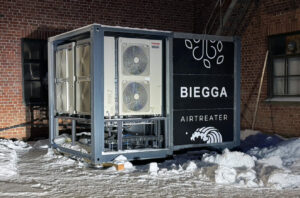
AirTreater Čáhci is the right backup heating choice when a site requires guaranteed nominal capacity at all outdoor temperatures, operates with an existing liquid-cycle heat distribution network, and cannot tolerate the performance limitations of a standard electric boiler or conventional heat pump in sub-zero conditions. The decision is driven primarily by site infrastructure, thermal load scale, and the operational cost of running backup heat over extended periods. The sections below address the most common technical and operational questions procurement engineers ask before specifying Čáhci as a backup system.
What makes Čáhci different from a standard backup heating unit?
AirTreater Čáhci is an air-to-water heat pump containerised solution that delivers a guaranteed nominal heating capacity of 120 kW at -15 °C using compressors alone, with a maximum output of 420 kW at the same temperature threshold. A standard backup heating unit, typically an electric boiler or resistance heater, converts electrical input to heat at a 1:1 ratio. Čáhci delivers multiple kilowatts of heat for every kilowatt of electricity consumed because it moves heat rather than generating it.
The distinction matters most when backup heating runs for extended periods. An electric boiler draws its full rated electrical load continuously. Čáhci’s heat pump circuit operates at a coefficient of performance that significantly reduces energy consumption for the same heat output. The heat pump operates down to -28 °C; below -28 °C, the integrated backup system activates to maintain at least 300 kW heating capacity even without external electric power in hazardous situations, but the primary load is still carried by the compressor circuit rather than resistance elements.
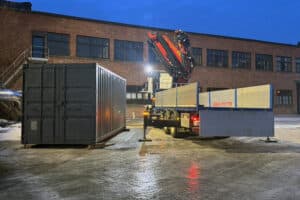
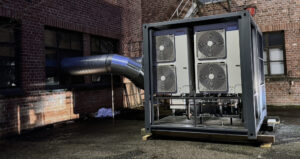
The other differentiator is form factor. Čáhci ships in a standard container and connects on site in a single working day. A conventional backup boiler installation typically requires permanent plant room space, flue infrastructure, and civil works that commit the asset to one location. Čáhci can be redeployed when site requirements change.
What types of sites are best suited for Čáhci as a backup?
Čáhci is best suited as a backup heating system for large industrial and commercial sites that already operate a liquid-cycle heat distribution network, require a minimum of 120 kW guaranteed heating capacity, and face outdoor temperatures at or below -15 °C during the heating season. Sites without an existing hydronic distribution system require additional infrastructure investment before Čáhci can be integrated.
The following site types align closely with Čáhci’s backup heating specification:
- Production halls and manufacturing facilities with hydronic underfloor or radiator systems where primary heating failure carries process or product risk
- Construction projects requiring temporary heating through Finnish or northern European winters, where the backup system must be relocatable at project completion
- Energy sector facilities, including biogas plants and power generation sites, where heating continuity is tied directly to process operation
- Remote industrial sites where running high-capacity electric backup heating is cost-prohibitive over a full heating season
- Sites with an existing geothermal borehole field, where Čáhci can be configured with a ground-source heat pump for enhanced efficiency
Sites with very low thermal loads, below approximately 80 kW peak demand, may be better served by AirTreater Biegga, which provides 84 kW of heat pump capacity in an air-to-air configuration without requiring liquid-cycle distribution infrastructure.
How does Čáhci integrate with an existing heating system?
Čáhci integrates with an existing heating system through its liquid-cycle output, connecting directly to the site’s hydronic distribution network via standard pipe connections. The system delivers outlet water temperatures sufficient to supply existing radiator circuits, underfloor heating, or process heat exchangers without requiring modifications to the downstream distribution infrastructure. Commissioning including electrical connection takes one working day; the system is fully operational within 4 hours of arriving on site when no heat distribution network is required.
For sites with automation infrastructure already in place, Čáhci is compatible with existing building management and industrial automation systems. This means the backup system can be monitored and controlled through the same interface as the primary plant rather than requiring a separate operator workflow. AirTreater systems also connect to an automated remote management platform, which provides real-time operational data and full settings control through a standard web browser from any location, and named end users can also have access to the automation system.
Where the site includes a geothermal borehole field, Čáhci can be configured with a ground-source heat pump module, which further improves efficiency and reduces dependence on ambient air temperature. Where the site has sufficient electrical supply capacity, an electric boiler can serve as the integrated backup system within the Čáhci configuration, providing an additional layer of redundancy beyond the compressor circuit.
When does Čáhci outperform an electric boiler as backup?
Čáhci outperforms an electric boiler as a backup heating system in any scenario where the backup is expected to carry a significant load for more than a few hours per year. The heat pump circuit delivers multiple kilowatts of thermal output per kilowatt of electrical input, while an electric boiler delivers one kilowatt of heat for every kilowatt consumed. At the thermal load scales Čáhci serves, 120 kW to 420 kW, the energy cost difference over a heating season is substantial.
The performance gap widens in the following conditions:
- Extended backup operation: If the primary heating system undergoes planned maintenance, seasonal shutdown, or an unplanned outage lasting more than a day, Čáhci’s lower energy consumption per kilowatt-hour of heat delivered reduces operating costs significantly compared to running electric resistance heat at the same capacity.
- High capacity requirements: Electric boilers at 300 kW to 420 kW capacity draw very large electrical currents. Sites with limited electrical supply capacity may not be able to run an electric boiler at the required output. Čáhci achieves the same thermal output with a smaller electrical demand because of the heat pump coefficient of performance.
- Regulatory and emissions alignment: Electric resistance heating at scale carries a high primary energy factor in most European energy accounting frameworks. Heat pump operation reduces the primary energy consumption attributed to the backup system, which is relevant for sites reporting energy performance metrics or operating under efficiency obligations.
An electric boiler remains the appropriate choice when backup operation is expected to be extremely infrequent, when site electrical capacity is constrained and the heat pump compressor circuit cannot be accommodated, or when the thermal load is low enough that capital cost outweighs efficiency gains. Čáhci itself includes an electric boiler option as its integrated backup system for conditions where the compressor circuit alone is insufficient, combining both technologies within a single containerised solution.
What operational support comes with a Čáhci backup installation?
Every AirTreater Čáhci installation includes access to a 24/7/365 help-desk service through AirTreater’s service centre. This means that if the backup system activates outside normal business hours, which is precisely when heating failures tend to occur in northern climates, technical support is available immediately rather than on the next working day. For a system designated as backup infrastructure, round-the-clock support availability is a baseline operational requirement, not an optional add-on.
Remote monitoring and control are provided through an automated remote management platform. Operators receive a real-time view of system status, outlet water temperatures, operating mode, and alarm conditions through a standard web browser. Settings can be adjusted remotely without requiring a site visit. Named end users can also have access to the automation system. For backup systems installed at unmanned or remotely staffed sites, this capability means the system can be verified as operational, and adjusted if necessary, from a central operations facility.
Čáhci’s containerised format also simplifies maintenance logistics. Because the system is self-contained within its container, scheduled service visits are straightforward and do not require access to permanent plant rooms or coordination with building management in the same way a fixed installation does. When the site’s operational requirements change, the system can be relocated rather than decommissioned, preserving the asset value of the backup infrastructure investment.
For procurement teams requiring technical documentation prior to specifying Čáhci as a backup heating system, contact AirTreater’s technical team to request a full specification package for procurement review.