The green transition does not belong to any single government, technology provider, or policy committee. It is a shared industrial and social challenge, one that demands action from every layer of the economy. The question of who is responsible is not rhetorical. It has a practical answer, and for industrial operators in particular, that answer carries significant weight.
Responsibility is distributed. But leverage is not.
The Shared Burden No Single Actor Can Carry Alone
Governments set the regulatory framework. The EU’s revised Energy Efficiency Directive, for example, binds Member States to measurable consumption reduction targets by 2030, translating directly into obligations for the industrial operators, building owners, and energy suppliers within those states. Policy creates the floor. It does not do the work.
Technology developers, financiers, and infrastructure providers each hold a piece of the puzzle. But the green transition stalls when responsibility is treated as someone else’s problem, when industrial operators wait for policy certainty before investing, or when policymakers wait for market signals before legislating.
The actors who move first tend to define the standard that everyone else follows. That dynamic is already visible in the heat pump sector, where early adopters in Nordic industrial markets have helped drive down costs and validate cold-climate performance for the rest of Europe.
Where Industrial Operators Hold the Most Leverage
Industrial facilities account for a disproportionate share of energy consumption and carbon emissions relative to other sectors. That concentration of impact means industrial operators also hold concentrated leverage: the decisions made at the plant level translate into measurable emissions outcomes at scale.
The most consequential decisions are not incremental. They concern the energy systems that provide process heat, cooling, and climate control, systems that run continuously, consume significant electrical or thermal energy, and are replaced infrequently. Choosing a high-efficiency heat pump system over a fossil-fuel boiler at the point of replacement is not a marginal improvement. It is a structural change to the facility’s emissions profile.
Industrial heat pump technology has matured substantially. Systems capable of delivering high-temperature process heat while operating reliably in sub-zero ambient conditions now exist as commercially available, deployable products. The technical barrier that once justified delay has largely been removed. What remains is an infrastructure decision.
What Separates Genuine Decarbonization from Greenwashing
Genuine decarbonization is measurable. It shows up in energy consumption figures, in the displacement of fossil fuel inputs, and in the verified performance of the systems that replace them. Greenwashing does not.
The distinction matters because procurement decisions made on the basis of vague sustainability claims produce facilities that look compliant on paper but continue to consume energy at the same rate. A heat pump that derates significantly below -10 °C does not deliver the same emissions reduction as one that maintains nominal capacity at all outdoor temperatures. The gap between rated performance and actual performance is where greenwashing hides.
Operators serious about decarbonization should ask three specific questions of any climate control system under evaluation:
- What is the guaranteed nominal capacity at the lowest ambient temperature this facility will experience?
- Does the system operate on electricity sourced from or compatible with renewable generation?
- What is the backup arrangement when ambient conditions exceed the primary system’s operating envelope, and does that backup itself consume fossil fuel?
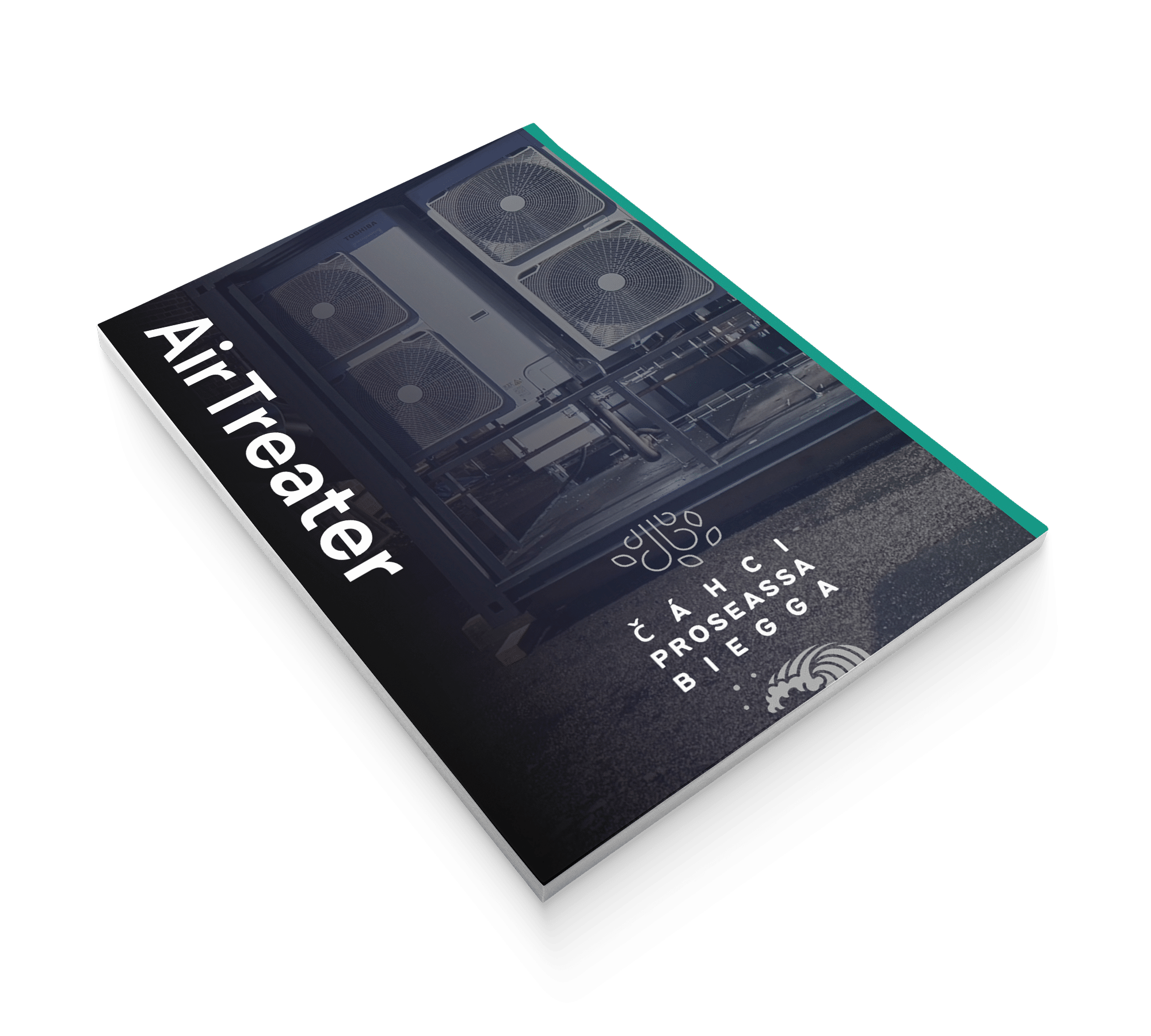
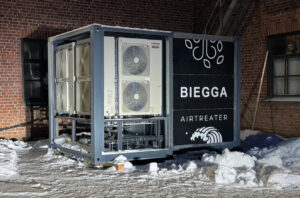
AirTreater systems are designed to answer all three questions directly. The AirTreater Čáhci, for example, maintains 120 kW of nominal heating capacity at -15 °C using compressors alone. That is not a rated condition. It is a guarantee, and it is the kind of specificity that separates a genuine decarbonization asset from a compliance-grade purchase.
How Infrastructure Choices Lock In Emissions for Decades
Industrial climate control infrastructure is not replaced frequently. A heating or cooling system installed today will typically operate for fifteen to twenty-five years. The energy source and efficiency profile of that system define the facility’s emissions trajectory for that entire period.
This is why the timing of infrastructure decisions matters as much as the decision itself. The Energy Efficiency Directive and the Energy Performance of Buildings Directive are already reshaping the regulatory environment in which these assets will operate. Facilities that lock in high-emission infrastructure today will face mounting compliance costs, potential regulatory penalties, and stranded asset risk as the regulatory floor rises through the 2030s.
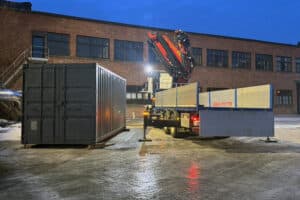
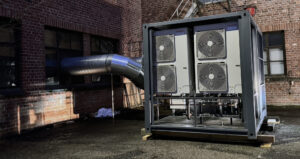
The containerised format of AirTreater systems addresses a specific aspect of this lock-in problem. Because the systems are not permanently embedded in the building structure, they can be relocated, upgraded, or replaced without the civil works and capital commitment of a fixed installation. The infrastructure decision is still significant, but it is not irreversible.
The revised F-Gas Regulation adds a further dimension to this calculus. From 2027, new monoblock heat pump systems up to 50 kW must use refrigerants with a global warming potential below 150. Operators evaluating systems today should verify refrigerant compliance not only for current regulations but for the requirements that will apply across the system’s expected service life.
Take the Next Step Toward Lower-Emission Operations
The green transition does not wait for consensus. It advances through individual infrastructure decisions made by operators who have assessed the technical options and chosen to act.
For industrial facilities evaluating heating and cooling infrastructure, the practical starting point is a site-specific assessment, one that accounts for actual ambient temperature ranges, process heat requirements, available electrical capacity, and the deployment constraints of the site.
AirTreater systems connect on site in a single working day. Without heat distribution infrastructure requirements, they reach full operation within two working days of arrival. Ouman’s remote management platform provides real-time operational visibility and settings control through a standard web browser, with 24/7/365 help-desk support available through AirTreater’s service centre.
The decision to act on decarbonization is yours. The technical and logistical barriers are lower than they have ever been.
Contact the AirTreater team to discuss your site requirements and review which containerised heating or cooling configuration fits your operational profile.