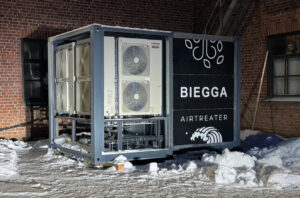
An air-to-water heat pump is the right choice for large facilities in 2026 because it delivers high-capacity, liquid-cycle heating and cooling with measurable energy efficiency — and modern industrial systems guarantee nominal capacity at all outdoor temperatures, not just in laboratory conditions. For facilities operating in cold climates or running continuous processes, that performance guarantee is the deciding factor. The following sections address the most common technical and operational questions facility managers ask before specifying an air-to-water system.
How does an air-to-water heat pump work in large-scale applications?
An air-to-water heat pump extracts thermal energy from outdoor air and transfers it into a liquid circuit — typically water or a water-glycol mixture — which then distributes heating or cooling energy throughout the facility via radiators, underfloor systems, fan coil units, or air handling units. In large-scale applications, the liquid circuit is the key advantage: it allows a single heat pump to serve multiple zones across a large building through a centralised distribution network.
The refrigeration cycle drives the process. A compressor raises the pressure and temperature of the refrigerant, which transfers its heat to the water circuit through a heat exchanger. The refrigerant then expands, cools, and absorbs heat from outdoor air through the evaporator before the cycle repeats. In cooling mode, the cycle reverses: heat is extracted from the building’s water circuit and rejected to outdoor air.
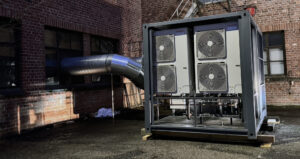
For large facilities, this architecture scales efficiently. A single containerised unit with sufficient nominal capacity can serve a production hall, warehouse, or industrial building without requiring individual air-handling units in every zone. AirTreater Čáhci, for example, operates on this liquid-cycle principle, maintaining 120 kW of nominal heating capacity at -15 °C using compressors alone, with a maximum output of 420 kW available when conditions allow. The outlet water temperature reaches +75 °C at -15 °C outdoor conditions, enabling direct integration with existing high-temperature hydronic distribution systems.
What size air-to-water heat pump does a large facility need?
The correct sizing for a large facility depends on three primary factors: the building’s peak heat loss at the lowest design outdoor temperature, the required outlet water temperature for the distribution system, and whether the system must also provide cooling. For most large industrial or commercial buildings in northern Europe, peak heating demand at -15 °C to -25 °C outdoor conditions is the governing calculation.
As a general principle, facility engineers calculate the building’s heat loss in kilowatts based on insulation values, air infiltration, and floor area, then specify a heat pump that delivers at least that nominal capacity at the lowest expected outdoor temperature. This last point is critical: a heat pump rated at 200 kW under standard test conditions may deliver significantly less at -15 °C if it is not designed to maintain nominal output at that temperature.
For large facilities requiring between 120 kW and 420 kW of heating capacity, a single AirTreater Čáhci unit covers the full range. Its integrated backup system — available as an electric boiler or ground source heat pump if a borehole field exists on site — guarantees at least 300 kW of heating output even in the most extreme sub-zero conditions. For facilities with large, open floor plans that suit direct air distribution rather than a liquid circuit, AirTreater Biegga delivers up to 165 kW of maximum heating capacity and at least 81 kW at all outdoor temperatures, with 84 kW of heat pump output supported by an 81 kW electric heater. The right choice between liquid-cycle and air-to-air distribution depends on the existing infrastructure and the uniformity of heating required across the space.
How does an air-to-water heat pump perform in cold climates?
In cold climates, air-to-water heat pump performance depends entirely on how the system is engineered. Conventional heat pumps are typically rated at nominal conditions — around +7 °C outdoor temperature — and their capacity drops significantly as outdoor temperatures fall. A system rated at 200 kW may deliver 120 kW or less at -15 °C. For facilities in Finland or other northern European countries, this performance gap is not a theoretical concern — it is a direct operational risk.
AirTreater systems are guaranteed to deliver at least nominal heating or cooling capacity at all outdoor temperatures. This is not a rated condition — it is a guarantee. AirTreater Čáhci maintains 120 kW of nominal heating capacity at -15 °C using compressors alone, with the heat pump operating down to -28 °C. When outdoor temperatures fall below -28 °C, the integrated backup system activates to ensure at least 300 kW of heating output is sustained without interruption, guaranteeing at least 300 kW even without external electric power in hazardous situations. The system does not derate as conditions worsen.
Finnish winters provide a natural validation environment for this performance standard. Engineering systems to operate at full nominal capacity at -15 °C, -20 °C, and below requires design choices — refrigerant selection, compressor specification, heat exchanger sizing — that are simply not made in systems designed for milder climates. For facility managers in cold regions, the practical question is not whether an air-to-water heat pump can work in winter, but whether the specific system they are specifying guarantees its output at the lowest temperature their site will experience.
What are the main advantages of air-to-water heat pumps over other heating systems?
The main advantages of air-to-water heat pumps over conventional heating systems are energy efficiency, operational flexibility, and the ability to provide both heating and cooling from a single unit. Unlike gas boilers or electric resistance heaters, a heat pump delivers more thermal energy than the electrical energy it consumes — typically two to four times more, depending on outdoor conditions and the outlet temperature required.
Compared to air-to-air heat pump systems, the liquid-cycle approach offers more even temperature distribution across large spaces, compatibility with existing hydronic infrastructure, and the ability to serve multiple zones simultaneously from one central unit. This makes air-to-water systems the preferred choice for facilities where heat distribution networks already exist or where zone-by-zone control is operationally important.
The following advantages are consistently relevant for large facility applications:
- Higher energy efficiency than direct electric heating at all outdoor temperatures above approximately -20 °C
- Reversible operation for both heating and cooling without separate systems
- Compatibility with high-temperature hydronic distribution systems, including radiators and fan coil units
- Scalable output through integrated backup systems for extreme conditions
- Lower carbon intensity than fossil fuel heating where electricity grids are increasingly renewable
- Remote management capability via an automated remote management platform, providing real-time operational data and full settings control through a standard web browser, with access also available to named end users
For large facilities evaluating total cost of operation, the energy efficiency advantage compounds over time. A heat pump that delivers average 2 or more units of heat per 1 kW of electricity consumed — with a COP typically between 1.5 to 2.5 — reduces energy costs significantly compared to direct electric heating, a difference that is material at industrial scale.
Can an air-to-water heat pump also provide cooling for large buildings?
Yes. An air-to-water heat pump operates in both heating and cooling modes using the same refrigeration circuit. In cooling mode, the cycle reverses: heat is extracted from the building’s water circuit and rejected to outdoor air, lowering the temperature of the circulating water and, through it, the building. This dual-mode capability eliminates the need for separate heating and cooling systems, reducing capital cost and mechanical complexity.
For large buildings, liquid-cycle cooling offers the same distribution advantages as liquid-cycle heating. A single central unit feeds chilled water to fan coil units, air handling units, or process cooling circuits throughout the facility. The precision of liquid-cycle temperature control is also well suited to applications where stable process temperatures matter — not just occupant comfort.
AirTreater Čáhci provides cooling as well as heating, making it a complete climate control unit for large facilities. For facilities with process cooling requirements that demand continuous, uninterrupted operation, the AirTreater Prosea range is designed specifically for process industry applications, with each unit engineered to the specific thermal load and temperature requirements of the site. The choice between a standard air-to-water heat pump and a process-specific cooling unit depends on the precision, continuity, and load profile of the cooling demand.
What should facility managers consider when choosing an air-to-water heat pump?
Facility managers evaluating an air-to-water heat pump for a large building should assess six key factors: guaranteed performance at minimum design temperature, outlet water temperature compatibility with the existing distribution system, peak capacity relative to the building’s heat loss, cooling requirements, deployment logistics, and ongoing operational support.
Guaranteed Performance at Minimum Design Temperature
This is the most important specification to verify. Request the system’s guaranteed nominal capacity at the lowest outdoor temperature your site will experience — not the rated capacity at standard test conditions. A system that cannot maintain its output at -15 °C or -20 °C will underperform precisely when heating demand is highest. Confirm whether backup heating is integrated into the system or requires a separate installation.
Outlet Water Temperature and Distribution Compatibility
The outlet water temperature the heat pump can deliver at low outdoor temperatures determines whether it is compatible with your existing distribution system. High-temperature hydronic systems — those designed for radiators rather than underfloor heating — require outlet temperatures of +60 °C to +75 °C. Verify this figure at the lowest design outdoor temperature, not at +7 °C. AirTreater Čáhci maintains outlet water temperatures of +75 °C at -15 °C outdoor conditions, which enables direct integration with high-temperature systems without supplementary heating.
Deployment Timeline and Site Requirements
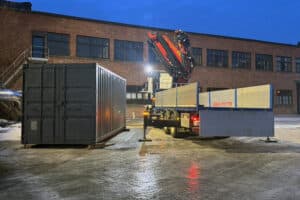
For facilities that need operational heating or cooling quickly — or where permanent plant room space is not available — a containerised air-to-water heat pump eliminates the civil works and lead times of fixed installations. AirTreater’s containerised systems can be started up within 4 hours of arriving on site where no heat distribution network is required, with commissioning including electrical connection completed within one working day, and with no permanent infrastructure commitment. This is particularly relevant for construction projects, temporary industrial operations, or facilities expanding into new buildings where permanent infrastructure is not yet in place.
Remote Management and Support Availability
For large facilities — particularly those operating around the clock or across multiple sites — remote visibility into system operation is an operational requirement, not a convenience. Verify that the system integrates with an automated remote management platform and that the supplier provides documented support availability. AirTreater systems are managed via an automated remote management platform, offering real-time operational data and full settings control through a standard web browser, with access also available to named end users, backed by 24/7/365 help-desk support through the AirTreater service centre.