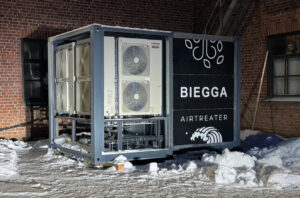
AirTreater Biegga is a reliable backup heating solution for industrial sites because it delivers guaranteed nominal heating capacity at all outdoor temperatures, combines an 84 kW heat pump with an 81 kW integrated electric heating element, and arrives in a containerised format that connects and operates within one working day including electrical connection, with startup achievable within 4 hours of arriving on site where no heat distribution network is required. Its reliability is not a design aspiration — it is a performance guarantee that holds regardless of how cold conditions become. The sections below address the specific technical and operational questions that procurement engineers and facility managers typically raise when evaluating backup heating options.
What makes a backup heating system reliable for industrial sites?
A backup heating system is reliable for industrial sites when it delivers its specified capacity under actual site conditions — not under laboratory conditions or at optimal ambient temperatures. For industrial applications, reliability means guaranteed output at the temperatures the site actually experiences, fast deployment when the primary system fails, and continuous operation without manual intervention. A system that derates in cold weather is not a backup — it is a liability.
Industrial sites operate under conditions that expose the weaknesses of conventional heat pump technology. When outdoor temperatures drop to -15 °C or below, standard air-source heat pumps lose a significant portion of their rated capacity precisely when heating demand is highest. A genuine backup heating system must close that gap, not widen it.
Three criteria define reliability in this context:
- Guaranteed nominal capacity at all outdoor temperatures, including extreme sub-zero conditions
- An integrated backup mechanism that activates automatically when primary heating alone is insufficient
- A form factor and connection process that allows the system to be operational before a heating interruption becomes a process or safety incident
AirTreater Biegga meets all three. Its performance guarantee is not conditional on ambient temperature, and its integrated 81 kW electric heating element activates to maintain output when heat pump capacity alone requires support.
How does Biegga maintain heating output in extreme cold?
AirTreater Biegga maintains heating output in extreme cold through a two-stage system: the primary air-to-air heat pump delivers 84 kW of heating capacity, and an integrated 81 kW electric heating element provides supplementary output when outdoor conditions require it. Together, the system delivers a maximum heating capacity of 165 kW, and at least 81 kW at all outdoor temperatures. This integrated backup system ensures nominal output is guaranteed at all outdoor temperatures — not just under the conditions where a heat pump performs optimally.
Conventional air-to-air heat pumps are rated at standard test conditions, typically around +7 °C outdoor temperature. As temperatures fall, their coefficient of performance drops and their delivered capacity decreases. At -15 °C, many standard systems operate at a fraction of their rated output — like 40% of rated capacity. AirTreater Biegga is designed and guaranteed to perform differently.
The electric heating element is not a fallback for a system that fails in the cold — it is an engineered component of the total heating architecture. When the heat pump’s compressor circuit alone is insufficient to maintain the required output, the integrated element activates to compensate. The transition is automatic and does not require operator intervention. The result is a system that industrial sites can depend on regardless of whether temperatures fall to -10 °C, -20 °C, or beyond.
What heating capacity does Biegga provide for large industrial spaces?
AirTreater Biegga provides a maximum heating capacity of 165 kW, combining 84 kW from the air-to-air heat pump and 81 kW from the integrated electric heating element, with a guaranteed 81 kW backup heating capacity at all outdoor temperatures. For cooling applications, Biegga delivers 81 kW of maximum cooling capacity. These figures make it suitable for large, open industrial spaces — production halls, warehouses, logistics facilities, and temporary site infrastructure — where substantial air volume requires consistent thermal management.
The air-to-air delivery format is particularly well matched to large, open-plan industrial environments. Unlike liquid-cycle systems, which require a hydronic distribution network to move heat through a building, Biegga distributes conditioned air directly into the space. This eliminates the need for pipework, heat exchangers, and associated civil works — a significant advantage in temporary or rapidly deployed installations.
For sites with existing heat distribution infrastructure, or where liquid-cycle distribution would deliver better thermal uniformity, AirTreater Čáhci is the appropriate alternative. Biegga’s 165 kW maximum output positions it as a standalone heating solution for spaces where direct air distribution is practical and sufficient.
How quickly can a portable heat pump be deployed on an industrial site?
A containerised heat pump system like AirTreater Biegga is fully operational within 4 hours of arriving on site where no heat distribution network is required. Commissioning including electrical connection takes one working day. This deployment timeline is a defined operational specification, not an estimate.
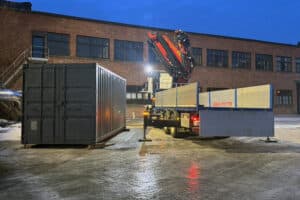
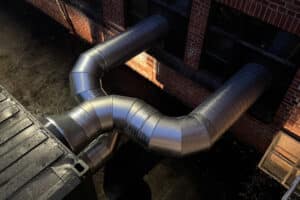
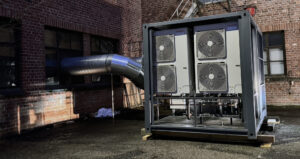
The containerised format is the key enabler of this timeline. Biegga arrives pre-configured and factory-tested inside a standard shipping container. On site, the connection process involves a power supply, any required ducting connections, and commissioning — no permanent civil works, no plant room construction, no extended installation programme. The container itself serves as the equipment housing.
For industrial sites managing a heating failure, a planned maintenance shutdown, or a temporary capacity requirement, this timeline has direct operational value. A system that is fully operational within 4 hours of arriving on site eliminates the extended exposure window that fixed-installation alternatives create. When the need passes, or when the project moves to a new location, the container is disconnected and redeployed — leaving no permanent infrastructure behind.
Can Biegga integrate with existing industrial automation systems?
Yes. AirTreater Biegga is designed to integrate with existing industrial automation systems, allowing it to operate within a site’s broader building management or process control architecture rather than as an isolated standalone unit. Integration eliminates the need for operators to manage the backup heating system through a separate interface, and allows heating setpoints and operational parameters to be coordinated with other site systems.
In addition to automation integration, Biegga is managed via an automated remote management platform. This platform provides real-time operational data and full settings control through a standard web browser, accessible from any location at any time. Facility managers, plant engineers, and named end users can monitor system status, adjust setpoints, and review operational history without being physically present on site.
For sites operating on a 24/7 basis — or for remote and unmanned installations where on-site personnel are not continuously available — this remote management capability is operationally significant. AirTreater’s service centre provides 24/7/365 help desk support, ensuring that if an issue arises outside standard working hours, technical assistance is available without delay.
When should an industrial site choose an air-to-air heat pump over other backup options?
An industrial site should choose an air-to-air heat pump like AirTreater Biegga when the space requires direct air heating, no existing hydronic distribution network is available, and deployment speed is a priority. Air-to-air systems are the correct choice for large open-plan spaces — production halls, warehouses, and temporary site structures — where distributing conditioned air directly into the volume is more practical than installing or connecting to liquid-cycle pipework.
The decision between air-to-air and air-to-water heating is primarily determined by site infrastructure and space geometry. Where a heat distribution network already exists — underfloor heating, radiators, or fan coil units connected to a hydronic loop — an air-to-water system like AirTreater Čáhci will typically deliver better thermal efficiency and more even temperature distribution. Čáhci maintains 120 kW of nominal heating capacity at -15 °C using compressors alone, with a maximum output of 420 kW, and integrates directly with existing high-temperature hydronic systems.
Where no such infrastructure exists, or where the site is temporary and permanent pipework is not justified, Biegga’s air-to-air format removes those dependencies entirely. The relevant selection criteria are:
- Space type: open-plan, high-volume spaces favour air-to-air distribution
- Infrastructure availability: sites without hydronic networks benefit from air-to-air systems that require no pipework
- Deployment timeline: air-to-air systems connect faster when no distribution network commissioning is required, with startup achievable within 4 hours of arriving on site
- Capacity requirement: Biegga’s 165 kW maximum output covers large industrial spaces without supplementary systems
- Mobility requirement: containerised air-to-air systems relocate without leaving infrastructure behind
For procurement teams evaluating backup heating options, the specification question to ask is not which technology is generically superior — it is which system matches the site’s actual infrastructure, space geometry, and deployment constraints. Contact the AirTreater technical team to discuss your site requirements and confirm which configuration delivers guaranteed performance for your specific application.