Indoor air quality is critical in NATO-standard facilities because personnel performance, equipment reliability, and operational continuity all depend on controlled, contaminant-free air. Military facilities operate under STANAG and national defense standards that set precise requirements for ventilation rates, temperature stability, and air filtration, because in mission-critical environments, air quality failure is an operational failure. The sections below address the specific standards, risks, and technical requirements that define indoor air quality management in NATO-grade facilities.
What air quality standards do NATO facilities follow?
NATO-standard facilities follow a combination of STANAG (Standardization Agreement) protocols, national defense building codes, and internationally recognized standards such as ASHRAE 62.1 for ventilation and ISO 16890 for air filtration. These frameworks define minimum ventilation rates, particulate filtration grades, temperature and humidity control ranges, and requirements for redundant HVAC systems capable of maintaining conditions without interruption.
STANAG documents relevant to built infrastructure address environmental control in shelters, field facilities, and permanent installations. They set thresholds for carbon dioxide concentration, airborne particulate levels, and thermal comfort ranges, all of which are operationally significant rather than simply regulatory. A facility that fails to meet these thresholds is not merely non-compliant; it is operationally degraded.
In practice, NATO facility air quality requirements are layered. The alliance-level standards establish a floor, while member nations apply additional national requirements on top. Finnish defense infrastructure, for example, must meet both NATO baseline requirements and Finnish building code provisions for ventilation in demanding climates. This layering means that HVAC systems specified for NATO-standard facilities must be engineered to the most stringent applicable standard, not merely the minimum.
How does poor indoor air quality affect military personnel performance?
Poor indoor air quality in military facilities directly degrades cognitive function, physical readiness, and decision-making speed. Elevated carbon dioxide concentrations above 1,000 parts per million measurably reduce concentration and increase error rates. Inadequate temperature control causes thermal stress that impairs both physical performance and mental acuity. In operational environments, these are not comfort issues, they are capability issues.
The cognitive effects of poor air quality are particularly significant for personnel performing high-stakes tasks: communications operators, intelligence analysts, medical staff, and command personnel working in enclosed facilities. Research across occupational health disciplines consistently identifies ventilation inadequacy as a driver of reduced alertness, slower reaction times, and increased susceptibility to errors under pressure.
Physical readiness is also affected. Facilities with inadequate humidity control create conditions that accelerate respiratory irritation, particularly relevant in cold climates where dry heated air compounds the problem. Personnel recovering between operational cycles in poorly ventilated rest facilities face extended recovery times, which has direct implications for unit readiness. Military facility air quality is not a secondary concern, it is a component of force readiness.
What are the biggest indoor air quality risks in NATO-standard facilities?
The primary indoor air quality risks in NATO-standard facilities are inadequate ventilation leading to CO2 accumulation, particulate contamination from external threats or internal sources, humidity imbalance causing respiratory stress or equipment corrosion, and HVAC system failure creating uncontrolled environmental conditions. In facilities housing sensitive electronics or medical operations, airborne particulate control is a secondary but equally critical concern.
Ventilation Failure and CO2 Accumulation
Enclosed military facilities, particularly hardened shelters, command posts, and containerised field installations, are designed for security and protection, which means they are often tightly sealed. Without active, correctly specified ventilation, CO2 levels rise rapidly when personnel are present. Systems that are undersized for the occupancy load or that fail in extreme cold create conditions that degrade personnel performance within hours.
Humidity Imbalance and Condensation Risk
Both excessive humidity and insufficient humidity present operational risks. High humidity in warm conditions promotes mold growth and accelerates corrosion of sensitive equipment. In cold-climate facilities, inadequate humidity control produces dry air that causes respiratory irritation and increases static electricity risk near electronics. Effective HVAC systems for NATO-standard facilities must manage humidity within a controlled band, not merely regulate temperature.
How does extreme cold affect HVAC performance in military facilities?
Extreme cold causes conventional HVAC systems to derate significantly, meaning their actual heating output at low outdoor temperatures falls well below their nominal rated capacity. A system rated at 100 kW under standard test conditions may deliver 60 kW or less at very low temperatures, creating a performance gap precisely when maximum output is most needed. For military facilities in northern and arctic operating environments, this derating is an operational liability.
The problem is rooted in how most heat pumps are specified and marketed. Nominal capacity figures are typically stated at standard outdoor test conditions, often +7 °C, which bears no resemblance to the actual operating conditions of a facility in Finland, Norway, or the Baltic states in winter. Procurement teams that do not interrogate the temperature-performance curve of a proposed system risk specifying equipment that fails its primary function when ambient temperatures drop.
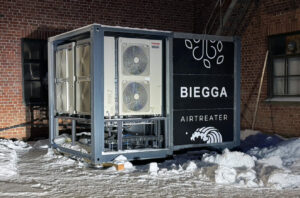
Auxiliary heating systems are one response to this gap, but they introduce additional failure points and energy costs. The more reliable engineering approach is to specify systems that guarantee nominal capacity at all outdoor temperatures, including extreme sub-zero conditions. AirTreater Čáhci, for example, maintains 120 kW of nominal heating capacity even at very low temperatures, with a maximum output of 420 kW, and the heat pump operates down to -28 °C. Below -28 °C, the integrated backup system guarantees at least 300 kW of heating output even without external electric power in hazardous situations. That is the specification standard that cold-climate military facility air quality management requires.
What HVAC solutions meet NATO facility air quality requirements?
HVAC solutions that meet NATO facility air quality requirements must deliver guaranteed nominal capacity at all operating temperatures, support continuous uninterrupted operation, provide remote monitoring and control capability, and be procurable through NATO-registered supply channels. Systems must also be deployable in the timeframes that defense projects demand, permanent fixed installations are not always feasible in forward or temporary operational contexts.
For permanent NATO-standard facilities, liquid-cycle heating and cooling systems integrated with high-efficiency ventilation and filtration deliver the most consistent air quality management. These systems distribute conditioned air evenly, maintain precise humidity control, and can be monitored continuously without on-site personnel.
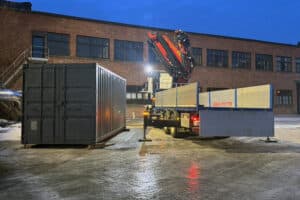
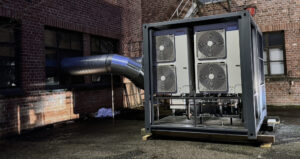
For deployable or temporary military installations, containerised HVAC systems provide a critical operational advantage. A containerised solution can be transported, positioned, and connected without civil works, enabling rapid establishment of controlled environments in forward locations. The container connects on site in one working day including electrical connection; without heat distribution network requirements, the system reaches full operational status within 4 hours of arrival.
Remote management capability is a non-negotiable requirement for facilities that operate continuously or are not permanently staffed. An automated remote management platform, integrated into AirTreater systems, provides real-time operational data and full settings control through a standard web browser, enabling facility managers and support teams to monitor and adjust system parameters from any location at any time. Named end users can also have access to the automation system. Combined with 24/7/365 help-desk support, this eliminates the support gap that leaves conventionally managed facilities exposed during out-of-hours failures.
For defense procurement teams, supplier qualification is a prerequisite. AirTreater holds NATO supplier registration with NCAGE code A04WG, confirming that its systems and supply processes meet the quality and reliability standards required for defense procurement. For facilities where air quality failure is an operational failure, that registration is not a procedural detail, it is a procurement requirement.
To review technical documentation for NATO procurement purposes or to discuss specific facility requirements, contact the AirTreater technical team directly.