Predictive maintenance for industrial HVAC equipment is a condition-based approach that uses real-time operational data to identify developing faults before they cause equipment failure. Rather than servicing equipment on a fixed schedule, it monitors actual system behaviour and triggers maintenance only when the data indicates a genuine need. The sections below address the most common questions procurement engineers and facility managers ask when evaluating predictive maintenance for industrial heating and cooling systems.
How does predictive maintenance differ from preventive maintenance in HVAC?
Predictive maintenance monitors real-time equipment data to identify faults as they develop, triggering intervention only when measurements indicate a problem is forming. Preventive maintenance follows a fixed schedule — filters replaced every quarter, refrigerant checked annually — regardless of whether the equipment actually needs attention. The core distinction is that predictive maintenance acts on evidence; preventive maintenance acts on time.
In practice, preventive maintenance is a reasonable baseline for low-criticality equipment where the cost of an unplanned failure is acceptable. For industrial HVAC systems supporting continuous processes, however, a scheduled approach has two structural weaknesses. First, it generates unnecessary maintenance labour and parts consumption when equipment is performing within specification. Second, it provides no protection against faults that develop between scheduled intervals. A compressor that begins to degrade six weeks after a service visit will not be flagged until the next scheduled inspection.
Predictive maintenance eliminates both weaknesses by replacing the calendar with the data stream. If compressor discharge pressure begins trending outside its normal operating band, the system flags the deviation immediately. Maintenance is dispatched to investigate a specific, identified condition rather than to perform a routine check that may reveal nothing actionable.
What data does predictive maintenance use to monitor HVAC equipment?
Predictive maintenance for industrial HVAC equipment relies on continuous measurement of key operational parameters: temperatures at inlet and outlet points, refrigerant pressures, compressor current draw, vibration signatures, flow rates in liquid-cycle systems, and energy consumption relative to delivered capacity. These data streams are compared against baseline values and historical trends to detect deviations that indicate developing faults.
The most diagnostically valuable parameters depend on the equipment type. For air-to-water heat pumps operating in liquid-cycle distribution systems, outlet water temperature stability and the delta between inlet and outlet temperatures are primary indicators. A narrowing delta at constant load suggests reduced heat transfer efficiency, which may point to fouling, refrigerant charge loss, or a compressor performance decline. For compressor-based systems, suction and discharge pressure ratios and compressor current draw relative to load are reliable early indicators of mechanical wear.
Energy consumption data adds a further diagnostic layer. A system drawing more electrical power than its historical baseline to deliver the same heating or cooling output is performing less efficiently than its specification requires. That efficiency gap is itself a fault signal, even before any mechanical symptom becomes visible. Combining energy data with temperature and pressure readings allows maintenance teams to distinguish between faults with similar surface symptoms but different root causes.
What types of HVAC faults can predictive maintenance detect early?
Predictive maintenance can detect refrigerant charge degradation, compressor wear, heat exchanger fouling, fan motor deterioration, pump performance decline in liquid-cycle systems, and control system drift before any of these conditions cause equipment failure or measurable capacity loss. The earlier these faults are identified, the lower the cost and complexity of the corrective action required.
Refrigerant charge loss is among the most common and consequential faults in compressor-based HVAC equipment. As charge decreases, suction pressure drops, compressor discharge temperature rises, and system efficiency falls. These changes appear in the data stream well before the equipment trips on a safety limit or fails to meet its setpoint. Early detection allows a controlled refrigerant top-up rather than an emergency shutdown and full system restart.
Heat exchanger fouling develops gradually and is difficult to detect by visual inspection alone. Predictive monitoring tracks the approach temperature — the difference between the refrigerant condensing temperature and the leaving fluid temperature — over time. A rising approach temperature under consistent load conditions indicates fouling is reducing heat transfer surface effectiveness. Cleaning at this stage is straightforward; allowing fouling to continue until the system fails to meet its capacity setpoint creates a more disruptive and costly intervention.
Compressor wear manifests through changes in vibration frequency and amplitude, rising current draw at equivalent load, and degraded pressure ratios. Vibration monitoring in particular provides advance warning of bearing wear that, if left unaddressed, progresses to compressor failure. The difference between replacing a bearing set and replacing a compressor is significant in both cost and downtime.
How does remote monitoring enable predictive maintenance for industrial systems?
Remote monitoring enables predictive maintenance by delivering continuous operational data from the equipment to a centralised platform where trend analysis, threshold alerting, and fault diagnosis can occur without requiring a technician to be physically present at the site. This is the technical foundation that makes predictive maintenance operationally viable for industrial systems, particularly those at remote or unmanned locations.
Without remote monitoring, predictive maintenance requires either permanent on-site instrumentation staff or frequent site visits to collect readings manually. Neither approach is economically viable for most industrial facilities. Remote monitoring platforms resolve this by transmitting sensor data continuously to a web-accessible interface, where both automated algorithms and support engineers can observe equipment behaviour in real time.
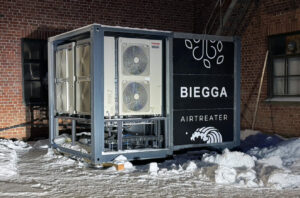
AirTreater systems are managed via an automated remote management platform, which provides real-time operational data and full settings control through a standard web browser. Named end users can also have access to the automation system. This means that when a parameter begins trending outside its normal operating envelope, the deviation is visible immediately to both the operator and the support team, regardless of where the equipment is installed. The 24/7/365 help-desk service available through AirTreater’s service centre means that anomalies identified outside business hours receive the same response as those detected during a standard working day.
For industrial facilities operating continuous processes, this combination of automated monitoring and round-the-clock human oversight is what converts raw data into actionable maintenance intelligence. A threshold alert at 02:00 on a Sunday that reaches a qualified engineer in real time is a fundamentally different capability from a Monday morning review of weekend log files.
What are the main benefits of predictive maintenance for industrial HVAC?
The primary benefits of predictive maintenance for industrial HVAC equipment are reduced unplanned downtime, lower total maintenance costs, extended equipment service life, and improved energy efficiency. These outcomes follow directly from the ability to address faults at their earliest detectable stage rather than after they have caused equipment failure or measurable performance degradation.
- Reduced unplanned downtime: Faults identified during their development phase can be scheduled for repair during planned maintenance windows. Equipment that fails unexpectedly forces an unplanned shutdown, which carries costs in lost production, process restart, and emergency service call rates that typically far exceed the cost of a planned repair.
- Lower maintenance expenditure: Condition-based intervention eliminates unnecessary scheduled maintenance on equipment that is performing within specification. Parts and labour are consumed only when the data justifies the work.
- Extended equipment service life: Addressing faults at early stages prevents the secondary damage that follows from operating degraded equipment. A compressor running with a low refrigerant charge sustains accelerated wear; correcting the charge early prevents the wear from accumulating.
- Sustained energy efficiency: Equipment operating with developing faults consumes more energy per unit of heating or cooling delivered. Predictive maintenance keeps systems operating within their design efficiency envelope, which has a direct effect on energy costs in continuous-process applications.
- Informed capital planning: Long-term trend data from predictive monitoring allows facility managers to forecast component end-of-life and plan capital replacement on a rational basis rather than reacting to unexpected failures.
For industrial processes where a heating or cooling interruption carries measurable consequences in lost production or equipment damage, the value of unplanned downtime prevention alone typically justifies the investment in predictive monitoring infrastructure.
When should an industrial facility switch to predictive maintenance?
An industrial facility should implement predictive maintenance for its HVAC equipment when the cost of an unplanned failure exceeds the cost of continuous monitoring, or when the equipment supports a process where interruption is not operationally acceptable. For most continuous-process industrial sites, that threshold is met by the HVAC systems serving production areas, critical cooling loops, or climate-sensitive storage.
The clearest trigger for adopting predictive maintenance is a history of unplanned HVAC failures that caused production interruptions or process damage. If the facility has experienced even one such event, the retrospective cost analysis will almost always demonstrate that continuous monitoring would have paid for itself. A second trigger is the installation of new high-value equipment where protecting the asset from premature wear is a financial priority from commissioning.
Facilities that operate at remote locations or with limited on-site technical staff have an additional reason to prioritise predictive monitoring. When a technician cannot reach a site quickly, early fault detection is the primary mechanism for preventing a developing problem from becoming a critical failure. Remote monitoring platforms that deliver real-time data to off-site engineering teams effectively extend technical oversight to sites that cannot be staffed continuously.
Facilities still operating on a purely reactive basis — repairing equipment only after it fails — should treat any unplanned HVAC failure as the prompt to evaluate predictive maintenance. The data required to justify the transition is typically available from the failure event itself: the cost of the repair, the value of lost production during the outage, and the elapsed time between the failure and the return to full operation. Those three figures, compared against the annual cost of a monitoring and support contract, generally make the case without further analysis.