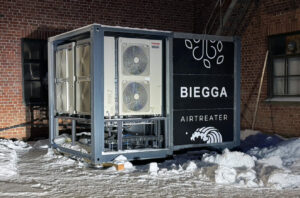
Certified climate technology for critical infrastructure means systems that guarantee nominal heating or cooling capacity at all outdoor temperatures, comply with recognized quality and procurement standards, and maintain continuous operation without performance degradation in extreme conditions. For infrastructure operators, “certified” is not a marketing label — it is a verifiable engineering and procurement baseline. The sections below address the most important questions procurement engineers and facility managers ask when evaluating climate control for critical sites.
What makes climate technology ‘certified’ for critical infrastructure?
Climate technology qualifies as certified for critical infrastructure when it meets two independent standards: verified performance under actual operating conditions, and documented compliance with recognized procurement or quality frameworks. A system that derates significantly even at very low temperatures or requires laboratory conditions to achieve its rated capacity does not meet the threshold, regardless of what its datasheet claims.
In practice, certification for critical infrastructure spans several dimensions. Performance certification means the system delivers at least its nominal capacity at all outdoor temperatures — not only under optimal conditions. Procurement certification means the supplier holds verifiable credentials recognized by institutional buyers. For defense and government-adjacent infrastructure, this typically means NATO supplier registration. AirTreater holds NATO supplier registration with NCAGE code A04WG, confirming compliance with the quality and reliability standards required for mission-critical deployments.
A third dimension is operational certification: the system must support continuous, unattended operation with remote visibility and documented support availability. Systems that cannot be monitored remotely or that lack 24/7 support structures are not operationally fit for critical sites, regardless of their thermal performance credentials.
What types of critical infrastructure require specialized climate control?
Critical infrastructure requiring specialized climate control includes any facility where a heating or cooling interruption causes measurable operational, safety, or financial consequences. The defining characteristic is not the sector — it is the cost of failure. Facilities that cannot tolerate downtime require systems engineered and guaranteed to prevent it.
The most demanding categories include:
- Power generation and energy facilities: Biogas plants, combined heat and power installations, and renewable energy infrastructure require continuous process cooling. Temperature excursions in these environments directly affect generation output and equipment integrity.
- Defense and military installations: Forward operating bases, command infrastructure, and logistics facilities require climate control that functions in extreme cold, deploys rapidly, and meets NATO procurement standards.
- Industrial process environments: Manufacturing lines, chemical processing, and precision production facilities depend on stable thermal conditions to maintain product quality and prevent equipment damage.
- Telecommunications and data infrastructure: Server rooms and communications nodes generate continuous heat loads that must be managed regardless of outdoor temperature or seasonal variation.
- Remote and off-grid industrial sites: Mining, forestry, and temporary extraction operations require self-contained climate control with no dependency on permanent building infrastructure.
What these categories share is intolerance for the performance gap that conventional HVAC systems introduce at temperature extremes. A biogas plant operating through a Finnish winter cannot accept a chiller that loses 40% of its cooling capacity when outdoor temperatures drop below -10 °C.
How does industrial heat pump technology protect against climate failure?
Industrial heat pump technology protects against climate failure by guaranteeing nominal capacity at all outdoor temperatures, eliminating the performance degradation that causes conventional systems to fail precisely when demand is highest. The protection mechanism is engineering-based, not redundancy-based: the system is designed to maintain its specified output under the actual conditions it will encounter.
AirTreater Čáhci illustrates this directly. The system maintains 120 kW of nominal heating capacity at -15 °C using compressors alone, with no auxiliary heat strips and no performance compromise. Maximum output reaches 420 kW at temperatures down to -15 °C. The heat pump operates down to -28 °C. When outdoor temperatures fall below -28 °C, the integrated backup system activates to guarantee at least 300 kW of heating capacity even without external electric power in hazardous situations — maintaining the thermal output the site depends on regardless of external conditions.
This approach contrasts with conventional heat pumps, which are typically rated at nominal conditions — often +7 °C outdoor temperature — and derate substantially as temperatures fall. At -15 °C, a conventional system may deliver 50 to 60% of its rated output. For a critical infrastructure site, that gap is not an inconvenience — it is a system failure.
The liquid-cycle distribution architecture of an air-to-water industrial heat pump adds a further layer of protection. Heat is distributed through a closed water circuit rather than through air, providing more even temperature distribution across large spaces and reducing the number of failure points compared to ducted air systems.
What’s the difference between portable and fixed climate systems for critical sites?
The key distinction between containerised and fixed climate systems for critical sites is deployment flexibility versus infrastructure integration. Fixed systems are permanently installed within a building’s mechanical plant, integrated with existing pipework and electrical infrastructure. Containerised systems are self-contained, ship in standard containers, and connect to a site in a single working day without permanent civil works.
Fixed Climate Systems
Fixed installations offer deep integration with a building’s existing infrastructure — hydronic distribution networks, building management systems, and permanent electrical supplies. For sites with established infrastructure and long operational horizons, fixed systems typically provide the most efficient long-term operation. The trade-off is lead time: permanent plant requires civil works, commissioning, and site-specific engineering that can extend deployment timelines to months.
Containerised Climate Systems
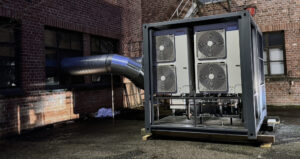
Containerised systems like AirTreater Čáhci and AirTreater Prosea eliminate the civil works dependency entirely. The container connects on site in a single working day. Without heat distribution network requirements, the system is fully operational within 4 hours of arrival. When the operational requirement changes — when a project completes, when a site relocates, or when a temporary need becomes permanent — the container moves with it. No asset is stranded, and no infrastructure is abandoned.
For critical infrastructure operators evaluating temporary or semi-permanent requirements, the containerised format also eliminates the procurement risk of committing to fixed infrastructure before operational parameters are fully defined. The system can be deployed to address an immediate need and redeployed or upgraded as requirements evolve.
How does remote monitoring reduce risk in critical climate systems?
Remote monitoring reduces risk in critical climate systems by providing continuous operational visibility and enabling intervention before a deviation becomes a failure. On unmanned or remote sites, the alternative to remote monitoring is periodic physical inspection — which means problems are discovered after they occur, not before.
AirTreater systems are managed via an automated remote management platform, which delivers real-time operational data and full settings control through a standard web browser. Operators can verify outlet temperatures, check system status, and adjust setpoints from any location at any time — without dispatching personnel to site. Named end users can also have access to the automation system. For critical infrastructure in remote locations, this capability is not a convenience feature; it is the primary mechanism for maintaining operational continuity between physical service visits.
The risk reduction operates across three dimensions. First, early fault detection: deviations from setpoint or anomalous operating parameters are visible immediately, allowing corrective action before thermal limits are breached. Second, remote adjustment: setpoints can be modified remotely in response to changing process requirements or weather conditions, without the delay of a site visit. Third, support integration: the 24/7/365 help-desk service available through AirTreater’s service centre operates in conjunction with the automation platform, giving support engineers direct access to the same operational data the site team sees.
When should critical infrastructure operators choose process cooling over standard HVAC?
Critical infrastructure operators should choose process cooling over standard HVAC when the cooling load is generated by equipment or a process rather than by occupancy, when the cooling requirement is continuous rather than seasonal, and when the consequences of a cooling interruption extend beyond discomfort to equipment damage, process failure, or production loss.
Standard HVAC systems are designed for comfort conditioning — managing the thermal environment for human occupants within a building envelope. They are sized for peak occupancy loads and operate intermittently. Process cooling systems are designed for equipment and process loads: they operate continuously, maintain precise temperature setpoints, and are specified against the thermal output of the equipment they serve rather than against building occupancy models.
AirTreater Prosea is a containerised process cooling package designed specifically for these applications, with capacity specified per project and site requirements. It delivers full cooling capacity energy-efficiently without engaging compressors in cold conditions, using its free-cooling function to reject heat to ambient air without mechanical refrigeration. This eliminates the primary mechanical failure point of conventional chiller systems during extended cold-weather operation and significantly reduces energy consumption. When outdoor temperatures rise sufficiently, the compressor circuit engages to maintain the specified setpoint.
For biogas plants, power generation facilities, industrial process lines, and telecommunications infrastructure, this combination of continuous-duty design, free-cooling capability, and containerised deployment addresses the specific requirements that standard HVAC cannot meet. AirTreater covers heating, cooling, filtration, and process cooling, and all systems are guaranteed to deliver at least nominal heating or cooling capacity at all outdoor temperatures. The decision criterion is straightforward: if the cooling load is process-driven and interruption-sensitive, a dedicated process cooling system is the correct specification.
For procurement teams evaluating process cooling for critical applications, contact AirTreater’s technical team to request specification documentation and discuss site-specific requirements.