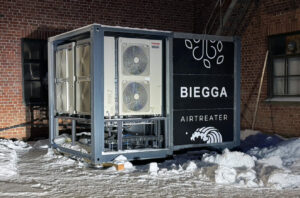
Industrial climate control is the engineering and management of temperature, humidity, and thermal conditions within industrial facilities to protect processes, equipment, and personnel. At an industrial scale, this means guaranteed heating and cooling capacity across all outdoor temperatures, not just under optimal conditions. The questions below address the core technical and operational decisions that facility managers and procurement engineers face when specifying an industrial climate control system.
What types of facilities need industrial climate control?
Industrial climate control is required in any facility where temperature variation directly affects process quality, equipment reliability, or operational continuity. This includes manufacturing plants, biogas and energy production facilities, data centres, pharmaceutical production halls, food processing operations, and construction sites with sensitive temporary infrastructure. The common factor is that a heating or cooling interruption carries measurable operational consequences.
The distinction between industrial climate control and standard commercial HVAC lies in the consequences of failure. In an office building, a heating fault is an inconvenience. In a biogas plant or chemical processing facility, the same fault can halt production, damage equipment, or create safety hazards. Industrial climate control systems are therefore specified to deliver guaranteed performance, not estimated performance under ideal conditions.
Facilities that operate continuously, particularly those running 24-hour processes, require systems that maintain setpoint temperatures regardless of outdoor conditions. In northern climates, where outdoor temperatures can drop below -20 °C for extended periods, this requirement eliminates a significant portion of conventional HVAC equipment from consideration. Conventional heat pumps derate substantially at low ambient temperatures; industrial heating systems must not.
How does an air-to-water heat pump work at industrial scale?
An industrial air-to-water heat pump extracts thermal energy from outdoor air and transfers it to a liquid circuit, typically water or a water-glycol mixture, which then distributes heat throughout the facility via radiators, underfloor systems, or air-handling units. At an industrial scale, the critical performance parameter is the ability to maintain nominal heating capacity across the full range of outdoor temperatures encountered on site.
The refrigerant cycle operates as follows: a compressor raises the pressure and temperature of the refrigerant; the hot refrigerant transfers heat to the water circuit through a plate heat exchanger; the refrigerant then expands and cools before passing through an outdoor heat exchanger, where it absorbs energy from the ambient air. This cycle repeats continuously to maintain the target outlet water temperature.
At an industrial scale, the engineering challenge is maintaining this cycle efficiently when outdoor temperatures fall well below zero. Conventional systems lose capacity as the temperature differential between the refrigerant and the outdoor air narrows. AirTreater Čáhci addresses this directly: it maintains 120 kW of nominal heating capacity at -15 °C using compressors alone, with a maximum output of 420 kW at temperatures down to -15 °C. The heat pump operates down to -28 °C, and when outdoor temperatures fall below -28 °C, an integrated backup system guarantees at least 300 kW of heating capacity even without external electric power in hazardous situations. Outlet water temperatures reach +75 °C, enabling direct integration with high-temperature hydronic distribution systems without supplementary heating.
What is free cooling and when does it replace compressor-based cooling?
Free cooling is a specific HVAC engineering function in which a cooling system rejects heat to the ambient environment without engaging compressors, using the temperature differential between the outdoor air and the process fluid to achieve cooling directly. Free cooling replaces compressor-based mechanical refrigeration when outdoor temperatures fall sufficiently below the required process fluid temperature to enable heat transfer without mechanical assistance.
The threshold at which free cooling becomes viable depends on the process setpoint and system design. AirTreater Prosea operates on exactly this principle: its free-cooling function delivers cooling energy-efficiently without engaging compressors when outdoor conditions are sufficiently cold. When temperatures rise above the point at which passive heat rejection is sufficient, the compressor circuit engages to maintain setpoint.
The operational benefits of free-cooling operation are twofold. First, energy consumption drops significantly when compressors are not running, reducing operating costs during the extended cold periods common in northern climates. Second, compressor-off operation eliminates the primary mechanical wear point in conventional chiller systems, directly improving long-term reliability. For facilities running continuous processes, this means fewer maintenance interventions and reduced risk of unplanned downtime during the periods when compressors would otherwise be under the greatest thermal stress.
How does a containerized climate system scale with facility size?
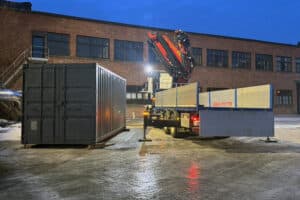
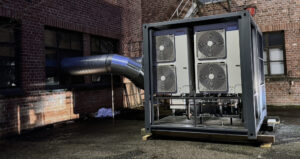
A containerised climate system scales with facility size by deploying additional container units in parallel, each delivering a defined increment of heating or cooling capacity, without requiring permanent plant room construction or significant civil works. This modular approach allows capacity to be added, removed, or redeployed as facility requirements change, matching the thermal load to the infrastructure investment at each stage of a project.
The practical advantage over fixed installations is the elimination of the over-specification problem. Permanent HVAC infrastructure is typically sized for peak demand, meaning capital is committed to capacity that sits idle during lower-demand periods. A containerised approach allows operators to deploy the capacity they need now and expand when demand justifies it, with each unit arriving pre-configured and ready to connect.
AirTreater’s containerised systems connect on site in a single working day. Where no heat distribution network is required, the system is fully operational within 4 hours of arrival. When the project completes or facility requirements change, the container relocates without leaving permanent infrastructure behind. For construction sites, temporary industrial operations, or facilities undergoing phased expansion, this deployment model eliminates the lead times and site dependencies that fixed installations require.
What’s the difference between process cooling and facility climate control?
Process cooling removes heat generated by a specific industrial process, such as a compressor, reactor, data server, or biogas digester, to maintain the process within its required temperature range. Facility climate control manages the ambient temperature and conditions within the building or space in which people and equipment operate. The two functions have different setpoints, load profiles, and reliability requirements, and they often require separate or purpose-designed systems.
Process Cooling: Precision at the Point of Heat Generation
Process cooling is typically continuous, with a defined and consistent heat load that must be removed to prevent equipment damage or process failure. The cooling setpoint is determined by the process specification, not by human comfort, and is often well below ambient temperature. Interruption of process cooling carries immediate consequences: equipment overheating, production loss, or in some cases, safety events. Systems designed for process cooling, such as AirTreater Prosea, are engineered to project-specific requirements and specified to deliver guaranteed nominal cooling capacity under all operating conditions, including extreme outdoor temperatures.
Facility Climate Control: Managing the Operational Environment
Facility climate control addresses the thermal environment of the space itself, maintaining temperatures within a range suitable for personnel, stored materials, or general equipment operation. Load profiles vary with occupancy, solar gain, and outdoor conditions. The consequences of a temporary failure are typically less severe than in process cooling, though in pharmaceutical storage, food production, or cold-chain logistics, the distinction narrows considerably. Industrial heating systems for large facilities, such as AirTreater Čáhci operating in a liquid-cycle heating configuration, are designed to maintain consistent outlet water temperatures across the full distribution network regardless of outdoor temperature.
How can remote monitoring improve industrial HVAC performance?
Remote monitoring improves industrial HVAC performance by giving operators continuous, real-time visibility into system operating parameters, enabling early identification of deviations from setpoint before they develop into failures. It also allows setting adjustments to be made without a site visit, reducing response times and eliminating the operational dependency on on-site personnel for routine control tasks.
The practical impact is most significant for facilities that operate continuously or are located in remote or unmanned environments. Without remote monitoring, a deviation from setpoint may go undetected until a scheduled inspection or until a process fault occurs. With a real-time monitoring platform, the operator sees the deviation as it develops and can intervene immediately, either by adjusting settings remotely or by dispatching a technician with full diagnostic information already in hand.
AirTreater systems are managed via an automated remote management platform, which provides a real-time operational dashboard accessible through a standard web browser from any location. Named end users can also have access to the automation system. Operators can view current system status, review historical performance data, and adjust settings directly through the interface without requiring specialist software or on-site access. This capability is supported by AirTreater’s 24/7/365 help-desk service, ensuring that when the monitoring platform identifies an issue outside business hours, qualified support is available to respond. For industrial operators running continuous processes, the combination of remote visibility and round-the-clock support eliminates the support gap that makes overnight and weekend failures disproportionately costly.