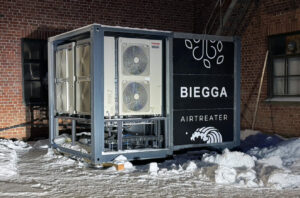
Defense-grade environmental control refers to climate management systems that guarantee full nominal heating or cooling capacity under all operating conditions, including extreme cold, remote deployment, and continuous mission-critical operation. Standard commercial HVAC equipment is rated under optimal conditions and degrades in the field. Defense-grade systems are built, tested, and guaranteed to perform when conditions are at their worst. The questions below address the specific technical and operational criteria that distinguish these systems from conventional alternatives.
What makes environmental control “defense-grade”?
Environmental control is defense-grade when it delivers guaranteed nominal capacity at all outdoor temperatures, operates without performance degradation in extreme conditions, meets documented procurement and quality standards, and can be deployed rapidly without permanent civil infrastructure. The defining characteristic is the guarantee, not the specification sheet rating. A system that is rated at 90 kW under laboratory conditions but delivers 40 kW at -15 °C is not defense-grade, regardless of how it is marketed.
For military and critical infrastructure applications, the performance gap between rated and actual capacity is an operational liability. Defense procurement officers require systems where the specified output is the guaranteed output, across the full range of temperatures the system will encounter in the field. This is the standard AirTreater builds to: every system — covering heating, cooling, filtration, and process cooling — is guaranteed to deliver at least its nominal heating or cooling capacity at all outdoor temperatures.
Beyond thermal performance, defense-grade environmental control must meet verifiable quality and compliance standards. AirTreater holds NATO supplier registration with NCAGE code A04WG, which confirms compliance with the quality and reliability standards required for deployment in mission-critical environments. For procurement teams operating within NATO frameworks, this registration is a prerequisite for engagement, not a differentiator to be weighed against price.
What types of operations require defense-grade climate control?
Operations that require defense-grade climate control share a common characteristic: an interruption in heating or cooling carries consequences that are operationally, financially, or physically unacceptable. This includes military installations and forward operating bases, critical infrastructure such as power generation and telecommunications facilities, biogas and continuous-process industrial plants, and remote or off-grid sites where equipment failure cannot be quickly remedied by on-site personnel.
In defense contexts, environmental control failures affect personnel safety, equipment operability, and mission continuity. Sensitive electronics, weapons systems, and communications infrastructure have defined operating temperature ranges. A climate control failure in a forward-deployed command post or a temporary field hospital is not an inconvenience, it is a mission-critical failure.
Industrial process applications present an equivalent level of criticality. A biogas digester that loses temperature control stops producing gas. A data center that loses cooling shuts down. A chemical process that drifts outside its thermal envelope may require a complete restart, with associated costs in lost production and equipment stress. The common thread across all these applications is that the cost of failure far exceeds the cost of specifying the right system from the outset.
How does an air-to-water heat pump perform in extreme cold?
A conventional air-to-water heat pump loses capacity as outdoor temperatures fall because the temperature differential between the ambient air and the refrigerant becomes smaller, reducing the efficiency of heat extraction. Most commercial systems derate significantly below -10 °C and may cease to function reliably at -20 °C or below. Defense-grade air-to-water heat pumps are engineered to maintain full nominal capacity at extreme sub-zero temperatures through compressor design, refrigerant selection, and integrated backup systems.
AirTreater Čáhci illustrates what guaranteed cold-weather performance looks like in practice. The system maintains 120 kW of nominal heating capacity at -15 °C using compressors alone, with no auxiliary heat strips and no performance compromise. Maximum output reaches 420 kW at temperatures down to -15 °C. The heat pump operates down to -28 °C, and when outdoor temperatures fall below -28 °C, an integrated backup system activates to guarantee at least 300 kW of heating capacity even without external electric power in hazardous situations. This is not a rated condition under optimal circumstances, it is the guaranteed operational baseline.
For liquid-cycle distribution systems, outlet water temperature is the operationally critical parameter. Čáhci maintains outlet water temperatures sufficient for direct integration with high-temperature hydronic distribution networks, even at extreme outdoor temperatures. This eliminates the need for supplementary heating equipment that adds cost, complexity, and additional failure points to the installation.
What’s the difference between process cooling and standard air conditioning?
Standard air conditioning is designed to maintain comfortable temperatures for building occupants by removing heat from interior air and rejecting it to the outside. Process cooling is designed to remove heat generated by industrial equipment, chemical reactions, or biological processes, maintaining precise temperature setpoints for operational rather than comfort reasons. Process cooling systems must maintain defined thermal parameters continuously, often at higher heat loads and with far less tolerance for temperature variation than comfort cooling applications.
Precision and Continuity Requirements
Standard air conditioning systems are designed for intermittent operation, cycling on and off in response to occupancy and ambient conditions. Process cooling systems must operate continuously, often 24 hours a day, 365 days a year. A biogas digester, a power electronics cabinet, or a server hall cannot tolerate the temperature swings that are acceptable in an office environment. Process cooling specifications are defined by the process requirements, not by human comfort standards.
Free-Cooling Function in Sub-Zero Conditions
One significant engineering advantage in process cooling applications is the ability to exploit cold ambient temperatures for heat rejection without mechanical refrigeration. This is the free-cooling function: when outdoor temperatures fall sufficiently low, the system rejects process heat directly to the ambient air without engaging compressors. AirTreater Prosea delivers this free-cooling capability energy-efficiently in cold conditions, eliminating compressor wear, reducing energy consumption significantly, and removing the primary mechanical failure point of conventional chiller systems during extended cold-weather operation. Prosea systems are designed on a per-project basis to meet each site’s specific process cooling requirements.
What should you look for in a portable environmental control unit?
A portable environmental control unit for high-stakes operations must meet four criteria:
- Guaranteed nominal capacity across the full range of expected operating temperatures
- A containerised form factor that enables rapid deployment without permanent civil infrastructure
- Startup within 4 hours of arriving on site (where no heat distribution network is required), with full commissioning including electrical connection completed within one working day
- The ability to relocate the system when operational requirements change
Units that meet only some of these criteria introduce operational risk at precisely the point where risk is least acceptable.
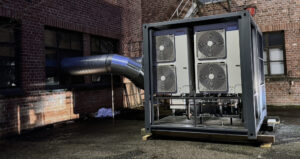
The containerised form factor is the correct standard for industrial and defense portable environmental control. A shipping-container-based system arrives pre-configured, connects to site services, and is fully operational within 4 hours of arrival, assuming no heat distribution network installation is required. When the project or operation concludes, the system relocates without leaving behind permanent infrastructure or requiring specialist civil remediation works.
Capacity guarantees are non-negotiable. A portable unit that delivers its rated output only at moderate temperatures provides no assurance for cold-climate deployments. Procurement specifications should require guaranteed nominal capacity at the lowest expected outdoor temperature for the site, not at a standard rating condition that may never occur in the actual operating environment.
How is remote monitoring used in critical environmental control systems?
Remote monitoring in critical environmental control systems provides operators with real-time visibility into system performance, enables settings adjustment without on-site presence, and supports proactive fault detection before a thermal deviation becomes an operational failure. For unmanned sites, remote sites, and 24/7 continuous-process applications, remote monitoring is not a convenience feature, it is an operational requirement that directly affects system reliability and response time.
AirTreater systems are managed via an automated remote management platform, which delivers real-time operational data and full settings control through a standard web browser, accessible from any location at any time. Named end users can also have access to the automation system. Operators can monitor outlet water temperatures, compressor status, energy consumption, and system alarms without dispatching personnel to site. Settings adjustments, setpoint changes, and operational mode changes are executed directly through the browser interface.
For defense and critical infrastructure applications, remote management capability also reduces the personnel burden on forward-deployed or remote sites. A climate control system that requires on-site intervention for routine adjustments creates a staffing dependency that may not be sustainable in all operational contexts. The automated remote management platform eliminates that dependency for the full range of routine operational tasks, while AirTreater’s 24/7/365 help-desk service through the service centre provides escalation support when issues require specialist intervention. Contact the AirTreater technical team to request documentation on remote management capabilities and integration requirements for your specific operational environment.