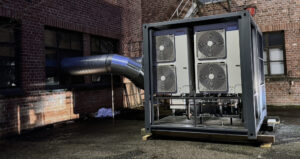
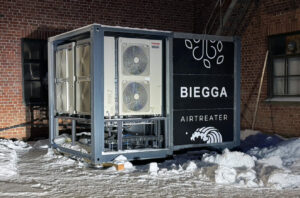
AirTreater Biegga delivers heating in extreme cold temperatures by combining an 84 kW air-to-air heat pump with an 81 kW integrated electric support heater, giving a maximum combined heating output of 165 kW. When outdoor temperatures fall and heat pump efficiency decreases, the electric support heater activates to maintain the required thermal output. The sections below address the specific performance mechanisms, temperature thresholds, and site conditions that determine how Biegga performs when temperatures drop well below zero.
What keeps Biegga’s heating output stable at extreme temperatures?
AirTreater Biegga maintains stable heating output in extreme cold through a two-stage thermal architecture: an 84 kW air-to-air heat pump operating as the primary source, backed by an 81 kW electric support heater that activates when ambient conditions reduce the heat pump’s contribution. The combined maximum heating capacity is 165 kW, and at least 81 kW is guaranteed at all outdoor temperatures, not rated at optimal conditions.
The electric support heater is not a fallback for system failure. It is an engineered component of the thermal design, sized specifically to compensate for the reduction in heat pump output that occurs as outdoor air temperature drops. As the temperature differential between outdoor air and the refrigerant circuit increases, the compressors must work harder to extract useful heat. The support heater fills that gap precisely, so the total heating output delivered to the space remains constant regardless of what is happening outside.
This is the core distinction between AirTreater Biegga and conventional air-to-air heat pumps, which are typically specified at a nominal condition and derate significantly in sub-zero temperatures. Biegga’s architecture treats cold-weather performance as a design requirement, not an edge case.
At what outdoor temperature does Biegga stop heating effectively?
AirTreater Biegga does not stop heating effectively at any defined outdoor temperature within its operating range. All AirTreater systems are guaranteed to deliver at least nominal heating capacity at all outdoor temperatures. The integrated electric support heater ensures the system maintains its rated output even when the heat pump alone cannot sustain it in deep sub-zero conditions.
Conventional air-to-air heat pumps typically show a pronounced performance drop below -15 °C, with some losing like 40% of rated capacity, and many are effectively unworkable as primary heat sources below -20 °C. Biegga’s architecture avoids this cliff because the support heater capacity is sized to compensate for the heat pump’s reduced contribution at low temperatures. The two components are not independent systems operating in parallel; they are a single integrated thermal solution designed to deliver 165 kW at maximum output and at least 81 kW at all outdoor temperatures regardless of outdoor conditions.
For procurement and engineering purposes, this means Biegga can be specified with confidence for sites in northern Finland and other extreme-cold environments where outdoor temperatures regularly reach -25 °C or lower. The performance guarantee is not conditional on a temperature range.
How does Biegga compare to a water-based heat pump in cold climates?
In cold climates, the primary difference between AirTreater Biegga and a liquid-cycle system like AirTreater Čáhci is the heat distribution method. Biegga distributes heat directly as conditioned air, while Čáhci heats water that circulates through a hydronic distribution network. For sites without an existing heat distribution infrastructure, Biegga is the faster and simpler deployment. For sites with large hydronic networks or high-temperature distribution requirements, Čáhci is the more appropriate specification.
From a cold-weather performance standpoint, both systems are guaranteed to deliver nominal capacity at all outdoor temperatures. Čáhci maintains 120 kW of nominal heating capacity at -15 °C using compressors alone, with a maximum output of 420 kW. Biegga delivers up to 165 kW maximum heating capacity through its combined heat pump and electric support heater architecture. The right choice depends on the site’s thermal distribution infrastructure, the required capacity, and the physical layout of the space to be conditioned.
For applications where a hydronic network is already in place, Čáhci will typically deliver better energy efficiency and more even temperature distribution across large or multi-zone facilities. For open, single-volume spaces where direct air heating is practical, Biegga eliminates the need for pipework and fluid systems entirely, reducing both installation time and the number of components that require maintenance.
Why does Biegga use an electric support heater alongside the heat pump?
Biegga uses an 81 kW electric support heater alongside the heat pump because air-to-air heat pump efficiency is directly affected by outdoor air temperature. As temperatures fall, the heat pump extracts less thermal energy per unit of electrical input. Without a supplementary heat source, total heating output would decline in the conditions where it is needed most. The electric support heater compensates for this reduction, maintaining the system’s guaranteed heating capacity.
This is a deliberate engineering decision, not a limitation. The alternative, sizing the heat pump to deliver full output at the lowest expected outdoor temperature, would require a significantly larger refrigerant circuit operating at low efficiency for most of its annual runtime. The hybrid architecture, using a correctly sized heat pump for the majority of operating hours and activating electric support only when outdoor conditions require it, delivers better overall energy efficiency across the heating season while guaranteeing performance at the temperature extremes.
The support heater also provides a degree of system redundancy. If the heat pump requires maintenance, the electric heater can maintain a baseline thermal output in the space, reducing the operational impact of any unplanned downtime. This matters in industrial and construction environments where a complete loss of heating is not an acceptable outcome.
What types of sites benefit most from Biegga in cold conditions?
AirTreater Biegga is best suited to large, open-volume spaces where direct air heating is practical and where a permanent hydronic heat distribution network is either absent or unnecessary. In cold conditions specifically, the sites that benefit most are those requiring guaranteed heating capacity without the infrastructure investment of a liquid-cycle system.
The following site types are well matched to Biegga’s capabilities in cold-climate applications:
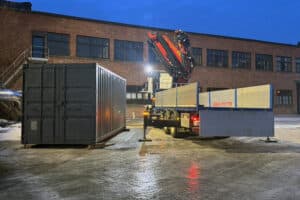
- Construction sites and temporary industrial facilities where permanent heating infrastructure is not available and the heating requirement is time-limited. Biegga’s containerised format connects in one working day including electrical connection, and is fully operational within 4 hours of arriving on site when no heat distribution network is required.
- Large industrial halls, warehouses, and production facilities with high ceiling volumes and open floor plans where air-to-air distribution covers the space efficiently without ductwork complexity.
- Logistics and storage facilities in northern climates where consistent interior temperatures must be maintained through extended periods of sub-zero outdoor conditions.
- Temporary military and defense installations where rapid deployment and guaranteed performance are non-negotiable operational requirements.
- Remote or off-grid sites where liquid-cycle infrastructure is impractical and where the site may be unmanned for periods. Biegga integrates with an automated remote management platform, providing real-time operational visibility and full settings control through a standard web browser from any location. Named end users can also have access to the automation system.
In each of these scenarios, the combination of Biegga’s 165 kW maximum heating capacity, guaranteed cold-weather performance, and containerised deployment format addresses the specific constraints of the site. For sites where a heat distribution network already exists or where capacity requirements exceed 165 kW, AirTreater Čáhci or a Prosea process solution would be the more appropriate specification. Contact the AirTreater technical team to discuss your site’s heating requirements and identify the right system for your conditions.