Industrial HVAC equipment needs servicing when it shows measurable performance deviations from its specified operating parameters — reduced output capacity, increased energy consumption, unusual noise, or irregular cycling behaviour. For industrial systems operating in demanding conditions, these signals rarely appear without cause, and ignoring them carries consequences that extend well beyond the equipment itself.
The threshold for action is lower in industrial settings than in commercial ones. When a heating or cooling system supports a continuous process, a biogas plant, a production line, or a critical infrastructure installation, any degradation in performance is an operational risk, not just a maintenance inconvenience. The sections below address the most common questions facility engineers and plant managers ask about industrial HVAC servicing intervals, warning signs, and the role of remote monitoring in catching problems early.
What are the most common warning signs that industrial HVAC equipment needs servicing?
The most common warning signs that industrial HVAC equipment needs servicing are: reduced heating or cooling output relative to the setpoint, increased energy consumption without a corresponding change in load, unusual mechanical noise from compressors or fans, refrigerant or fluid leaks, frequent cycling on and off, and error codes or fault flags from the control system. Any one of these signals warrants investigation.
In liquid-cycle systems, reduced outlet water temperature relative to the setpoint is one of the clearest early indicators. If a system is specified to deliver a particular outlet temperature at a given outdoor condition and it is consistently falling short, the cause is almost always one of a short list: refrigerant charge loss, fouled heat exchangers, a degrading compressor, or a controls fault. Each of these has a different service response, but all require a qualified technician to diagnose.
Energy consumption is a frequently overlooked indicator. When a system draws more power than its baseline to maintain the same output, efficiency has degraded somewhere in the refrigeration circuit. Tracking energy consumption per unit of heating or cooling output over time gives facility managers an objective measure of system health that does not depend on subjective observation.
Mechanical noise deserves particular attention in industrial heat pump systems. Compressors operating outside their normal acoustic signature — rattling, grinding, or intermittent clicking — are signalling internal wear or lubrication issues. Catching these early typically means a compressor service or component replacement. Ignoring them typically means compressor failure.
How often should industrial HVAC systems be professionally serviced?
Industrial HVAC systems operating continuously should receive a full professional service at least once per year, with a lighter inspection every six months. Systems running in extreme temperature environments, at high utilisation rates, or in process-critical applications benefit from quarterly inspections. The correct interval depends on operating hours, ambient conditions, and the consequences of unplanned downtime at the specific site.
Annual servicing covers the full scope of mechanical and electrical inspection: refrigerant charge verification, heat exchanger cleaning, compressor performance testing, fan motor and belt checks, controls calibration, and fluid system integrity for liquid-cycle installations. Six-month interim checks focus on operational parameters — outlet temperatures, energy consumption trends, error log review, and visual inspection for leaks or corrosion.
Sites operating in harsh northern climates, where systems cycle through extreme temperature ranges across seasons, should treat the shoulder seasons — late autumn before deep winter, and spring after sustained cold — as natural service trigger points. Verifying that compressor performance, refrigerant charge, and controls are within specification before the most demanding operating period begins is straightforward risk management.
What happens if industrial HVAC maintenance is delayed too long?
Delaying industrial HVAC maintenance long enough causes a predictable sequence: performance degradation leads to increased energy consumption, which accelerates component wear, which eventually produces a system failure. In process-critical applications, that failure means production interruption, process restart costs, and potentially damaged equipment or product. The cost of deferred maintenance is almost always higher than the cost of the service itself.
Compressor failure is the most expensive consequence of neglected maintenance. Compressors that run with degraded refrigerant charge, contaminated oil, or worn valve assemblies fail earlier and more completely than those maintained within specification. A compressor replacement in an industrial heat pump system is a significant capital cost. A compressor service or refrigerant top-up is a fraction of that figure.
Heat exchanger fouling is a slower but equally damaging consequence. As heat transfer surfaces accumulate scale, biological growth, or particulate contamination, thermal efficiency drops. The system compensates by running longer and harder to maintain the setpoint, which increases wear across every mechanical component. By the time fouling is severe enough to trigger visible performance loss, the cumulative energy waste and component stress have already been significant.
For sites where heating or cooling interruption is genuinely unacceptable — biogas digesters, server cooling loops, defence installations, production environments with temperature-sensitive processes — the risk calculus is straightforward. Scheduled maintenance is a controlled cost. Emergency repair or system replacement is an uncontrolled one, with the additional burden of downtime consequences layered on top.
Can remote monitoring detect HVAC service needs before they become failures?
Yes. Remote monitoring systems can detect early indicators of HVAC service needs — including performance deviations, abnormal energy consumption, fault codes, and temperature drift from the setpoint — before those conditions escalate into component failure. The effectiveness depends on the quality of the monitoring platform and how consistently the data is reviewed and acted on.
AirTreater systems integrate an automated remote management platform, which provides real-time operational data through a standard web browser. Facility managers, named end users, and service teams can monitor outlet temperatures, system cycling behaviour, fault logs, and energy consumption from any location, at any time. When a parameter drifts outside its normal operating band, the platform flags it — giving the service team the opportunity to investigate and respond before the condition worsens.
The practical value of remote monitoring is greatest at unmanned or remote sites, where no on-site staff are available to notice early warning signs. A compressor that begins cycling abnormally at 02:00 at a remote biogas installation will not be observed by anyone on site — but it will appear in the automation platform as a deviation from normal operating behaviour. That visibility converts what would otherwise be a surprise failure into a scheduled service call.
Remote monitoring does not replace physical inspection. It supplements it. Refrigerant charge, mechanical wear, and heat exchanger condition cannot be fully assessed remotely. What remote monitoring does is narrow the window between the onset of a problem and the moment a qualified technician is dispatched to address it.
What maintenance tasks can site staff handle versus a certified technician?
Site staff can handle visual inspections, basic cleaning of accessible air intake and discharge areas, monitoring of control panel displays and error codes, checking fluid levels in liquid-cycle systems where access is provided, and logging performance data for trend review. Refrigerant handling, compressor servicing, electrical fault diagnosis, and heat exchanger chemical cleaning require a certified HVAC technician.
Tasks appropriate for trained site staff
- Visual inspection of the unit exterior for physical damage, corrosion, or fluid leaks
- Clearing debris from air intake grilles and discharge areas
- Reviewing the control panel or remote management dashboard for active fault codes
- Logging outlet temperatures and comparing against the setpoint to identify drift
- Checking and recording energy consumption data for trend analysis
- Confirming that isolation valves and bypass arrangements are in the correct position
Tasks requiring a certified technician
- Refrigerant charge verification, leak testing, and refrigerant handling
- Compressor performance testing and internal inspection
- Electrical fault diagnosis and component replacement
- Heat exchanger cleaning using chemical or mechanical methods
- Controls calibration and firmware updates
- Pressure testing of the refrigeration circuit
- Full system commissioning or recommissioning after repair
The boundary between these two categories is not arbitrary. Refrigerant handling is regulated under F-gas legislation in most European jurisdictions and requires certified personnel. Electrical work on industrial equipment carries obvious safety implications. The value of site staff performing routine observation and logging is that it produces the data a certified technician needs to diagnose problems efficiently when they do arrive on site — reducing diagnostic time and, therefore, downtime.
How does extreme cold affect industrial heat pump service intervals?
Extreme cold intensifies the operating demands on every component in an industrial heat pump — compressors, expansion valves, heat exchangers, and fans all work harder to maintain the setpoint as outdoor temperatures fall. This increased mechanical stress justifies shorter service intervals in cold-climate applications, and it makes pre-winter inspection a non-negotiable step in any maintenance programme.
The core challenge in extreme cold is that the temperature differential between the refrigerant circuit and the ambient air narrows, forcing compressors to operate at higher pressure ratios to deliver the same outlet temperature. Systems that are not maintained within specification — correct refrigerant charge, clean heat exchangers, properly lubricated compressors — experience accelerated wear under these conditions. A refrigerant shortfall that causes only marginal performance loss at moderate temperatures may cause a significant output deficit at the most extreme points of the operating range.
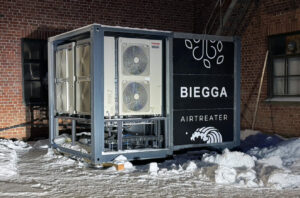
AirTreater Čáhci is guaranteed to maintain 120 kW of nominal heating capacity at -15 °C using compressors alone, with a maximum output of 420 kW available down to -15 °C. The heat pump operates down to -28 °C, and below -28 °C the integrated backup system guarantees at least 300 kW even without external electric power in hazardous situations. Delivering on those guarantees in service requires that the system is maintained to the manufacturer’s specification. A unit operating with a partial refrigerant charge or fouled heat exchangers will not perform to its guaranteed parameters, regardless of how the system was specified at commissioning.
For industrial sites in northern climates, the practical recommendation is to schedule a full professional service in early autumn, before sustained sub-zero temperatures arrive, and a follow-up inspection in early spring to assess any wear accumulated during the winter operating period. This two-point annual schedule aligns service activity with the natural peaks of mechanical stress rather than distributing it arbitrarily across the calendar year.